Johnny Beskow and Else Meiner’s Hostility
The CallerJohnny Beskow and Else Meiner’s Hostility grows from a child’s public taunts into Johnny’s private fixation and retaliatory sabotage. Their conflict is sharply unequal: Else openly mocks the passing Johnny, while he watches, broods, and chooses when to answer. The shift from words to deliberate damage makes their encounters an early illustration of Johnny’s capacity to turn humiliation into calculated revenge.
First Encounters on Rolandsgata
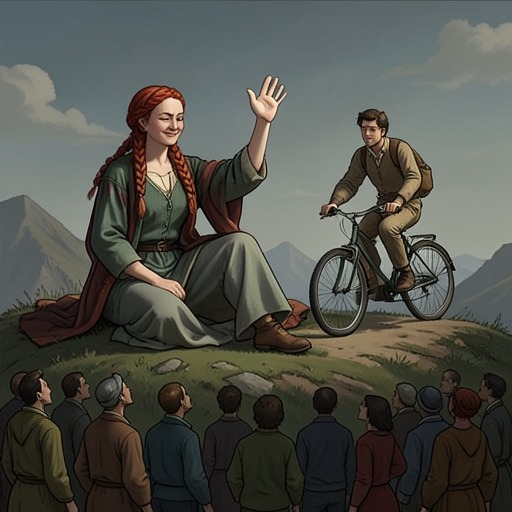
Else first appears near the house of Johnny’s grandfather, Henry Beskow, on Rolandsgata. She sits on a small rocky knoll beside the street, a pale, freckled girl of perhaps ten with a conspicuous red plait. The narration establishes her as a fixture in the neighborhood: she watches people passing through what she considers her territory and is rude to them. When she sees Johnny ride by wearing a red helmet, she calls him “Lingonberry head!”
Johnny brakes and fixes her with a threatening stare, but Else does not appear frightened. He does not confront her then; instead, he continues to Henry’s house, carrying his anger with him. The encounter establishes an important difference between their modes of hostility. Else’s insults are visible and immediate, while Johnny’s threat remains unspoken, a promise to return when he decides the time is right.
The taunting continues on Johnny’s next known trip past the knoll. Else calls him “Wobblewheels!” as he rides by. The repetition makes her insults more than a single exchange: she recognizes him, and he repeatedly encounters her in the same place. Yet Johnny again does not stop to retaliate. His restraint is not forgiveness; it gives the resentment time to accumulate.
Henry’s View of Else
At Henry’s house, Johnny asks about the girl with the red hair. Henry identifies her as Else, the youngest Meiner, whose family lives in the yellow house down the road. His account complicates Johnny’s hostile impression. Henry describes Else as a kind of guard dog who watches people entering Rolandsgata and barks at them when they leave. In Henry’s view, her watchfulness is useful: if someone came to his house with bad intentions, Else would warn him.
Henry’s affection for her vigilance contrasts with Johnny’s complaint that she is not nice. The same behavior reads differently to the two men: for Johnny, Else’s attention becomes an insult and a provocation; for Henry, her noisy scrutiny is a form of protection. Henry also knows that she plays in the Hauger School Band and has heard her practise trumpet at night, including pieces he names as “Bravura” and the “Entry March of the Boyars.” Johnny’s questions about the band and whether it practises at Hauger School show him gathering details about her life, although the exchange does not establish what he intends to do with that information.
Insults, Observation, and Restraint
Later, Johnny sees Else again as he rides toward Bjørnstad after visiting a toy shop. She is on a blue Nakamura bicycle and wears a Hauger School Band pullover. She calls him “Codface.” He feels considerable effort is needed to keep his anger in check, but decides not to respond yet. His silence is a chosen postponement: he tells himself to be patient and frames retaliation as something Else will receive when the time is right.
The episode shows that Johnny is no longer merely reacting to an insult in the moment. He notices details that identify Else’s routines and affiliations, including her bicycle and school pullover, and privately treats those observations as useful. His outward nonresponse therefore sits beside an inward plan. The gap between the casual, public nature of her taunts and the seriousness with which he stores them gives their conflict its growing menace.
Sparbo Dam and Retaliation
The hostility turns into action at Sparbo Dam. Johnny pushes his moped through the last stretch of woods and discovers someone on the dam wall, the place he considers his own secret spot by the water. A blue bicycle lies nearby. He recognizes it as Else’s Nakamura and sees her reading, unaware that he is watching from behind a tree. The setting intensifies his sense of trespass: Else has not only mocked him on Rolandsgata but is now occupying a place he regards as private.
Johnny imagines that a small shove could send her face-first into the water, but he does not push her. Instead, he watches her red plait in the sun, leaves without approaching, and takes his army knife to both tyres of her bicycle. The rubber has been warmed by the sun and gives way easily under the blade. He then rolls his moped to the road and walks for a considerable distance before starting it. His departure follows the deliberate damage, not a direct confrontation; the narrative therefore locates the revenge in a concealed act against Else’s means of transport.
The Escalation of the Relationship
Across these encounters, the conflict changes from a repeated exchange of insults into targeted retaliation. Else’s mockery is openly directed at Johnny, while he first answers it with a threatening stare and concealed vows, then with surveillance and the cutting of her tyres. Henry’s approving picture of Else as the street’s watchful protector supplies a counterpoint to Johnny’s interpretation of her as an enemy, without erasing the fact that she repeatedly provokes him.
The available scenes leave the relationship at the point of escalation rather than resolution. Else is not shown discovering who damaged her bicycle, and the excerpts do not establish a later reconciliation or the full outcome of Johnny’s plans. What they do establish is a pattern: an insult becomes an injury Johnny keeps in mind; patience becomes a way of selecting the moment; and his eventual response is covert, physical damage rather than an argument. That pattern makes the hostility consequential beyond the exchanges themselves, because it reveals how Johnny converts perceived humiliation into deliberate acts of revenge.