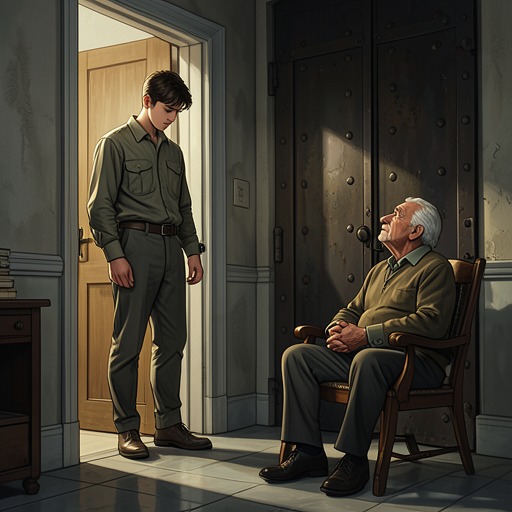
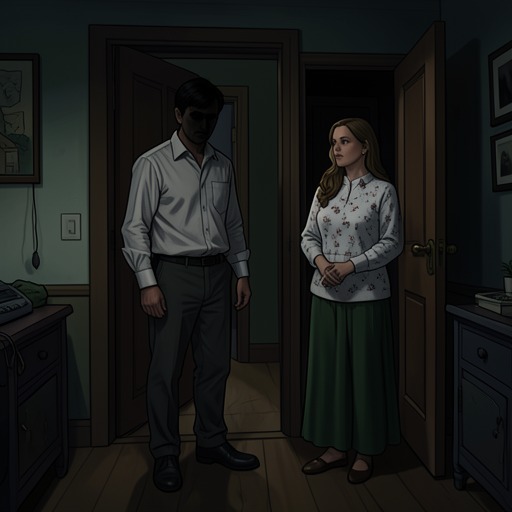
Johnny Beskow—Trude Beskow
The CallerJohnny Beskow and Trude Beskow share a home but little apparent warmth. Their relationship is shaped by neglect, anger, and unmet expectations: Johnny despises his mother and resents what he experiences as her treatment of him, yet imagines her offering the tenderness and welcome he does not receive. The contrast gives their domestic scenes an unsettled charge and helps frame Johnny’s mischief and later anger without making family hardship an excuse for his actions.
Identity and Background
Trude is identified in the narrative as Johnny’s mother. The available scenes present her as an unemployed drinker who spends much of her time at home; Johnny describes her as seldom sober and says she takes her troubles out on him. That account is his complaint, voiced during his later conversations with Konrad Sejer, rather than an independent explanation of every conflict between them. Trude, for her part, tells Johnny that he needs to find a job and that she cannot support him indefinitely, pointing to his youth and ability to work. Her demand makes their financial dependence explicit, but the exchange offers no sign that they resolve the deeper hostility beneath it.
Johnny’s narration of his mother is intensely contemptuous. He focuses on her appearance, habits, and presence in the house, and describes his disgust as one of the few feelings that makes him feel fully alive. The force of that response suggests a relationship in which resentment has become a consuming emotional posture. It also matters that the account is filtered through Johnny’s own outlook: the narrative records the extremity of his loathing, not a neutral verdict on Trude’s worth as a person.
A Home of Estrangement
One domestic episode makes the distance between them visible through Johnny’s imagined alternative. After carrying dishes to the kitchen, he takes a plastic canister from the shed and walks to Bjørnstad Centre to fill it. On the way back across Askeland, he pictures his mother noticing him, greeting him warmly, asking whether he is hungry, and offering to make him something to eat. The imagined welcome is strikingly ordinary. It is not a grand reconciliation but a hoped-for moment of recognition and care, and its vividness contrasts with the bitterness that takes its place as he approaches home.
When Johnny hears that only a little petrol remains in the canister, his thoughts turn hostile. He considers using it against his mother if he finds her drunk on the sofa. He then enters the lounge and stops in the doorway, facing her in a silence described as tense. The scene records a threat in Johnny’s thinking, not an act carried out in that moment. Its significance lies in the abrupt gap between the welcome he had rehearsed and the harm he now contemplates: his desire for maternal attention and his capacity for retaliatory anger coexist, without either cancelling the other.
After Trude directs him to his room, Johnny takes Butch, his hamster, from its cage and lies on his bed. From there he hears her moving through the kitchen, opening cupboards and drawers and handling cutlery. He interprets the household sounds through contempt, imagining her assembling a meal while monitoring her movements between rooms. When she eventually goes to the bathroom, he gets up and opens a drawer in his chest. The scene makes the home feel divided into watched spaces and private intentions: Trude carries on with ordinary tasks, while Johnny listens for an opportunity. The surviving account does not establish the contents of the drawer or what he does next, so the episode should not be treated as proof of an action beyond what it states.
Resentment and Unequal Expectations
The two characters’ expressed positions do not meet. Trude tells Johnny to work because she cannot provide for him forever; Johnny’s later complaint is that she is never sober and treats him unfairly. Her words frame him as a young, able person expected to become economically independent. His complaint frames himself as the injured party in a household where he believes fairness has already failed. The evidence offers no shared conversation in which either perspective is heard and answered. Instead, the relationship appears through demands, accusations, and Johnny’s private interpretations.
A later Sunday scene returns to Trude’s everyday presence in the house. She searches among dirty clothes for something to wear, moves from one object to another, and leaves belongings scattered around the bedroom. The narration notes that she rarely does laundry and seldom goes out among other people or to work, except when she has to leave home. These details establish the narrow domestic setting around the pair, while also showing how Johnny’s attention fixes on the disorder he associates with her. The account emphasizes his hostile framing; it does not supply Trude’s own explanation of her circumstances or her feelings about her son.
Conflict and Aftermath
Johnny’s resentment remains visible after the prank campaign brings him into contact with the police. Because he is a minor, he cannot be held in custody, but he must report to the station three times a week. He arrives punctually and goes to Konrad Sejer’s office, where the two speak over mineral water. In that setting Johnny admits that frightening people had been fun and describes it as a game, while insisting that he did not mean to hurt anyone. The admission does not erase the consequences of his conduct; it places his stated intention beside the fear he caused.
When the conversation turns to home, Johnny grows morose and complains that Trude is never sober and takes her frustrations out on him. He then gets up, paces, and challenges the idea that he should behave fairly when, in his view, nobody else behaves fairly toward him. The exchange exposes the grievance through which he understands their relationship, but it also shows how he converts perceived unfairness into a justification for his own conduct. His neglect and anger form important context, not a release from responsibility.
Narrative Significance
The relationship is defined less by a single confrontation than by a recurring disjunction: Johnny wants the signs of affection he imagines—a greeting, interest in his hunger, an offer of food—while seeing Trude chiefly through disgust and grievance. Trude’s demand that he work likewise offers a practical limit without repairing their emotional estrangement. The narrative places those ordinary needs and claims beside fantasies of retaliation and Johnny’s wider pattern of intimidation, keeping his vulnerability in view without presenting it as an excuse. Their bond therefore provides a domestic context for his bitterness while remaining unresolved in the evidence: neither a reconciliation nor a changed understanding between mother and son is shown.