Johnny and Henry Beskow’s Grandfather-Grandson Bond
The CallerJohnny Beskow and Henry Beskow’s grandfather-grandson bond is one of reciprocal need: Henry depends on care as his body weakens, while Johnny, neglected at home and unsure that anyone needs him, finds welcome and purpose in visiting. Their affection is expressed less through grand declarations than through attentive routines—questions about food and medicine, newspaper reading, a shared meal, pocket money, and the touch of Johnny’s hand around Henry’s arthritic one.
Identity and Background
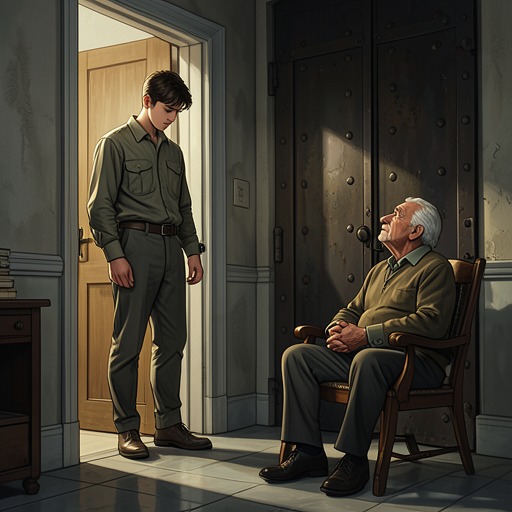
Henry lives alone in the last and oldest house on a cul-de-sac in Bjørnstad. His bad legs keep him in an armchair, his hands are twisted by arthritis, and even ordinary tasks require assistance. Johnny visits him there, arriving on his red moped and settling beside him on a soft footstool. The house becomes a refuge from the disorder Johnny associates with home, though Henry’s own dependence means it is not a place untouched by difficulty.
The contrast between their circumstances shapes the relationship. Henry is physically vulnerable and worries about losing the help he receives; Johnny is young, isolated, and has little confidence that he can make a life of his own. Neither has everything the other needs, but their visits give each a role: Henry can listen and welcome him, while Johnny can offer company and practical help.
Care as a Shared Routine
Johnny’s concern takes concrete forms. He asks whether Henry has eaten and taken his medicine, and checks whether Mai Sinok is treating him well. When Henry praises Mai’s work, he also voices his anxiety that social services might reorganize or cut costs and leave him without dependable support. Johnny listens to that worry rather than treating care as an invisible service. Later, when Henry admits that Mai comes every day, including Sundays, and that he pays her privately so she will not lose her job, the arrangement reveals how precarious his security feels to him.
The visits are shaped by heat and Henry’s fear of wasps. Johnny wants to air the house because the stuffy conditions could make his grandfather sluggish; Henry resists opening the windows because insects might get in. Johnny raises the problem again and offers to go through Henry’s bank statement. The account has few transactions, but years of savings have accumulated into a substantial sum. The scene brings practical concern, financial dependence, and the limits of Henry’s control into the same ordinary conversation.
Reading aloud is another form of companionship. Johnny picks up the local paper and reads in a clear voice, glancing over to check that Henry is following. The articles range from a horse that bites a handler to Polish immigrants’ working conditions; Johnny skips a story about mishandled bodies at Central Hospital, then reads the weather and television listings. The exchange is not simply a service for someone with limited mobility: Johnny pays attention to what his grandfather might want to hear or watch, and Henry has someone to share the day with.
Trust and the Weight of Home
Henry explicitly gives Johnny room to speak honestly, telling him not to lie to spare his grandfather. Johnny says things at home are bad because his mother lies on the sofa and drinks vodka. Henry responds with sympathy for what Johnny has endured and condemns the person who hurt him; Johnny answers with a deliberately harsh suggestion of retaliation. The moment joins tenderness to anger: Henry does not dismiss Johnny’s grievance, but their exchange also shows how readily talk of justice turns toward punishment.
The importance of Henry’s listening becomes clearer when Johnny wanders through the house looking at photographs. Pictures preserve him as a small child in short trousers and tiny trainers, but when he searches his memory for good times, he recalls slammed doors and his mother standing with her back to him, consumed by despair. He wonders when malice began to grow in him. His grandfather’s house holds a visual record of childhood, but not an uncomplicated one; the photographs sit beside memories of an unsettled home. Johnny returns to Henry and gently squeezes his hand.
Dependence, Dignity, and the Future
Henry knows what dependence costs him. He describes himself as too old, slow, and useless, and says his condition will not improve. He also compares his compliance with that of an obedient dog, explaining that a person who relies on others can lose the strength to argue. Johnny answers sternly when Henry speaks of himself this way. His insistence that Henry will not die for a long time is not a solution to aging, but it is an effort to keep his grandfather from being reduced to his weakness.
The care between them is not one-sided. Henry offers Johnny pocket money for petrol and imagines that, when Johnny is older, he can move away and live his own life. Johnny recognizes that getting a job must come first. Their exchange gives the future a modest, practical shape: not an escape already achieved, but the possibility of independence that Henry wants him to have. When Henry later nods off after they have eaten, Johnny looks at the photographs and then takes his hand again; Henry wakes and remarks that he is still there. The small exchange makes continued presence feel like a gift.
Change and Narrative Significance
Henry’s frailty repeatedly brings the limits of their shared time into view. When he says he is not afraid of dying, Johnny is anguished by the thought: he likes his grandfather and has nowhere else to go. As Henry dozes, Johnny holds one of his crooked hands and asks whether he would like a window opened, still trying to ease his discomfort even as he cannot promise that the old man will remain. His reassurance and his practical offers coexist with fear rather than overcoming it.
The relationship gives both characters something the surrounding circumstances withhold. Henry is not only a recipient of care: he remembers Johnny’s hardship, invites the truth, offers money, and imagines a future for him. Johnny is not only a troubled boy: he notices discomfort, reads attentively, prepares food, and returns to hold his grandfather’s hand. Their bond is therefore a quiet counterweight to isolation, grounded in ordinary acts that make each person visible and needed to the other.