Johnny’s army knife
The CallerJohnny’s army knife is both the weapon Johnny deliberately brings to his ambush of Else Meiner and the object that gives her a concrete detail to report afterward. Its role shifts from an instrument of imagined bodily harm to the blade he uses to cut off her braid; in the aftermath, its red handle and short blade become clues through which police explore what kind of knife she saw.
Selection and Intended Use
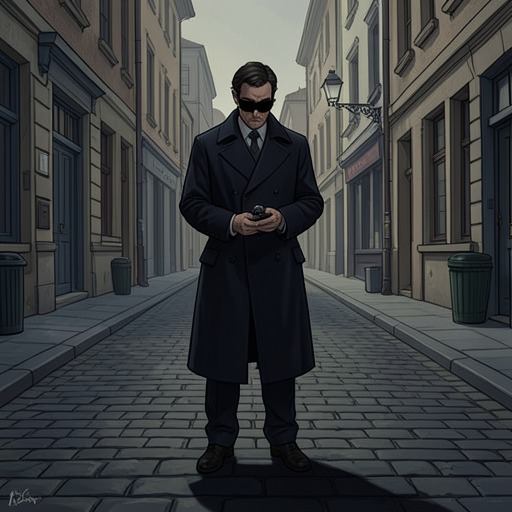
Johnny’s choice of the knife begins before the assault. Remembering that it is Thursday, he connects the day with band practice at the Hauger School gymnasium, where Else plays trumpet. His first plan is explicitly more violent than the action he eventually carries out: he imagines puncturing both her lungs to silence her playing. The army knife is therefore not an accidental object at the scene but a tool selected in advance for an attack he has begun to envision.
He later thinks through Else’s likely departure from band practice, her bicycle and the trumpet case carried over its back wheel. He does not know whether the rehearsal will last two hours or an hour and a half, and plans to watch through a window. Before going out, he searches his chest of drawers for a small surprise for her, intent on not being unprepared, then briefly pets Butch before leaving. These details place the knife within a deliberate sequence of anticipation and preparation: Johnny has settled on a target, considered her routine, and equipped himself before following her.
The Knife on the Love Trail
The assault takes place after Else chooses the Love Trail and is alone. Johnny has hidden his moped in the undergrowth and waits with the army knife in his hand. As Else rides along, humming to herself, he crawls out of the bushes and attacks from behind. When he pulls out the longest blade, the planned threat becomes immediate and physical. The fallen bicycle and trumpet case mark the abrupt interruption of her ordinary journey; the knife is present as Johnny tries to overpower her.
Else resists rather than submitting as he expects. She kicks and struggles, then bites his forearm hard enough to make him nearly lose his grip. Johnny sees her face through the holes in his gorilla mask and, despite recognizing her in that moment, presses on with the attack. His stated purpose has narrowed to humiliating her and ending what he regards as her hold over his life. He pins her down, grabs her red hair and uses the knife to slice off her plait in one movement. The blade does not carry out his earlier fantasy of puncturing her lungs; instead, it makes the intended humiliation visible and takes something from her body that he can carry away.
Johnny puts the braid in his pocket and keeps hold of Else, using the possibility of further violence to make her stay still. He drives a knee into her lower back, tugs her hair, gives her a final shove and escapes into the woods. From the bushes he watches her collect herself, right her bicycle and replace the trumpet on its rack before feeling the back of her head. His thought that this was only a warning, followed by a threat of worse violence next time, makes clear that the knife’s use in cutting the braid does not end his threat to her.
Description and Identification
Afterward, Skarre asks Else whether scissors were used. She says the braid was cut with a knife, then describes what she saw as a small knife with a short blade and a red handle, like a pocket knife. Her account makes the army knife legible as evidence through visible features rather than through Johnny’s intentions: size, blade length and handle color are the details she can provide.
Sejer asks whether it was a Swiss army knife and checks that Else knows what that means. She says that she does, adding that there is one in a drawer at home. Her response establishes familiarity with the type of knife Sejer is asking about, but the exchange does not explicitly confirm that the weapon she saw was a Swiss army knife. The distinction matters: Else’s report is a specific observation, while the precise identification remains a question raised by the police.
From Threat to Evidence
The knife links Johnny’s private preparation to the consequences of the assault. Before the attack, it belongs to his plan and his imagined power over Else; in the encounter, its longest blade is used to cut the braid; afterward, its short blade and red handle are details available to the investigation. The object thus carries the change from threatened violence to an identifiable act without requiring the assault to become the more lethal attack Johnny had first imagined.
The scene also makes the weapon’s limits part of its significance. Johnny brings a knife intending to control Else, but she fights back, bites him, and remains able to recover her bicycle and trumpet after he flees. He does manage to cut her braid and take it, yet the attack does not give him the effortless mastery he anticipated. In the police conversation, the knife is no longer only an instrument in Johnny’s hands: it has become something Else can describe, while the account of its use preserves the difference between his threat to her life and the specific humiliation he inflicted.