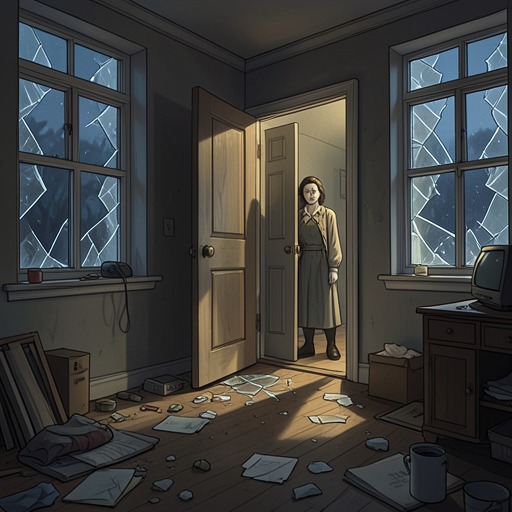
Margrete Sundelin
The CallerMargrete Sundelin enters the story as an eight-month-old whose apparent vulnerability becomes the measure of a family’s shattered security. Found covered in blood in her pram but declared unharmed, she is at once the child her parents protect and the focus of fears and expectations that she is too young to express herself.
Identity and Early Life
Margrete is the daughter of Lily Sundelin and Karsten Sundelin. At eight months old, she sleeps in a Brio pram beneath a maple tree behind the family home, wearing a bonnet fastened under her chin and lying beneath a crocheted blanket. The ordinary calm of this arrangement depends on her mother’s confidence: Lily is in the kitchen, unable to see the pram through the window, yet initially feels no concern for the sleeping baby.
A week before the blood-soaked incident, Margrete appears in the local newspaper as Heartbreaker of the Week. Karsten takes the photograph with his old Hasselblad camera. In it, she sits naked on the kitchen table except for her white bonnet, her skin compared to marzipan from Anthon Berg. The image makes her a subject of public attention even as she remains entirely dependent on her parents’ care.
The Blood-Soaked Incident
When Lily returns to the pram, she notices that the blanket is crumpled, though the pram is still beside the maple’s trunk. Pulling the blanket away, she finds Margrete covered in blood. Lily collapses to the ground, unable to get up, and screams; Karsten rushes around the corner, takes the baby against his chest, and tells Lily to get the car. The scene’s violence is registered first through the parents’ bodily reactions and frantic response, while Margrete herself is not described as injured.
At the hospital, the waiting feels to both parents like a suspended state between life and death. A nurse eventually brings Margrete through the glass doors, wrapped in a white blanket, and tells them she is completely unharmed. Karsten takes her and feels that her small body is warm. When he unfolds the blanket, he finds her wearing only a disposable nappy. The confirmation that she has suffered no physical injury does not undo the terror of finding her covered in blood.
Care, Growth, and Parental Fear
After the incident, Margrete sleeps in the middle of her parents’ double bed, freshly bathed and wrapped in a soft pink blanket. Lily has put baby oil in the bathwater, leaving the baby’s skin glowing and fragrant. The blanket makes Margrete seem like a cocoon; Lily cannot bring herself to uncover her even though she is too warm. Her wish that Margrete might never unfold, grow up, and leave the house turns ordinary infant care into an expression of fear about separation.
Margrete’s growth also becomes a point of tension. When a visiting nurse observes that the baby has gained considerable weight, Lily rises so abruptly that her chair falls and pounds on the table. The reaction is Lily’s, not Margrete’s: the child’s body is being watched and assessed by others, while her mother responds with a force that suggests how completely her attention has gathered around the baby since the incident.
The Family’s Fracture
The incident leaves Karsten questioning the foundations of his life with Lily and the responsibility he feels toward Margrete. He wonders whether having a child was carefully chosen or simply seemed inevitable, and imagines Margrete at fifteen, thirty, and forty, asking whether her future success or failure would be his responsibility. These are Karsten’s anxieties about the years ahead, not knowledge of Margrete’s later life; the story shows how the infant has already become the focus of his fears about fatherhood and his capacity to protect his family.
In the aftermath, Karsten becomes more volatile and throws himself into physical work, securing loose boards in the garden fence and chopping wood. He believes he failed to protect Lily and Margrete and thinks that a stranger from outside has blasted the relationship apart. Lily, meanwhile, is absorbed in caring for the child. Karsten begins staying out for drinks after work and comes home late, sometimes drunk, without seeing irritation in Lily. The care surrounding Margrete persists, but it no longer restores the couple’s former sense of ease.
Karsten removes the old pram from the house and takes it to the rubbish dump: blood has seeped into its mattress, cannot be washed out, and leaves a fishy smell. The family replaces it with an expensive Emmaljunga pram in dark red corduroy, choosing what they describe as the very best for Margrete after what happened. The discarded pram and its replacement mark a practical attempt to make the child’s surroundings safe again, though the object’s stain cannot be separated from the memory attached to it.
Separation and Narrative Significance
The rupture eventually becomes literal separation. Lily moves out with Margrete and goes to live with her parents; Karsten says that their lives have fallen apart and that he feels completely exhausted. The evidence does not describe Margrete’s own understanding of the move. Instead, it shows her carried within the consequences of her parents’ distress, first as the baby they rush to save and later as the child Lily takes with her when the marriage breaks down.
Margrete’s narrative importance lies in this gap between her limited, infant presence and the meanings adults place upon her. A sleeping child under a maple, a newspaper photograph, a pink-blanketed bundle, and a pram that must be discarded become successive images through which safety, growth, and parental responsibility are tested. She is unharmed in the incident, but the family’s life does not simply return to its earlier shape: her survival becomes inseparable from the fear and separation that follow.