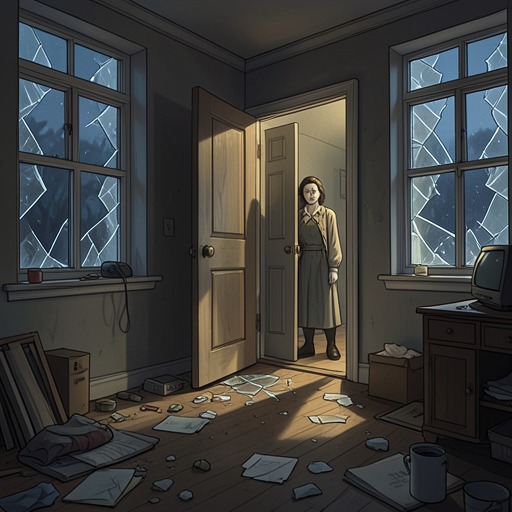
Margrete's pink smock
The CallerMargrete's pink smock is a small, ordinary garment made newly conspicuous by its unexplained disappearance after an attack on the Sundelin family. Lily Sundelin's discovery turns the absence into a source of fear at home; later, Sejer treats the smock as a possible trophy, giving the missing object a place in the investigation as well as in the family's unease.
The Disappearance
Lily recalls the missing smock when speaking with Karsten Sundelin. The realization comes to her just after she gets up: the pink garment is gone. As she tells him, she leans forward and pats Margrete's cheek, bringing the child's presence close to the discovery. The smock is not described as damaged or recovered; what matters is that it has vanished.
Lily is sure that the person who took it carried it away. She cannot make sense of that choice: the smock seems an unlikely thing to steal, and its absence feels more disturbing precisely because she cannot assign it an ordinary purpose. The object that had belonged to everyday family life is now evidence of an intrusion whose meaning remains uncertain.
A Household Made Watchful
Karsten has no answer when Lily asks why anyone would take the garment. His silence sits within a wider change Lily has noticed since the incident. He has become angry and vigilant, his voice coarser, especially when he answers the telephone; she sees him as continually on guard and ready to meet a new threat. The missing smock therefore belongs not only to the past attack but to its continuing effect on the family.
Lily's response to Karsten is divided. His sudden rage frightens her, and she wants him to let the matter go so they can resume their lives. At the same time, she is touched that he has risen to protect them. The smock's disappearance sharpens this tension: even an unexplained, seemingly minor loss keeps open the possibility that the danger has not ended. Lily asks whether the person is watching them, but the passage gives her no answer.
The Smock as a Clue
The missing garment also enters the police inquiry. Sejer has Lily Sundelin's exhaustive handwritten account of the fateful day in his file, and singles out the fact that the girl's smock was taken. He interprets it as a possible trophy, shifting the detail from an inexplicable household loss toward a clue about the taker's conduct. His reading is suggestive, not a confirmed explanation of why the garment was removed.
The discussion takes place alongside attention to the wolverine postcard: Holthemann asks to see it again, and Sejer retrieves it from his desk drawer for him to examine. The postcard and the smock are distinct pieces of material evidence, but their juxtaposition places the missing garment within the investigation of threatening acts. The smock's significance thus rests on a contrast: at home it is an intimate, ordinary possession whose absence fuels fear; in Sejer's file it is a possible trophy, a physical trace of the unknown person whose actions the police are trying to understand.