Memento’s Daimler limousine
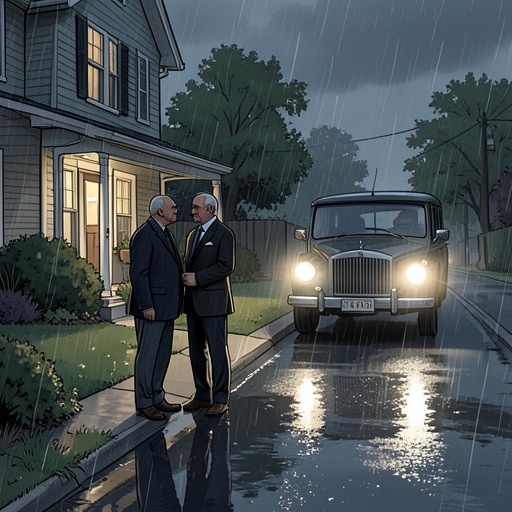
The CallerMemento’s Daimler limousine is both the imposing vehicle outside the Landmark home and, by the end of the encounter, the car Helge Landmark chooses for his eventual final journey. Its arrival initially alarms Astrid, but Helge redirects the scene: instead of treating the limousine only as a sign of death, he asks about it, learns what it is, and arranges for its men to return when his time comes. The change in meaning gives Astrid a concrete reassurance about a future she would otherwise have to face alone.
Arrival at the Landmark Home
The car remains outside while one of its occupants speaks on a mobile phone. Astrid anxiously wonders why the men have not driven away; Helge guesses that the man is probably calling the police and identifies the vehicle as a limousine. Astrid resists the assumption that the men are at fault, pleading that someone must have called them. The car’s presence thus begins as a source of alarm and uncertainty, before Helge makes it the focus of a different kind of exchange.
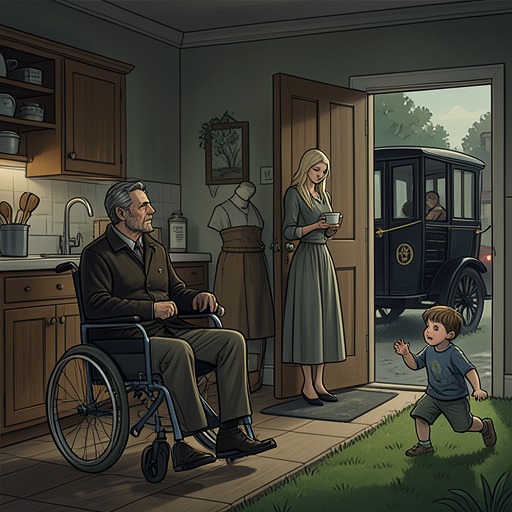
At Helge’s urging, Astrid runs down the steps and reaches the limousine just as it is about to leave. She asks the men to come inside because Helge wants to speak with them, apologizing for the disturbance and explaining that the situation is difficult. The men hesitate: facing Helge Landmark makes them uncomfortable, and they seem unsure whether they can bear what he has to say. They nevertheless follow Astrid into the lounge, where they find him in his wheelchair. The car is not merely a vehicle passing through the scene; its arrival brings the men into direct contact with the person whose future it may one day serve.
A Car Recast Through Conversation
Helge greets the men and apologizes for delaying them, then explains that he is interested in the car. When he asks what kind it is, Arnesen identifies it as an 1987 Eagle Daimler. Helge responds with practical curiosity, asking whether it is a pleasure to drive. The men, who had entered the room apprehensively, become more animated as the exchange turns to the vehicle itself.
Helge asks whether passengers in the back seat complain. Arnesen says no, describing the ride as a ship’s gentle sway and noting that the engine is nearly silent. These details make the limousine imaginable not as an abstract emblem of a funeral but as a particular, comfortable vehicle: smooth-moving and quiet. Helge looks back at it through the window and then asks whether he can make a reservation. The change from a difficult encounter to an ordinary discussion of comfort and travel allows the men to respond to him as a person asking about a car, rather than only as a gravely ill man confronting them with his death.
A Future Journey Arranged
Helge makes the purpose of his question explicit: he wants the men to drive him in the Daimler when his time comes. The request turns the car’s association with death into a plan stated in his own terms. The men cross the room and take his hand. Arnesen says that it would be an honour and a pleasure; Knoop repeats the assurance. Their response converts an uncertain encounter into a personal promise.
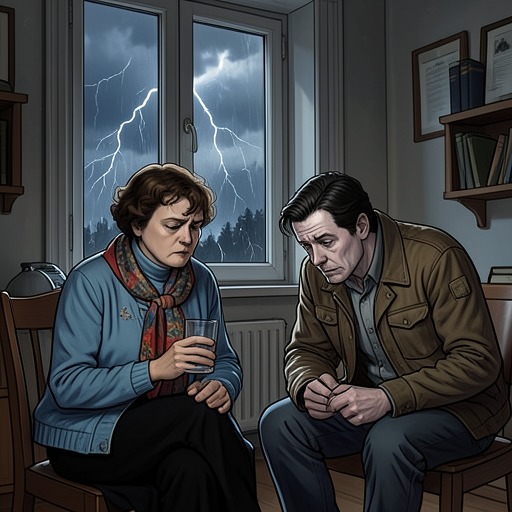
Helge’s concern extends beyond securing the ride. He says the arrangement will make things easier for Astrid, because when the men eventually stand at the door they will be old acquaintances. He asks whether she agrees, and she nods with tears in her eyes. The limousine therefore represents more than transportation: the promise establishes recognition and familiarity in advance, placing a known relationship where an otherwise distressing future arrival might have been. Astrid’s response registers both the emotional weight of Helge’s decision and the comfort contained in its practical detail.
Departure and Aftermath
The brief meeting ends, and Astrid accompanies the men to the door to say goodbye. When Memento’s Daimler limousine drives away, Helge asks her for a good dram of cognac. She reacts apprehensively because he has not had a drink for a long time and she fears the combination with his medication could be dangerous. The car’s departure does not erase the seriousness of the scene: it leaves behind Helge’s request, the men’s agreement, and Astrid’s awareness of his frailty. Yet the encounter has altered what the vehicle signifies. It arrived amid anxiety and hesitation; it leaves as the car Helge has selected and the means of a future farewell he has helped make less strange for his wife.