Responsibility and Scapegoating
The CallerResponsibility and scapegoating become inseparable when a community shaken by weeks of pranks seeks someone to blame for a boy’s death. Johnny Beskow admits that he frightened people for amusement, making him responsible for genuine harm; but suspicion also spreads beyond what that admission establishes, while Bjørn Schillinger insists that someone else opened the gate before his dogs attacked Theo Bosch. The distinction matters: the novel does not treat hardship as an excuse, or public certainty as proof. It asks who caused which harm, what can be established, and how quickly a community turns suspicion into a verdict.
Publicity and the appetite for a culprit
The prank campaign reaches the public as spectacle. Reporters gather outside the police department, and Jacob Skarre recognizes that the case offers drama and originality. Newspaper headlines about a baby found covered in blood turn the incident into a shock story. The lurid attention is part of the problem: Konrad Sejer worries that newspapers give a criminal the attention he wants, while Skarre warns that ignoring the perpetrator might make him more dangerous or angry. Their exchange frames publicity as a force with consequences, not merely a record of events.
Sejer chooses a restrained public response. He plans to say that the police are keeping every possibility open and working methodically, limiting his remarks so the story will not be exaggerated. His caution contrasts with the reporters’ appetite for a dramatic account. Yet the impulse to keep the story from growing does not settle the underlying question of responsibility. When later events provoke fear, the community already has a public narrative ready: a campaign of terror, a suspected instigator, and a demand for someone to answer for it.
Johnny’s wrongdoing and the conditions around it
Johnny is not simply an innocent target of rumor. As a seventeen-year-old, he has a distinct talent for mischief and takes pleasure in feeling something through disgust and hostility toward his mother, whose drinking and neglect shape their home life. Their poverty is concrete: her disability payment is 4,020 kroner, his allowance is 1,800, and they also have subsidized housing. When she tells him he should get a job, he resists the prospect of being ordered around and imagines freedom on his Suzuki instead. These circumstances help describe his isolation and resentment; they do not establish that hardship made his choices inevitable.
His relationship with his mother includes more than one kind of injury. When she tells him that Bleeding Heart, his rat, has got loose, Johnny trembles and insists that the animal could not have escaped its latched cage. He believes she took it; her response makes clear that the rat is dead. The scene gives his distress a specific object and exposes another point of conflict in a relationship marked by bullying and neglect. It offers context for his anger without turning that anger into a justification for frightening others.
Later, while required to report to the police station three times a week because he is a minor and cannot be held in custody, Johnny arrives punctually and speaks with Sejer over mineral water. He admits that scaring people senseless was fun and describes the campaign as a game, saying he did not mean to hurt anyone. Sejer makes the distinction Johnny resists: intention does not undo consequences. The people he frightened were hurt, perhaps for a long time. Johnny’s admission establishes responsibility for the pranks, while the novel keeps that responsibility separate from proof about every other incident.
Schillinger’s duty and his disputed account
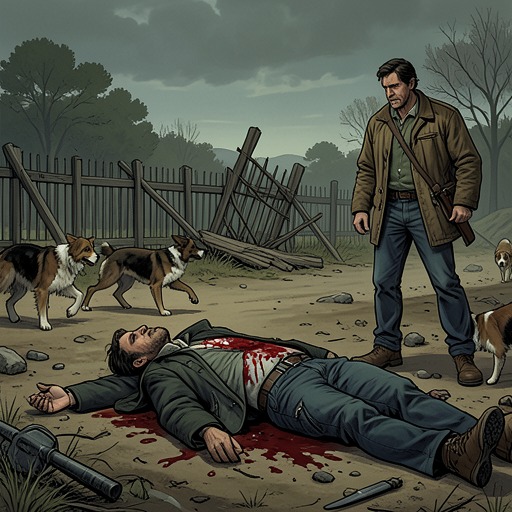
The dog attack brings a different form of accountability into view. Schillinger describes thirty years of experience with dogs and a precise routine for securing them: when he enters to feed them or tend their paws and claws, he shuts the door, latches the bolt, and lowers a hook, listening for its click. He says the procedure has become reflexive and that the dogs are his life. His account makes the gate more than a vague point of negligence; it is the center of a detailed, emphatic claim that he did not forget to secure it.
Sejer distinguishes that disputed question from the owner’s duty. The justice system must determine punishment, but Schillinger remains responsible for keeping his dogs locked up. The police confiscate the dogs and plan to take DNA samples. Schillinger fears losing the right to keep dogs and being driven out of town; he says he was attending his six-year-old daughter’s birthday when they got out and suggests that someone sabotaged the gate. His grief and fear are evident, but neither proves sabotage nor removes the duty Sejer names.
Schillinger points to earlier hoaxes, including the release of Sverre Skarning’s sheep, as a possible reason someone might have opened the gate for a laugh. The suggestion is plausible within a summer already marked by pranks, yet plausibility is not confirmation. Interrogated repeatedly, Schillinger continues to deny forgetting the gate and insists that he should not carry the blame for another person’s crime. The repeated certainty of his account mirrors Johnny’s own insistence, but the two claims concern different acts and require different evidence.
From suspicion to scapegoating
Sejer sees how suspicion can outrun what is known. At the Meiner home, he observes that Johnny has become a scapegoat: if a house burned in Kirkeby that night, Johnny would be blamed too, despite his established talent for terrorizing people from afar. Sejer’s warning does not erase Johnny’s actual conduct. It identifies the point at which a substantiated pattern of wrongdoing becomes a general-purpose explanation for unrelated misfortune.
Residents respond to Schillinger in opposing ways. Gunilla Mørk distrusts his claims of sabotage, dislikes his bitterness, and suspects that he lacks humility or is exploiting the tragedy. Her own response to the prank campaign is complicated: she has framed her fabricated obituary and reads it each morning, taking satisfaction in still being alive. Sverre Skarning, by contrast, defends Schillinger as considerate and meticulous, recalling that he slows his dog team for people on Glenna Trail and makes way for skiers in winter. Nihmet Skarning takes the opposite line, arguing that the known prankster has brought suspicion upon himself and should turn himself in. These judgments reveal how character and reputation shape belief before the gate has been conclusively explained.
The rumor eventually spreads that a teenage boy from Askeland was behind the acts of terror that had beset the community. It has a basis—Johnny has admitted to frightening people—but its broad wording risks merging that campaign with the fatal attack on Theo. The novel’s distinction is not between blame and innocence in the abstract. It is between established harm, a legal duty, an unresolved allegation, and the social urge to collapse them into one story.
Justice without an easy equivalence
Johnny’s youth, lack of prior convictions, and troubled upbringing may lead the justice system to treat him leniently. Sejer nevertheless insists that the damage to those he frightened cannot be dismissed as play. At the same time, justice for Theo remains a separate matter. Schillinger’s possible responsibility as a dog owner, the unresolved claim of sabotage, and Johnny’s confessed pranks cannot substitute for one another simply because the community wants a single culprit.
That separation gives the theme its moral force. Context can clarify a person’s choices without cancelling them; a duty can exist even when the precise cause of a breach is uncertain; and a reputation can make accusation feel convincing without making it true. By placing Johnny’s admitted cruelty beside Schillinger’s contested responsibility, the novel shows both the necessity of assigning blame and the danger of assigning more than the evidence supports.