Snellevann
The CallerSnellevann is a lake reached through the woods from St Olav’s Spring, a familiar destination that shifts from a place of companionship to one of exposure. For Hannes Bosch and his eight-year-old son Theo Bosch, it first offers a quiet family outing, a view across the water and the spectacle of an orange sheep in distant fields. When Theo later goes there alone, the route becomes a test of the independence he longs to claim; the same wilderness that has seemed welcoming begins to feel threatening.
Setting and Approach
Snellevann lies along a recreational route through the woods. A notice asks visitors to treat the forest as a place for recreation and pleasure and to be considerate of others. On the walk with Hannes, Theo reads the request aloud in a clear, cheerful voice. They pass St Olav’s Spring, drink its fresh water, and continue for another forty minutes before sitting on a rock beside the lake. The route is not an untouched wilderness: it is also used by landowners and farmers checking livestock and fences, as well as hikers, cyclists and people picking berries.
The landscape opens at the water’s edge. From the rocks, Hannes scans the lake and the ridges beyond with binoculars, while the father and son look out across the water together. Their pause makes the place feel spacious but accessible: the lake is a destination reached on foot, with paths, familiar landmarks and people moving through the surrounding countryside.
A Shared Outing
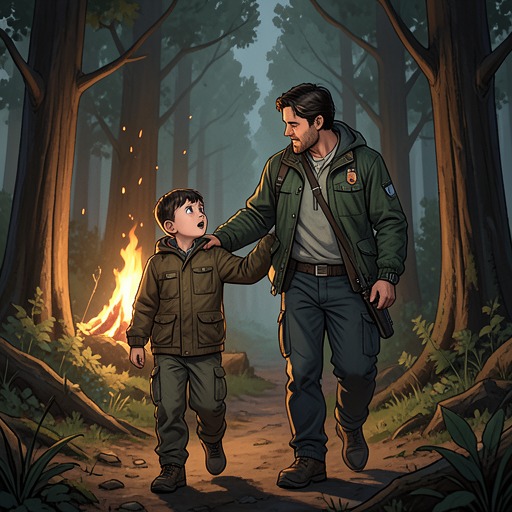
The first visit is marked by ease and closeness. Hannes puts an arm around Theo’s shoulder and draws him near; they agree that they are lucky to have each other. He has brought drinks in his rucksack, and Theo chooses Solo. The small practical details—the bottle, the rock, the binoculars—give their time at the lake the texture of an ordinary outing rather than an expedition.
The view becomes an unexpected event when Theo spots an orange sheep among the white ones. Hannes initially searches the landscape through his binoculars, then sees the animal and remains staring at its striking color. The sheep moves comfortably, apparently unaware of its difference. Hannes laughs, and he and Theo take turns looking through the binoculars; Theo is so absorbed that he jumps down from the rock and runs around enthusiastically. Hannes, meanwhile, worries that the expensive Zeiss binoculars might be smashed against the rocks.
Hannes wants the odd sight reported. He calls the local newspaper from the lake, identifies himself as Hannes Bosch and explains that he and his son have found something incredible, asking for a reporter and a photographer with color film. The request turns a private discovery into a possible public story, while the orange sheep remains a living presence in the landscape, not merely a view to be collected. Snellevann holds both the family’s shared amusement and Hannes’s impulse to carry that amusement beyond the lakeside.
Theo’s Solitary Journey
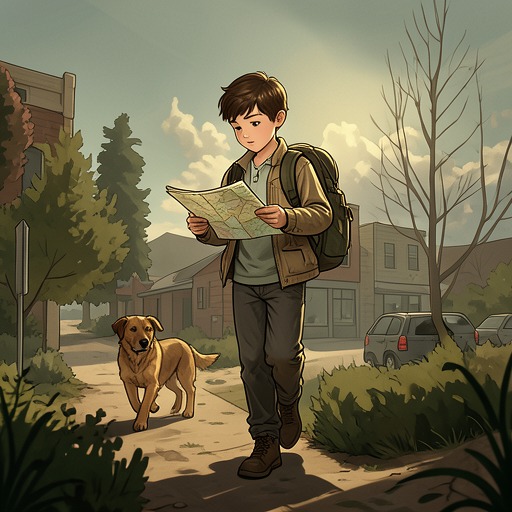
Theo’s later wish to go to Snellevann by himself grows from his desire to be an explorer. He asks Hannes for permission, imagining the birds, fish and forest, and says he will take lunch and needs help packing his rucksack. Hannes weighs the distance and Theo’s age: the boy is only eight, and the round trip, including a stop at the water, could take two hours and twenty minutes. Yet the weather is fine, nightfall is distant, and the route has regular traffic from people working or walking outdoors. Hannes also believes that the woods are safer than almost anywhere else, a confidence he and Theo had shared for a long time. He knows Theo’s mother would probably refuse, but he lets the journey proceed.
On his solo walk, Theo stops at St Olav’s Spring, whose history his father has read to him many times. He treats the spring as holy and imagines that drinking its water will make him holy too. The water is believed by some to have healing powers; Theo feels that his own energy has been renewed after drinking deeply. The spring therefore serves not only as a landmark on the way to Snellevann but as a source of reassurance and strength that Theo carries into the woods.
As he approaches the lake, Theo settles into a walking rhythm and checks that the hunting knife is still on his belt. A bird fluttering from the brush startles him, though his nerves soon settle. He walks the final few metres barefoot and sits close enough to the water for his toes to touch it. His trainers and socks are placed beside him; he sets out three slices of bread, a Thermos of blackcurrant squash and his Optimus Prime toy. Out of breath from running the last stretch, he takes in the scene as proof, to himself, that he is tough and belongs in the wilderness.
From Refuge to Unease
The lake’s calm does not hold. Theo encounters Lars Monsen in a green canoe, and the exchange leaves him frightened and confused. As the canoe moves beyond the headland, Theo gathers his things and decides he must get home. He wonders whether the encounter was one of his daydreams, but even that possibility does not undo its effect: he resents being frightened with talk of bears, which he believes do not live this far south. He cannot recover his walking rhythm, begins to run, and becomes certain that something is about to catch him. The narrative also makes the surrounding trail ominous: someone is watching from its edge, and Theo senses that something terrible lies ahead.
Snellevann thus gathers contrasting meanings without changing its physical features. On the first visit, the lake’s distance and openness allow Hannes and Theo to share a discovery and delight in the view. On the later journey, the same route measures a child’s ambition against his vulnerability. The spring, rocks, cold water and surrounding woods remain concrete parts of the landscape, but their significance changes with Theo’s company and state of mind. The place that once confirmed the comfort of walking together becomes the setting in which he must make his way back alone.