The Desire for Attention and to Be Seen
The CallerThe Desire for Attention and to Be Seen is central to Johnny Beskow’s prank campaign and to the way the community responds to it. What begins as a private sense of power becomes public spectacle: Johnny learns to make strangers react, the press gives his actions a larger audience, and suspicion spreads beyond the pranks he actually committed. The concept therefore links a neglected teenager’s hunger for recognition with the real harm and collective fear generated by his chosen means of obtaining it.
Power in Being Noticed
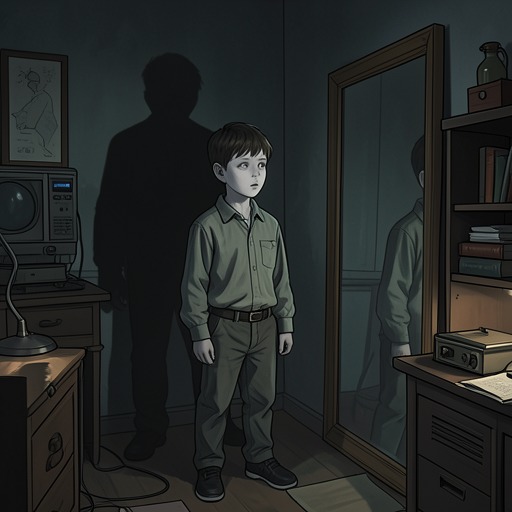
Johnny’s desire for attention grows alongside a home life marked by his mother’s heavy drinking, poverty, and conflict. He watches her with disgust and describes that disgust as a way to feel something, to feel fully alive. When she tells him he must get a job because she cannot provide for him indefinitely, he resists the prospect of being ordered around. He wants instead to be his own master, riding his Suzuki and remaining free. The scene does not make his later actions inevitable, but it establishes the contrast between his lack of control at home and the agency he finds in frightening others.
That sense of agency is explicit when Johnny holds Bleeding Heart, his guinea pig, and reflects on the power of making people believe what he tells them. A phone call or letter, he realizes, can disrupt a community because people are polite and willing to help. The discovery supplies him with an imagined scale of influence: although he has been treated as weak and dismissed at school, he can make others respond to him. His pranks become a substitute for ordinary recognition, but one that depends on deception and on other people’s distress.
From Local Prank to Public Spectacle
The publicity surrounding The Blood-Soaked Baby Incident makes Johnny’s actions visible well beyond their immediate target. At a shop, Sejer sees the story announced in several newspapers, each presenting the incident as a shocking discovery or grotesque joke. The headlines turn a local act into a circulating public drama. Johnny later reads coverage at a Shell station in Bjerkås, where Karsten Sundelin has been interviewed and says that whoever did this to his family should not feel safe. Johnny delights in the threat rather than recoiling from it: the family’s anger confirms that his act has reached them.
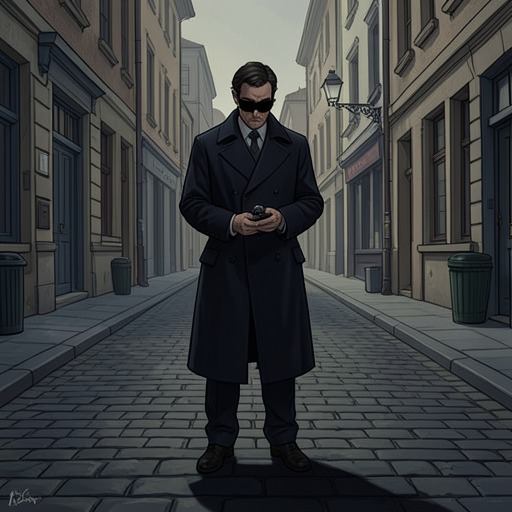
The setting sharpens the contradiction between anonymity and notoriety. At the station, Johnny enjoys walking around without being recognized while also being the talk of the town. He can consume the public response to his own actions without yet being identified as their author. At Sparbo Dam, after reading the papers, he savors what he has set in motion. His pleasure lies not simply in performing a prank but in watching its consequences become a story shared by strangers.
Sejer and Skarre recognize that publicity itself may feed the campaign. Looking down at journalists gathered in the square, they compare the press to a hungry crowd and discuss how much to say. Sejer considers whether newspapers give a criminal the attention he wants and whether silence might deprive him of it. Skarre counters that ignoring the perpetrator could make him angrier or more dangerous. Their exchange exposes the difficulty of responding: reporting can enlarge the spectacle, but withholding a response may also carry risks. The case, involving a baby weighing only seven or eight kilos, is inherently alarming; the officers cannot treat publicity as a simple switch they can safely turn off.
Recognition, Attribution, and Harm
The campaign gives Johnny the recognition he craves in the form of nicknames circulated by editorial staff and the public. He regards their inventiveness as proof that he has finally made something of himself and that people are forced to acknowledge him. In late summer, he rides through residential streets watching children on trampolines, people tending gardens, washing cars, painting fences, and taking clothes from washing lines. He is drawn to this ordinary, teeming life even as he imagines pushing its inhabitants toward danger. The contrast makes his desire more than a wish to be famous: he wants to intrude upon the security of other people’s everyday routines.
Public attention also distorts the assignment of responsibility. By the later stages of the campaign, Bjørn Schillinger is blamed for sabotage despite Gunilla Mørk’s disbelief in his claims and Sverre Skarning’s insistence that Schillinger is meticulous with his dogs and would not simply forget to close a gate. Nihmet Skarning voices the countervailing logic of rumor: because Johnny has been associated with so many strange acts, people will blame him for this and that, and he should turn himself in or face their theories. The spread of attention thus produces a widening shadow of suspicion. Being seen does not mean being accurately understood; Johnny’s notoriety makes him a convenient explanation for events beyond the pranks established as his.
Gunilla’s response to her own forged obituary complicates the victims’ relationship to the spectacle. She distrusts Schillinger’s bitterness and suspects he may be exploiting the terrible incident, while also recognizing creativity and style in the prankster’s work. She frames the obituary in a small silver frame and reads it each morning, thinking that she is still alive. The false report has frightened and offended her, yet its daily presence acquires a peculiar, private meaning. That response does not erase the harm; it shows how a public deception can persist in a victim’s life in ways its maker cannot control.
The Limits of the Game
When Johnny later reports to the police station three times a week, he is not held in custody because he is a minor. He is consistently punctual and goes on to speak with Sejer over mineral water. There he admits that frightening people senseless had been fun, but calls the campaign a game and says he only wanted to stir things up, not hurt anyone. The distinction between his stated intention and the outcome becomes the moral center of the encounter. Sejer tells him that he did hurt people, perhaps for life, and that he may understand the damage only when he is older.
Sejer then asks about Johnny’s life with his mother at Askeland. Johnny answers that she is never sober and takes it out on him, describing the situation as unfair. The exchange brings his neglect into view without treating it as an excuse: the novel places his need for recognition beside the choices through which he obtains it. Attention gives Johnny a feeling of power, but it does not grant him control over what that power does to others. The campaign’s central irony is that he succeeds in making himself impossible to ignore while losing any authority over the meaning and consequences of being seen.