The False Funeral Pickup at the Landmark Home
The CallerThe False Funeral Pickup at the Landmark Home is a hoax in which a caller falsely reports Helge Landmark’s death and sends a funeral-home car to collect him. The hearse arrives while Helge is alive, seriously ill, and watching from inside; the deception therefore brings the prospect of death out of the private space where the Landmarks have struggled to face it and places it, unmistakably, at their gate.
Background and Vulnerability
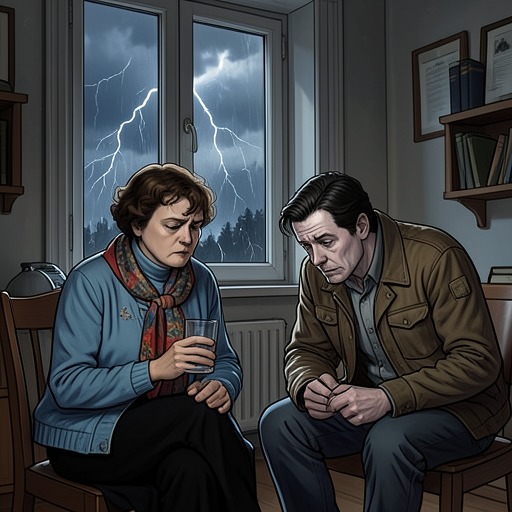
Before the car appears, Astrid Landmark is ironing beside her fifty-nine-year-old husband, Helge, who is sitting in a wheelchair in front of the television. He is unable to follow the programme. His paralysis is advancing, and both spouses understand that he will eventually be unable to swallow, speak, or breathe. His fear of death is already part of their daily life, though the subject has become difficult to discuss between them. Even ordinary plans—whether to keep their cabin at Blefjell, how to manage their house, and who will maintain its lawn, snowblower, and fruit trees—are shadowed by the prospect of his decline.
Astrid keeps busy with household tasks partly because activity makes it possible to postpone the truth. She irons a blue shirt with white collar and cuffs even though she knows Helge will never wear it again. When his head falls forward, she wonders whether he has died without her noticing, then realizes he is fumbling for the television remote. The episode thus begins with death already present as an expectation, but not as an event: Helge is alive, and the couple’s ordinary routines continue around the knowledge of what is coming.
The wider setting is a community already unsettled by fabricated death-related messages. Gunilla Mørk has recently celebrated her seventieth birthday with children, friends, and neighbours, and has begun to think more insistently about her own mortality. A newspaper notice bearing her name, birth date, and the claim that she died peacefully in her sleep shocks her at home. Astrid later recalls such false obituaries, along with an earlier episode involving a baby in Bjerketun, when she tries to explain the hearse to Helge. These incidents establish the pickup as part of a recent pattern of pranks, although Astrid can only speculate that the same people are responsible.
The Hearse at the Gate
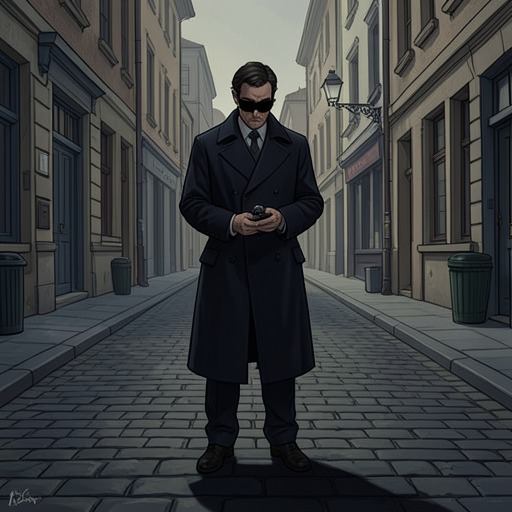
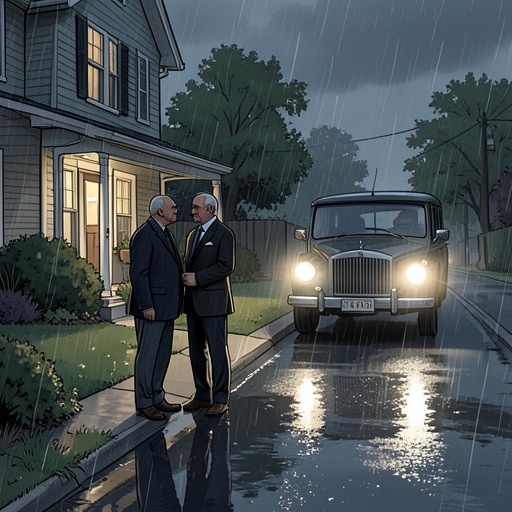
The disturbance starts with a car moving unusually slowly past the Landmark driveway. It pauses at the gate, then reverses into the drive. Astrid sees a large black vehicle with a cross on its roof and recognizes it as a hearse. A man in a dark suit gets out and looks toward the house. Helge has heard the car and asks whether someone is coming in; Astrid quickly tells him they are not. She is not simply confused by an unexpected visitor: she is trying to keep the hearse from unsettling her husband, who does not want people to see him in his present condition.
The man introduces himself as Ingemar Arnesen from Memento Funeral Home. Immaculately dressed and composed, he offers his condolences before Astrid can understand why he is there. He explains that he has been called to collect Helge Landmark. Astrid corrects him: Helge is not dead but is sitting by the window, watching them. The scene’s central reversal is stark. A professional arrival that ordinarily follows a death has come before one, and the supposed deceased is present to witness the mistake.
Arnesen says that a doctor called him and reported the death two hours earlier. The caller claimed to be Dr Mikkelsen from Sandberg Medical Centre. Astrid knows no such doctor and identifies Helge’s actual physician as Dr Onstad at the Central Hospital. Arnesen also recalls asking the caller to send a death certificate by post and receiving agreement. The false report has therefore imitated the language and practical arrangements of a legitimate funeral pickup, but its details unravel as soon as Astrid compares them with her own knowledge of Helge’s care.
A second man, dressed in black, gets out of the passenger side and asks whether they have the wrong address. Arnesen answers that the mistake is wrong on every conceivable level. The younger man’s presence makes the arrival look more like an organized collection than an isolated misunderstanding; Astrid initially assumes there are two men because a body must be carried. Yet no body exists for them to take. Their formal clothing, respectful manners, and the car’s funeral markings give the deception the outward shape of a real death announcement, while the living Helge remains inside the house.
Exposure and Aftermath
Astrid tells Helge that someone summoned the men as a prank and that the household will report it. She connects it to the fake obituaries and the earlier baby episode, suggesting that boys may be responsible, but the account does not identify the caller or confirm who organized the pickup. Her explanation cannot make the event harmless. She feels that death has crossed into the home, a subject the couple had scarcely dared to discuss now made physically present by the hearse and the men waiting outside.
The incident also exposes Helge to precisely the public attention he dreads. He has asked whether the visitors must come inside, and Astrid’s effort to conceal the car leaves him aware that she is keeping something from him. The deception turns his illness into the apparent basis for a death report and places his private vulnerability before strangers. In that way, the prank’s force comes not only from the false claim but from its arrival at a household already organized around the fear of losing him.
At the same time, the episode does not end only in panic. Helge looks at the car and asks whether it is possible to make a reservation. His question gives the hearse a different meaning: it remains a vehicle sent on the strength of a fabricated report, but Helge can also regard it as a means of transport. That turn does not undo the cruelty of the hoax or remove the reality of his illness. It does, however, shift the scene from the imposed announcement of his death toward Helge’s own response to the object at the centre of the deception.
Narrative Significance
The pickup makes the distinction between anticipated death and actual death unstable without erasing it. Astrid and Helge have been living with an ending they know is coming, yet the funeral home’s arrival falsely treats that ending as already completed. The error forces an intimate, largely unspoken fear into a public procedure: a professional offers condolences, asks to take Helge away, and has been told that a doctor can provide the certificate. The practical details make the prank more unsettling than a bare rumour, because they reproduce the steps by which death is ordinarily recognized and handled.
Set beside Gunilla Mørk’s forged newspaper notice, the scene extends the campaign’s use of death as an instrument of alarm. Gunilla reads that she has died in her sleep; at the Landmark home, a hearse and its attendants arrive to act on the claim that Helge is dead. Both incidents exploit the gap between a person’s lived presence and an external message declaring that person gone. In the second, that gap is made visible at the window: Helge is alive, watching the men who have come to collect him.