Theo Bosch Hikes Alone to Snellevann
The CallerTheo Bosch’s solo hike to Snellevann begins with a small but consequential act of parental trust: Hannes Bosch lets his eight-year-old son go alone after considering the risks, and prepares him for the walk. The episode follows Theo from the request for permission to the water’s edge, making the separation between father and son both practical and deliberate.
Permission and the father’s calculation
Theo asks whether he can hike to Snellevann by himself. Hannes checks his watch; it is still early. He considers how long the outing might take: about an hour to reach the lake on Theo’s short legs, perhaps twenty minutes sitting by the water, and another hour to return. In all, Hannes estimates two hours and twenty minutes away—a substantial interval for a child of eight.
The conditions give Hannes reasons both to worry and to allow the hike. The weather is fine and nightfall is not near. The route is not deserted: landowners and farmers work in nearby fields, tending cows and sheep, putting out salt blocks, and checking fences. Hikers, cyclists, and berry pickers may also be out. Hannes weighs this activity against Theo’s youth; his thought that the woods are safer provides another consideration in the decision, rather than removing the uncertainty altogether.
Preparation and the boundary of supervision
Hannes responds by turning permission into a lesson in preparation. He tells Theo that a hike requires a plan and invokes Lars Monsen as an example of someone who plans every detail, including food, equipment, and clothing. The advice makes the outing more than an unstructured escape: Theo is expected to think ahead, even as his father remains responsible for setting the terms of his independence.
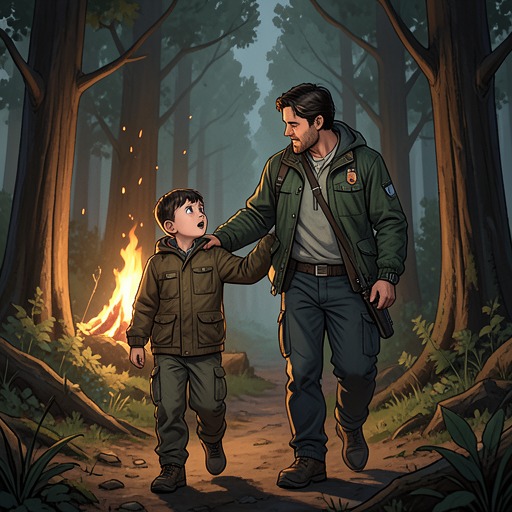
Hannes also says that a good knife is essential in the woods and lends Theo his hunting knife. He asks his son not to tell his mother, explaining that she does not understand knives. The confidence he places in Theo therefore comes with an instruction to keep the loan from the other parent. Hannes offers a limited escort as well, suggesting that he walk Theo as far as the metal barrier. He accompanies his son only to that point, marking where direct parental oversight gives way to the boy’s own progress.
Theo continues alone
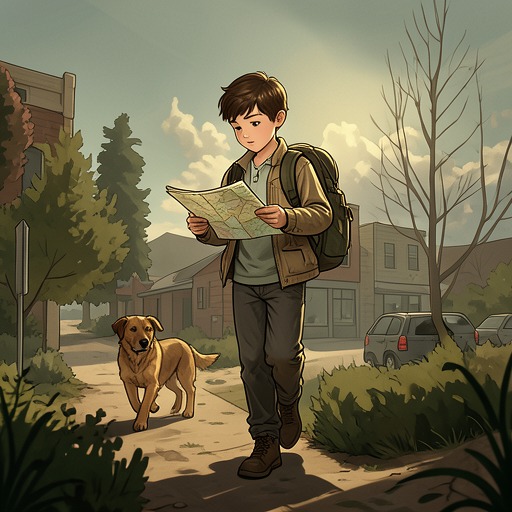
At the barrier, Theo turns and walks on by himself. Hannes notices his son’s large feet, inherited from him, and the enormous trainers that make Theo look like a tottering duck. This detail holds the child’s independence beside his unmistakable smallness: he is undertaking the walk on his own, but remains a young boy whom his father watches closely as he sets off.
The walk proceeds through specific stopping points rather than as an abstract journey. Theo stops at St Olav’s Spring, then makes his way over rocks toward the water. He finds a suitable place to sit, close enough to the edge that his bare toes reach the water. By this point he has arrived at Snellevann and is alone at the lake, fulfilling the outing’s immediate purpose.
Significance of the outing
The episode’s tension lies in the distance Hannes allows and the care with which he tries to manage it. He estimates the duration, takes account of the weather and other people on the route, gives practical instructions, lends Theo equipment, and walks him to a defined boundary. None of these precautions changes the central fact that Theo proceeds without his father. The hike thus presents independence not as a sudden break from family protection, but as a carefully permitted step whose risks Hannes recognizes even while deciding to trust his son.