Alchemy
The Canterbury TalesAlchemy is portrayed as a slippery science whose promise of material transformation conceals a pattern of self-impoverishment. Its practitioners hope to turn base substances into gold, yet the craft repeatedly converts their own wealth, health, and labor into nothing. The concept therefore functions not as a credible route to prosperity but as a literary demonstration of credulity: technical language and repeated experiments sustain hope even when experience has already supplied abundant evidence of failure.
Definition and Technical Appearance
Alchemy presents itself through a dense system of operations, substances, and correspondences. The practitioners speak of trying to “sublimate,” a process identified with calcining or amalgamating quicksilver, or crude mercury. This vocabulary gives the work the appearance of disciplined procedure, as though the desired transformation could be reached by correctly managing heat, metals, and stages of treatment.
The system also organizes matter into the “seven bodies and four spirits.” Quicksilver is named as the first spirit, while metals receive planetary identities: lead corresponds to Saturn, tin to Jupiter, and copper to Venus. Such correspondences make the material world seem legible and ordered. They also allow the practitioners to move between laboratory description and inherited authority, presenting what they have heard from earlier teachers as a body of knowledge rather than as an unverified tradition.
The Promise of Gold
The central attraction of alchemy is multiplication: the hope that a small quantity of precious material can be enlarged into a fortune. The alchemists claim that one pound of gold might be made into two, although the speaker openly admits that this is false. The admission is crucial because it exposes the contradiction at the heart of the practice: the practitioners know that their claim is untrue, yet continue to hope that it may nevertheless be achieved.
That hope is sustained by the philosopher’s stone, also called the elixir. The stone is imagined as the final solution that would make the practitioners safe and prosperous. Because it remains undiscovered, every failure can be interpreted as evidence that the method was incomplete rather than that the premise itself was wrong. The desired object thus operates as an endlessly deferred guarantee, keeping the search alive after ordinary calculation should have ended it.
Labor, Damage, and Ruin
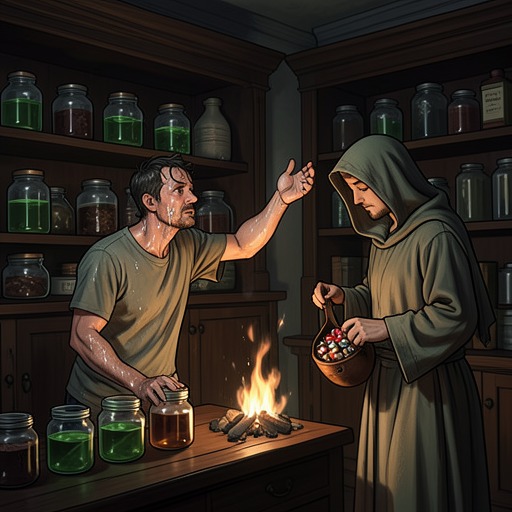
Alchemy demands sustained physical labor around furnaces and fires, some warm and others intensely hot. The practitioner describes the care and sorrow involved in the repeated attempt to process substances, and the imagery of fire turns the craft into a form of bodily endurance as well as financial speculation. He is so accustomed to blowing on the fire that he believes his complexion has changed, while his eyes have become so blurred that he can hardly see.
The damage is not merely incidental. The speaker declares that alchemy has stripped him bare, leaving him with nothing. Its tools include ingots, crucibles, and the other equipment required for the work, but these instruments do not lead to wealth; they mark the continuing expense of the enterprise. The practitioner spends money in pursuit of relief, becomes nearly mad from sorrow, and still allows “good hope” to creep back into his heart. The phrase captures the craft’s psychological mechanism: pain does not extinguish expectation but becomes another condition in which expectation survives.
Failure and Deception
The craft’s failures are dramatized through the instability of its materials and procedures. A pot may explode during an attempted operation, sending the supposed science back into disorder. The explosion punctures the reputation of the process, since the alchemist may possess a famous name or method but can seldom live up to the fame attached to it. The volatile metals turn technical promise into physical breakdown.
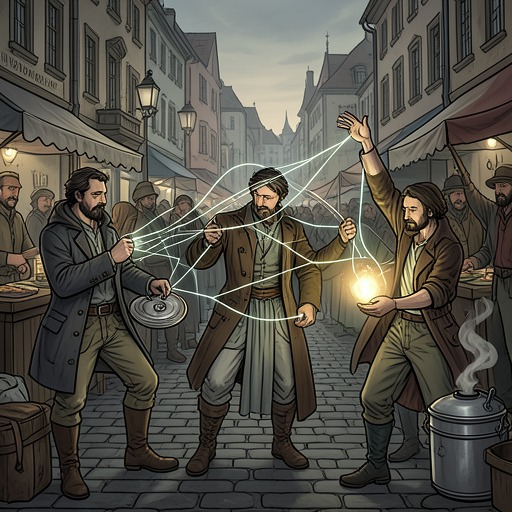
Alchemy also becomes a means of infiltration and ruin. Its practitioners can hoodwink and beguile people who are willing to believe in profitable transformation, entering their confidence through specialized terminology and promises of multiplication. What they attempt will never come to be, but the language of expertise can delay recognition of that fact. A person can learn the procedures easily enough to multiply not wealth but loss, turning whatever property he possesses into nothing.
Narrative Significance
Alchemy binds together false knowledge, avarice, and self-deception. Its elaborate classification of spirits and metals contrasts sharply with its practical result: poverty, blindness, sorrow, and wasted resources. The more precise its vocabulary becomes, the more devastating the gap between explanation and outcome. The craft’s apparent order therefore intensifies its irony rather than correcting it.
As a moral example, alchemy shows how hope can become an instrument of ruin when it is detached from honest judgment. The practitioners are not destroyed by a single failed experiment alone. They are held by recurrence: each operation promises success, each failure demands another attempt, and each expense is justified by the belief that the philosopher’s stone may finally be found. Alchemy’s decisive lesson is that the dream of multiplying gold can instead multiply debt, suffering, and deception.