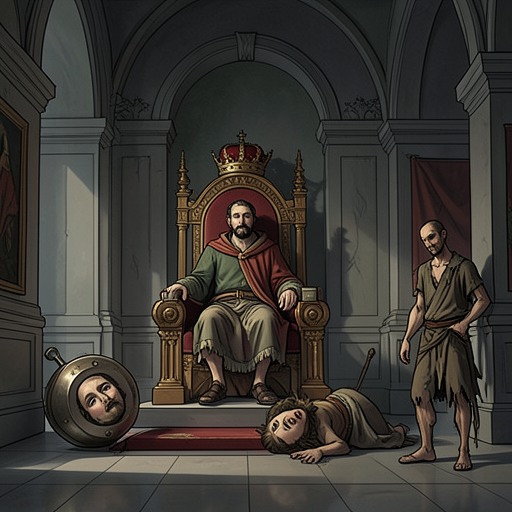
Alexander the Great
The Canterbury TalesAlexander the Great appears in the narrative as the exemplary conqueror whose fame is so widespread that the teller assumes his story is already familiar. His greatness is measured not only by the extent of his victories but also by the fear he inspires: wherever he goes, he overturns the pride of men and beasts, and the world trembles before him. Yet the same portrait that raises him above every other conqueror turns toward tragedy, since the ruler who seemed invincible is ultimately destroyed from within his own camp.
Identity and Reputation
Alexander the Great is identified as the son of Phillip of the Macedonian race and as the first and greatest king of Greece. The account treats his story as exceptionally well known, suggesting that even a brief reference is enough to summon an entire history of conquest. His renown therefore functions as a cultural measure of greatness: he is not merely one successful ruler among others, but the standard against which conquerors are compared.
The narrator declares that no comparison can adequately contain Alexander's stature. Above all other conquerors, he towers, while the whole world lives in dread of him. This language joins admiration to intimidation. His power is so expansive that it appears almost elemental, extending beyond political victory into the domination of human and natural pride itself. The image is deliberately disproportionate, making Alexander a figure of unmatched worldly force.
Conquest and Sovereignty
Alexander's defining action is the toppling of pride wherever he travels. The narrative does not provide a campaign-by-campaign account, but it presents the cumulative result of his warfare: kingdoms and peoples are imagined as falling before him, and his advance reaches the farthest limits of the world. His knighthood and achievements are said to be too numerous to recount in full, so the omission itself emphasizes excess. His career exceeds the capacity of the teller's catalogue.
The account gives his reign a precise political frame. According to Maccabees, Alexander ruled for twelve years as king of Greece. That duration makes his achievement more than a momentary triumph, while the title of Greece's first and greatest king places him at the beginning of a national history as well as at its summit. His authority is thus both temporal and symbolic: he governs for a defined period, but his reputation is made to outlast the limits of ordinary historical measurement.
Reversal and Death
The praise of Alexander is interrupted by an abrupt lament. After being presented as the conqueror before whom the world quakes, he is addressed as a worthy figure of noble grace whose story nevertheless contains profoundly sad events. The reversal is stark: the man who defeated others cannot secure himself against treachery within his own circle.
Alexander is poisoned by his own men. The detail transforms the meaning of his greatness. External enemies and distant peoples cannot stop him, but proximity creates the danger that conquest cannot solve. His death therefore acts as a tragic counterweight to his victories, shifting the narrative from worldly supremacy to human vulnerability. The conqueror's fall is not described as a defeat in open battle; it comes through the concealed hostility of those who serve him.
Fortune and Narrative Significance
The account places Alexander's fate under the sign of Fortune. The language of Fortune turning an apparent winning throw into its opposite gives his death the structure of a sudden reversal: the ruler who has accumulated every advantage discovers that worldly success can be overturned without warning. His career becomes a compact example of the instability of earthly glory.
Alexander's appearance in the narrative is therefore both historical and moral. He embodies the maximum of human conquest, but that maximum cannot guarantee permanence, loyalty, or survival. The contrast between universal fear of his power and his poisoning by his own men exposes the limits of dominion. His story remains memorable not simply because he conquered more than other rulers, but because the height of his ascent makes his final reversal more severe.