April
The Canterbury TalesApril functions both as a season of regeneration and as a measure of narrative time. It first appears through rain that penetrates the drought of March and carries life-giving moisture through every vein of new growth. Later, the date of the eighteenth day of April fixes a particular moment in the unfolding action, making the month more than atmospheric background: it becomes a temporal coordinate by which the reader can locate human movement and change.
Spring Renewal
April’s defining image is restorative rain. After March has dried the earth, April’s showers reach down to the roots and bathe each emerging sprout with sustaining liquid. The month therefore marks a transition from barrenness to fertility, from winter’s restraint toward the active growth associated with spring. Natural processes are described as gradual but forceful: moisture travels through the plant’s veins, suggesting that renewal is not merely a surface effect but a transformation reaching into the life of the soil and its vegetation.
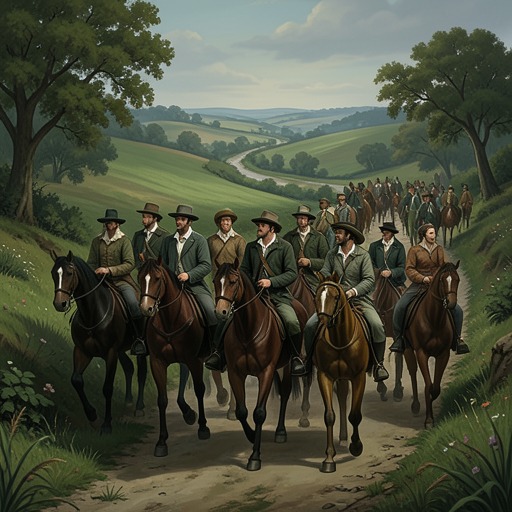
This seasonal renewal also establishes the emotional and narrative atmosphere for the opening journey. April’s vitality helps explain why people are drawn outward, away from enclosed domestic and urban spaces, toward travel and pilgrimage. The month supplies a natural rhythm beneath the human world, linking bodily energy, movement, and expectation without reducing the landscape to a static decoration.
Calendar and Narrative Precision
April also serves as an instrument of exact chronology. During an episode of observation and travel, a character recognizes that it is the eighteenth day of April, described as the herald of May. The specific date narrows the otherwise expansive seasonal image into a measurable point in time. The month thus operates at two scales: it is the broad season of spring, and it is a precise date within an individual sequence of events.
The reference to May gives April a forward-looking quality. It is not only the fulfillment of rain and growth but also the threshold of what is approaching. In narrative terms, that position suits a world in motion, where journeys are underway and present circumstances anticipate further developments. April makes time visible as both recurrence and transition.
Human Activity within Seasonal Time
The month’s significance extends beyond the opening landscape. The book repeatedly places social life against temporal and environmental conditions: travelers assemble, characters meet, lovers negotiate, and material exchanges are settled within a world governed by seasons and dates. April’s natural abundance provides the first large-scale temporal frame for these activities, while the later eighteenth-day reference shows that individual episodes can be anchored to the calendar with unusual specificity.
This contrast between expansive seasonal description and exact dating gives the narrative both breadth and control. April evokes a recurring cycle that exceeds any one person, yet the eighteenth day records an unrepeatable moment in the lives of particular characters. The result is a double sense of time: nature renews itself according to a pattern, while human choices occur at definite points within that pattern.
Narrative Significance
April’s decisive function is to connect renewal with departure. Its rains prepare the earth for growth, and its springtime energy accompanies the movement of people into the larger social and spiritual world of travel. At the same time, its calendar precision prevents the season from remaining a generalized symbol; the month is also part of the practical chronology through which the narrative organizes action.
As a recurring temporal reference, April therefore joins natural vitality, human mobility, and narrative anticipation. It opens the book with the promise of reawakening and later returns as an exact date, preserving the tension between cyclical nature and irreversible human events.