Arcite
The Canterbury TalesArcite is the Theban knight whose pursuit of Emily turns victory into tragedy. Found among the defeated after Theseus’s battle, he survives imprisonment, adopts the disguise of Philostrate to approach the woman he loves, and finally wins the tournament arranged for Emily—only to die when his horse throws him and shatters his breast. His story gives the rivalry with Palamon its most devastating reversal: the knight who appears to have gained the prize cannot live to possess it.
Identity and Introduction
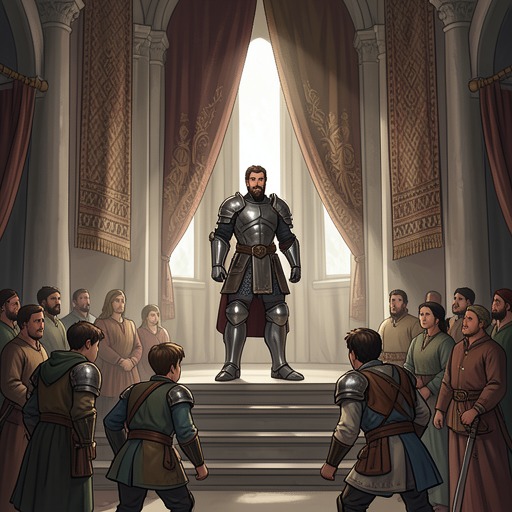
Arcite first enters the narrative as one of two youthful knights discovered in a heap of the slain after the battle and victory. He lies on the ground with grievous wounds beside Palamon, and the two are distinguished by their identical, richly wrought arms. Their condition suspends them between life and death, but their names establish them as noble Theban opponents rather than anonymous casualties. Arcite’s introduction therefore joins identity to aftermath: he is revealed not in a courtly setting but among the physical remains of war.
The discovery also binds Arcite to Palamon from the beginning. They have fought side by side, wear matching armor, and share the fate of defeated prisoners. Yet this apparent unity becomes the foundation of a rivalry. Their common capture does not erase their separate desires; instead, the two knights’ attachment to Emily transforms shared suffering into competition.
Disguise and the Pursuit of Emily
Arcite’s most consequential act of concealment occurs after he is released from imprisonment. He changes his knight’s clothing for that of a poor laborer for hire, allowing no one to recognize who he is. The disguise is not an abandonment of his rank but a means of remaining close to Emily: hidden from public knowledge, he can see his lady every day.
Under the name Philostrate, Arcite serves as Emily’s chamber-page for a year or two. The disguise produces an extraordinary reversal in his social position. Although he appears to be a laborer, he becomes more beloved at court than any other man of equal rank. His success depends on the gap between visible identity and concealed identity: the court honors Philostrate without realizing that Philostrate is Arcite, the imprisoned Theban knight. His disguise thus advances his love while postponing the open contest that his true identity would provoke.
The assumed name also makes Arcite a figure of divided existence. He is simultaneously a knight and a servant, a rival hidden within the household he wishes to enter, and a lover whose daily access to Emily depends upon being misunderstood. The concealment gives him proximity but not resolution. It brings him near the object of his desire while preserving the conflict with Palamon for a later and more dangerous confrontation.
Tournament and Fatal Reversal
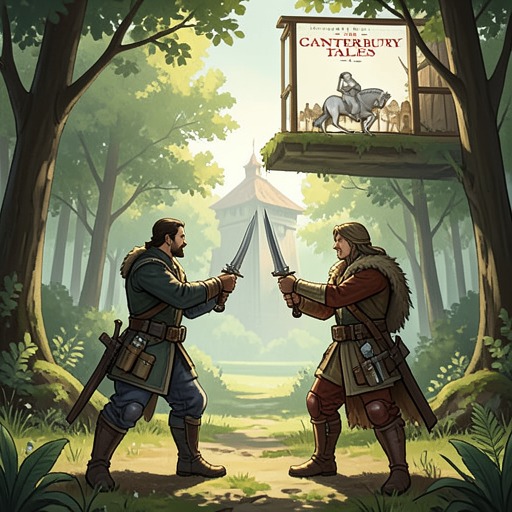
Arcite’s return to the public role of knight culminates in the tournament for Emily. The contest externalizes the rivalry that began in imprisonment: what had been concealed through service and disguise is now decided through martial performance. Arcite’s victory seems to confirm that courage, skill, and noble identity have finally overcome the obstacles separating him from Emily.
That apparent resolution is overturned almost immediately. Arcite’s horse turns, rears, and founders so quickly that he cannot react. He is thrown and lands on his head, lying as if likely to be dead; the fall shatters his breast against the saddlebow. The violence is abrupt and bodily, cutting through the ceremonial logic of the tournament. Victory does not lead to possession, celebration, or secure happiness. It becomes the instant before catastrophe.
The fall is the decisive peripeteia of Arcite’s plot. He has moved from wounded prisoner to disguised court favorite and then to victorious champion, but the upward movement ends in physical collapse. The contest grants him the external success he sought while denying him its human consequence. His death makes the tournament’s apparent order unstable: the winner is not the one who survives to marry Emily, but the one whose triumph creates the conditions for Palamon’s eventual future.
Relationships and Rivalry
Arcite’s central relationship is with Palamon, whose name is paired with his from the moment the two are found wounded together. Their bond contains both fellowship and opposition. They are comrades in battle, prisoners under the same power, and lovers of the same woman; each fact strengthens the connection while also making peaceful coexistence impossible. Their rivalry is therefore not a contest between strangers but a fracture within a shared history.
Emily is the focus of Arcite’s movement through the plot. His disguise as Philostrate is valuable because it permits daily sight of her, and his return to knightly identity makes his desire a public matter. The text presents his love through action rather than sustained private explanation: he changes his clothing, assumes a new name, serves in the court, and enters the tournament. Each transformation makes the same objective more visible while also increasing the cost of failure.
Arcite’s death leaves the emotional consequences to those who remain. When the narrator declares that Arcite is cold and invokes Mars to guide his spirit, Emily shrieks and Palamon howls in grief. The reactions reveal the breadth of his significance. He is not merely a defeated rival removed from the plot; his death wounds the woman he loved and the companion against whom he competed. His absence becomes the condition through which the rivalry can cease to be destructive.
Change, Ending, and Narrative Significance
Arcite’s trajectory is shaped by repeated changes of status and appearance. He begins as a wounded knight among the defeated, becomes a prisoner, reappears in the clothing of a hired laborer, and lives at court under the name Philostrate. He then returns to the visible identity of a knight and wins the tournament. These changes show a character continually adapting his outward form to pursue an inward aim, but they also expose the limits of human strategy. Disguise can alter access, and valor can secure victory; neither can control the final turn of fortune.
His ending is tragic because it arrives at the point of apparent fulfillment. Arcite does not die while merely longing for Emily or while languishing in confinement. He dies after winning the contest designed to decide the lovers’ claims. The sequence makes success itself dangerous: the closer he comes to the desired conclusion, the more sharply the narrative reverses it.
Arcite consequently embodies the tragic instability of worldly achievement. His story combines rivalry, metamorphosis through disguise, love, and sudden reversal, but its governing pattern is the conversion of triumph into loss. The narrator’s brief lament—“Arcite is cold, Mars guide his spirit free!”—closes his active career with a stark recognition that martial glory cannot protect the victor from death. Arcite’s final importance lies in that contradiction: he wins the tournament, loses his life, and leaves behind a grief that reshapes the fate of Palamon and Emily.