Arcite–Emily relationship
The Canterbury TalesArcite–Emily relationship is one of the central tragic attachments in the story of the two Theban cousins. It begins not through courtship or mutual exchange but through Arcite’s sudden sight of Emily, whose beauty wounds him with an intensity he compares to the injury already suffered by Palamon. The relationship therefore joins desire to pain from its first moment: Arcite’s love is not a settled bond but an overwhelming force that redirects his identity, his loyalties, and the conflict surrounding Emily.
First Sight and the Birth of Desire
Arcite encounters Emily while she is roaming to and fro, and the movement of the scene matters. He does not approach her after a deliberate introduction; he happens to see her, and vision itself becomes the cause of his transformation. The narrator says that her beauty hurt Arcite as much as, or even more than, it had hurt Palamon. Love is thus presented as a shared wound, transmitted through the sight of the same woman but experienced with distinct intensity by each cousin.
Arcite gives this wound a language of sudden death. He sighs piteously and declares that he is slain by Emily’s fresh beauty and by the beauty of her roaming in that place. His response turns perception into fate: the beloved’s appearance is not merely pleasing but destructive, and Arcite understands his passion as something that has overtaken him rather than something he has chosen through reasoned action. The scene establishes the relationship’s governing paradox, since Emily’s presence animates Arcite while simultaneously making him speak as though he has already been condemned.
Love as Wound and Devotion
Arcite later addresses Emily directly and intensifies the metaphor of injury. He says that she has struck his loving heart with such a hurt that his death was knit before the shirt he wears, and he identifies her eyes as the agents of his destruction. In this formulation, Emily’s gaze becomes more powerful than any physical weapon. Arcite’s love is embodied as a wound lodged in the heart, while his anticipated death gives the passion a terminal horizon from the beginning.
The declaration also reveals the asymmetry of Arcite–Emily relationship. Arcite speaks to Emily as the cause of his death, but the evidence presents no corresponding declaration from Emily and no established mutual intimacy. His speech is therefore both confession and self-diagnosis: he names the force governing him, yet the naming does not restore control. By attributing his earthly care to the woman whose eyes have slain him, Arcite places his emotional life under Emily’s power even though she has not been shown deliberately exercising it.
Love Within the Cousins’ Rivalry
Arcite’s passion cannot be separated from the bond and competition between Arcite and Palamon. Both men are captivated by Emily, and the narrator explicitly compares their wounds. The relationship consequently becomes one of the forces that turns shared kinship into rivalry. Emily is not simply a romantic interest appearing beside the plot; her beauty becomes the point at which the cousins’ common condition divides into competing claims.
Arcite’s love also gives the rivalry a tragic rather than merely strategic shape. The emotional language of being slain, hurt, and doomed makes the contest over Emily resemble a struggle over life itself. The beloved is treated as the source of the wound, but the deeper conflict lies in the cousins’ incompatible responses to the same desire. Arcite’s attachment binds personal longing to honor, competition, and the consequences of choosing passion over peaceful kinship.
The Tournament and the Reversal of Fortune
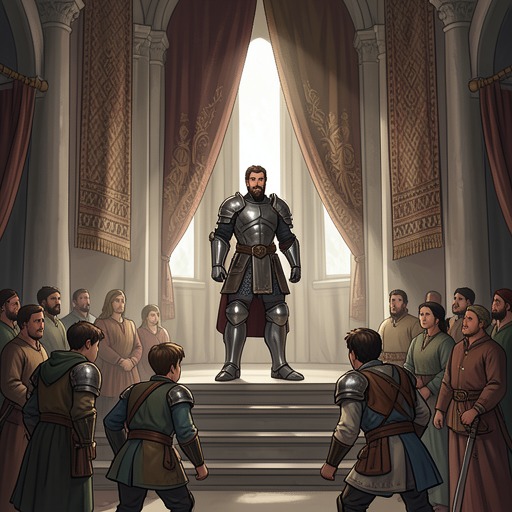
The relationship reaches a decisive public moment during the tournament. Arcite, described as fierce, removes his helmet and rides out across the lengthy course. The gesture reveals his joyful face at the very instant when his private love enters the visible arena of combat. The tournament makes the rivalry legible to others: Arcite is no longer only the man sighing over Emily’s beauty, but a combatant whose body and reputation are placed before the society that will judge the contest.
This scene produces a sharp reversal in the emotional value of Arcite’s love. His exposed face and forward movement suggest confidence and triumph, yet the relationship remains governed by the earlier wound. Victory in the course cannot simply heal the passion that made the contest meaningful. Instead, Arcite’s apparent success heightens the tragic contradiction between public achievement and private vulnerability: he can prevail as a warrior while remaining helpless before the love he describes as fatal.
Tragic Meaning and Unfulfilled Desire
Arcite–Emily relationship follows the pattern of love as a consuming and destructive force rather than as a completed romantic union. Arcite’s language repeatedly converts beauty into violence and desire into mortality. The effect is not sentimental idealization alone; it is a tragic anatomy of how an involuntary passion can reorder a man’s entire field of action. The relationship’s strongest evidence lies in Arcite’s bodily vocabulary—hurt, slain, death, and the heart—through which emotional intensity becomes physical danger.
The relationship also functions as a dramatic value shift. At first sight, Emily’s presence changes Arcite from a participant in the surrounding crisis into a lover marked by sudden pain. In his direct declaration, love deepens into an apparent sentence of death. During the tournament, public victory temporarily reverses his visible condition, but it does not remove the underlying wound. The pattern explains why the relationship carries tragic pressure even in moments of exhilaration: every rise in Arcite’s outward fortune remains shadowed by the fatal logic with which he first understood Emily’s beauty.