Arveragus
The Canterbury TalesArveragus is the knight at the center of the marriage plot involving Dorigen. His significance emerges through a contrast between public chivalric reputation and private fidelity: he leaves home in pursuit of honor, returns as a celebrated warrior, and then confronts the crisis created by Dorigen’s promise to Aurelius. The narrative ultimately presents him as a husband whose response preserves both love and honor, allowing the marriage to return to a state of complete harmony.
Identity and Background
Arveragus is identified by name as the husband of Dorigen and as a knight whose home is Kayrrud. His social identity is explicitly tied to chivalry, and the narrative later describes him as “one who is of chivalry the flower.” That description makes him more than a participant in a romance: he embodies the public code of honor against which his private decisions are measured.
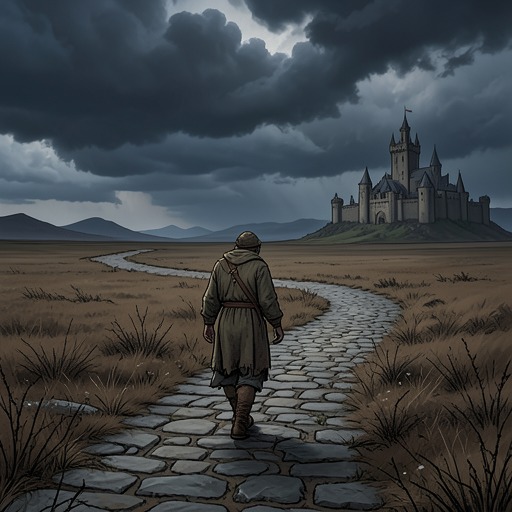
His first major action is a departure from domestic life. After the couple has enjoyed a year and more of happiness, Arveragus leaves on a journey in the hope of gaining fame. The absence is not presented as a rejection of Dorigen or as a collapse of their marriage. Rather, it is the knightly demand for reputation and achievement intruding upon an otherwise blissful household. The book says that he dwells for two years on the island, making his absence a substantial test of the attachment between husband and wife.
Public Honor and Return
Arveragus’s departure gives his character a double orientation. He belongs to the world of chivalric action, where fame is a legitimate objective, but he is also bound to a wife who loves him “as much as life.” His quest for renown therefore carries an emotional cost even though the narrative does not portray the departure as wrongful. The marriage must endure separation while the knight seeks the public status associated with his order.
When Arveragus returns, he comes back “in honor, health, and power,” accompanied by other worthy men. The three terms join moral reputation, bodily survival, and social strength. His return confirms that the journey has achieved its public purpose: he has not merely come home, but come home with the authority and recognition he sought. Yet the story shifts attention from that public triumph to Dorigen, whose emotional experience has become the real pressure point of the marriage plot.
The contrast is important. Arveragus can succeed in the outward world and still face a more difficult trial at home. Military or chivalric accomplishment gives him honor, but it does not by itself resolve the vulnerable promises and anxieties that have arisen during his absence. His character is tested most fully not by combat but by the interpretation of a wife’s desperate commitment.
Marriage and Moral Crisis
Arveragus and Dorigen are represented as deeply attached. Dorigen loves him with exceptional intensity, and their relationship is described as a life of “sovereign bliss.” The narrative adds that anger never comes between them. Their marriage is therefore defined not by routine peace alone but by the absence of resentment even when circumstances become dangerous.
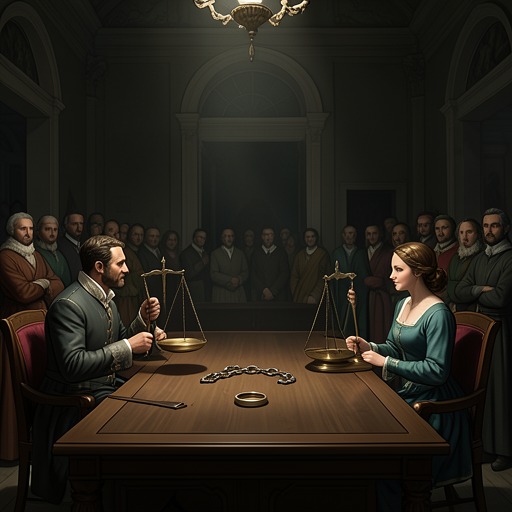
That harmony is threatened when Dorigen tells Arveragus what has happened. She has promised Aurelius that she will yield to him if the rocks along the Breton coast are removed, believing that such a condition is impossible. Once the promise becomes morally pressing, she discloses it to her husband. Arveragus listens and answers her in a friendly and cheerful manner, beginning with the words, “Now, Dorigen, there’s nothing else but this?” His response is striking because the situation invites anger, accusation, or an assertion of marital authority, yet the narrative first emphasizes his manner as that of a friend.
The scene places Arveragus between competing forms of obligation. He must reckon with Dorigen’s promise, her distress, the claims of marriage, and the code of honor that governs his own identity. The evidence does not present him as trying to control her through force or to punish her for the crisis. Instead, his conduct belongs to the story’s larger interest in whether a promise can be honored without destroying the person who made it.
Relationship with Dorigen
Arveragus’s relationship with Dorigen is marked by mutual affection and an unusual ideal of companionship. She loves him absolutely, while he responds to her confession as a friend rather than as a suspicious husband. That emotional posture matters because the crisis could easily turn the marriage into a contest over possession, shame, and authority. Arveragus’s first visible reaction resists that transformation.
The narrative’s final description restores the couple to their earlier condition: Arveragus and Dorigen share their life in “sovereign bliss,” and “Not once did any anger come between.” The ending does not erase the danger that preceded it. Instead, it defines the marriage by the capacity to pass through a morally threatening situation without allowing anger to become its permanent language.
Arveragus consequently functions as both Dorigen’s husband and the person who makes her ethical predicament possible to resolve. His willingness to hear her account, rather than reduce it to betrayal, keeps the relationship within the sphere of trust. The marriage is not depicted as free from external pressure; it is depicted as strong enough to prevent that pressure from becoming mutual hostility.
Change and Narrative Role
Arveragus begins as an absent knight seeking fame, returns as a figure of established honor, and then becomes the domestic judge of a crisis that cannot be settled by martial power. His trajectory moves from public action to private interpretation. The story first asks whether he can win renown; it then asks what kind of husband that renown has made him.
His decisive quality is the integration of chivalric honor with marital generosity. A narrower version of honor might demand anger or punishment, while a purely private attachment might ignore the seriousness of a promise. Arveragus instead occupies the tension between the two. The narrative associates his nobility not simply with being powerful or admired, but with how he behaves when Dorigen’s word places both of them under pressure.
For that reason, Arveragus serves as the stabilizing force of the marriage tale. His departure creates the conditions for uncertainty, his return brings public honor back into the household, and his response to Dorigen’s confession prevents the plot from ending in domestic rupture. The final image of the couple in unbroken bliss gives his character a clear narrative verdict: the flower of chivalry is also measured by patience, friendship, and the preservation of love under strain.