Belshazzar
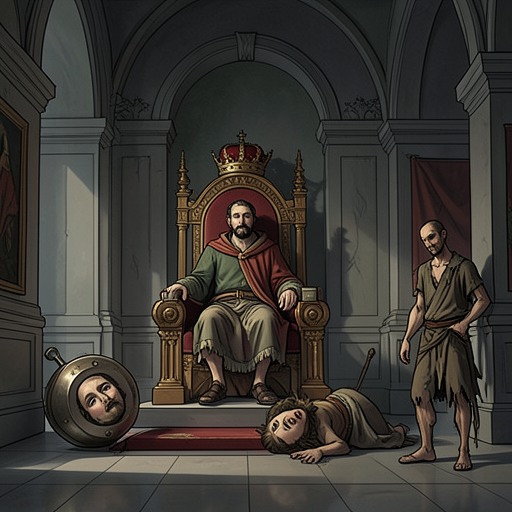
The Canterbury TalesBelshazzar is presented as the son and heir of Nebuchadnezzar whose reign ends in a single night. His story turns royal confidence into terror: while he presides over a lavish feast, an armless hand writes a warning on the wall, and the interpretation announces that his kingdom will be divided. The prophecy is fulfilled at once when Belshazzar is slain and Darius takes his place, making him a concentrated example of power overturned by divine judgment.
Identity and Inheritance
Belshazzar is identified directly as Nebuchadnezzar’s son and heir. His position therefore rests on dynastic succession and inherited authority rather than on any personal achievement described in the narrative. He assumes power after Nebuchadnezzar’s reign, occupying the throne at the moment when the earlier king’s story has already established the limits of earthly dominion.
The contrast between father and son is significant. Nebuchadnezzar is remembered as retaining recognition of God’s might and grace until his death, whereas Belshazzar appears in the midst of royal self-assurance. The narrative places the son’s rule against the father’s religious awareness, making Belshazzar’s downfall part of a generational pattern in which inherited power does not guarantee inherited wisdom.
The Feast and the Display of Power
Belshazzar’s decisive action is to give a feast for all his lords and command them to be merry. The feast is not merely private enjoyment; it is a public performance of sovereignty. By gathering his lords and directing the atmosphere of celebration, Belshazzar displays the apparent stability of his court and the abundance available to the ruling class.
The scene also presents power through consumption. The guests drink various wines from noble vessels, turning precious objects into instruments of royal pleasure. The vessels’ nobility and the scale of the feast reinforce the impression that Belshazzar possesses the material resources of an established kingdom. Yet the abundance is immediately exposed as fragile. The same banquet that stages his command becomes the setting in which his authority is judged.
The Writing on the Wall
During the feast, Belshazzar looks toward a wall and sees an armless hand writing rapidly upon it. The apparition interrupts the social ritual without warning. It is not introduced as an ordinary messenger or courtly announcement: the disembodied hand makes the source of the message both visible and unknowable, while its lack of an arm intensifies the strangeness of the sign.
Belshazzar’s response is fear. The sight that should be impossible breaks through the confidence of the banquet and makes the king physically quake. This reversal gives the episode its dramatic force: the ruler who has summoned others to merriment can no longer control the meaning of what appears before him. The feast’s public spectacle is displaced by a supernatural inscription whose authority exceeds the king’s own.
Judgment, Death, and Succession
The writing is interpreted as a prophecy that Belshazzar’s kingdom will be divided and given to the Medes and Persians. The message converts the unexplained sign into a precise political sentence. The threatened loss is not limited to Belshazzar’s personal safety; it concerns the partition and transfer of the entire kingdom, showing that royal power can be revoked at the level of history as well as at the level of an individual life.
The warning is fulfilled immediately. Belshazzar is slain that very night, and Darius replaces him despite having no lawful means or right to the succession. The speed of the transition is crucial: there is no prolonged resistance, recovery, or orderly inheritance. Belshazzar’s death and Darius’s accession enact the division announced on the wall, while the irregularity of Darius’s claim further emphasizes the collapse of the legal and dynastic order surrounding the throne.
Narrative and Moral Significance
Belshazzar’s episode functions as a compact moral exemplum about the instability of worldly prosperity. His feast gathers rank, wealth, ceremony, and confidence into one scene, but the wall writing reveals that none of these can secure a kingdom against judgment. The narrative moves from inheritance to celebration, from celebration to terror, and from terror to death with almost no interval, compressing the rise and fall of power into a single dramatic reversal.
The character also belongs to the book’s wider concern with Fortune’s wheel and divine providence. Belshazzar’s authority appears settled because it is supported by lineage and courtly magnificence, yet it is overturned by a sign that exposes the limits of human control. His ending therefore does not present political succession as a neutral change of rulers. It presents the fall of a king as the revelation that apparent permanence was temporary all along.