Chanticleer's capture and escape
The Canterbury TalesChanticleer's capture and escape is the decisive reversal in the animal tale of Chanticleer, Pertelote, and Russell. A black-marked fox who has lived for three years in the grove near the widow's cottage approaches the rooster through calculated friendliness, captures him when vanity overcomes caution, and loses him when the captive exploits the fox's own appetite for triumph. The episode joins physical pursuit to verbal deception: the fox wins by speech, while Chanticleer escapes by making speech betray its speaker.
Causes and Background
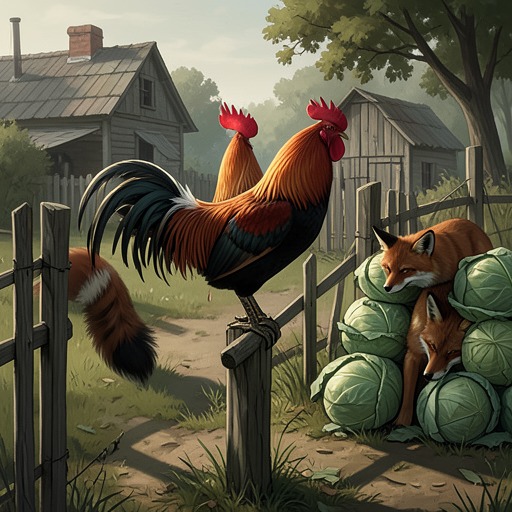
The danger begins with Russell's patient concealment. He is described as an iniquitous and sly fox who has dwelt in the nearby grove for three years, a duration that makes the encounter seem less like a chance attack than the culmination of sustained predatory opportunity. When Chanticleer looks across the cabbage bed while trying to catch a butterfly, he sees the fox lying low. The scene places the rooster's ordinary activity beside the predator's deliberate stillness: Chanticleer is occupied with immediate pleasure, while Russell has already adopted the posture of ambush.
The fox understands that open force may fail if the rooster reacts quickly. Instead of lunging at once, he addresses Chanticleer as a gentleman and claims friendship, asking whether anything is wrong and insisting that he would be worse than a fiend if he meant harm. His language is not incidental politeness. It is the mechanism by which he interrupts flight, creates a false social relation, and turns the rooster's suspicion into an opportunity for vanity.
The Capture
Chanticleer does not remain because Russell has proved trustworthy; he remains because the fox's address gives him a flattering role to inhabit. The narrative has already framed the rooster as vulnerable to esteem, and Russell's performance draws that weakness into the open. The fox's apparent deference persuades Chanticleer that he is being recognized rather than hunted, allowing the predator to approach within reach.
The capture occurs when Chanticleer stretches upward, closes both eyes, and begins to crow loudly. That gesture makes the danger visible in bodily form: the rooster voluntarily heightens his posture, abandons visual vigilance, and gives voice at the exact moment when he should be watching. Russell springs from concealment and seizes Chanticleer by the throat. He then carries him on his back toward the woodland, converting the scene from deceptive conversation into unmistakable abduction.
The change is witnessed almost immediately by the widow and her daughters. Hearing the hens' woeful cries, they rise and run outside. Their response establishes the capture as a communal crisis rather than a private contest between two animals. The hens' alarm, the household's sudden movement, and the fox's flight toward the woods all accelerate the episode after the lingering deception of the opening.
The Escape
Chanticleer's position appears hopeless while he lies on Russell's back, but fear does not erase his intelligence. Instead, he speaks to the fox and proposes a hypothetical reversal: he asks what he would do if he were in the fox's place. The rooster's strategy is to make Russell imagine himself displaying victory before the watching household. The appeal is directed not to mercy but to vanity, and it places the predator inside a scene of public triumph.
Russell accepts the suggestion and opens his mouth to answer. As he says that he will eat Chanticleer immediately in front of the pursuing witnesses, he repeats the boast that the rooster has induced him to make. At that instant, without a pause, Chanticleer breaks free from the fox's jaws and flies high into a tree. The escape depends on a precise reversal of the first exchange: Russell originally used speech to make Chanticleer stop and close his eyes, whereas Chanticleer uses speech to make Russell open his mouth and surrender his grip.
The physical outcome therefore grows directly from the verbal contest. Chanticleer does not overpower Russell, outrun him on the ground, or receive rescue before the decisive moment. He survives by recognizing that the fox remains susceptible to the same self-regard that the fox exploited in him. The predator's appetite and pride become the opening through which the captive escapes.
Narrative Structure and Meaning
The episode is told as a concentrated pursuit and escape, but its discourse repeatedly delays physical action with speech and commentary. The fox is first presented as a settled threat, then discovered in concealment, then allowed to speak at length before the attack. After the capture, the household's alarm supplies an external pressure, yet the narrative returns to the exchange on the fox's back for the final reversal. This arrangement makes language the central arena of the event even though the stakes are bodily and immediate.
The narrator explicitly warns against flattery and treachery, and the warning is dramatized rather than merely stated. Chanticleer's raised neck and closed eyes turn credulity into an image; Russell's spring turns persuasive courtesy into violence. The same pattern is then reversed. Russell's confident reply, intended as a declaration of control, becomes the action that releases his prey. In this irony, the tale's moral is distributed between both animals: Chanticleer must learn that flattering words can conceal danger, while Russell demonstrates that a deceiver who delights in his own cleverness can be deceived in turn.
The event also joins the tale's larger preoccupation with Fortune's sudden reversals. The fox appears to possess complete power when he carries the rooster toward the woodland, but the balance changes in a single utterance. Capture and escape are separated not by a long struggle but by the instant in which Russell chooses to speak. The scene consequently presents fortune as unstable and pride as an unreliable foundation for victory.
Consequences and Significance
Chanticleer's flight into the tree ends the immediate threat and restores the boundary between predator and prey. The hens' cries and the widow's household have exposed the danger, but the rooster's own verbal maneuver determines the outcome. The escape thus preserves Chanticleer while leaving the moral responsibility of the initial mistake intact: he survives, but survival does not make his susceptibility to flattery harmless.
Russell's failure is equally instructive. His three years of concealment, his careful false claim of friendship, and his successful throat-grip all suggest a predator who understands both patience and performance. Yet the final exchange reveals a limit to his cunning. He can imitate courtesy to ensnare another creature, but he cannot resist the chance to proclaim his victory before an audience. His appetite is defeated through his vanity, and the fox's own speech becomes the instrument of his loss.
As an episode, Chanticleer's capture and escape therefore functions as a moral exemplum built from pursuit, captivity, and reversal. It gives concrete form to the warning that treacherous flattery should be resisted, while refusing to make caution a simple guarantee of safety. The rooster is endangered by pride, saved by counter-deception, and raised into the tree through a sudden change in the contest's verbal logic. The result is both comic and severe: the threatened victim escapes, but the tale makes clear that in a world governed by persuasive appearances, cleverness must remain alert to the cleverness of others.