Chanticleer's dream of the fox
The Canterbury TalesChanticleer's dream of the fox is the warning vision that turns an apparently comic animal tale toward danger. At daybreak, while beasts and birds are imagined as capable of speech and song, Chanticleer dreams that a hound-like beast has appeared within the yard and may carry him into captivity. The dream is not treated as a private oddity: it provokes an argument with Pertelote over the meaning of dreams, the reliability of fear, and the limits of rational confidence.
Setting and Immediate Occasion
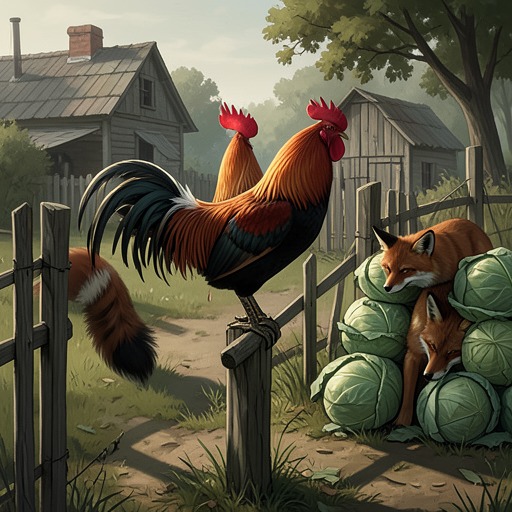
The episode begins as the day starts to spring. Chanticleer is on his perch with his seven wives in the hall, and the surrounding world belongs to a fabulist order in which animals can speak and sing. This setting makes the dream narratively legible before its meaning is explained: the birds possess human-like speech, judgment, marriage, and debate, yet remain exposed to the physical dangers of the animal world.
The vision comes as a bodily disturbance rather than a calm report. Chanticleer groans in troubled sleep, and Pertelote is aghast when she hears him. She asks what has caused the groaning and rebukes him for complaining despite being such a sound sleeper. Her reaction places the dream first within domestic life, as an interruption that must be explained to a spouse before it can become a public or prophetic matter.
The Vision and Chanticleer's Fear
Chanticleer explains that the dream has left his heart full of fright. He asks Pertelote not to take his distress the wrong way, then describes himself roaming back and forth in the yard and seeing a beast much like a hound. The animal's resemblance to a dog gives the vision an immediately recognizable form, but its appearance inside the familiar yard transforms the household space into a place of possible pursuit.
The decisive threat is captivity. Chanticleer does not merely fear being startled or attacked; he fears that the dream may signify his being taken prisoner. He asks God to help him interpret it correctly, lest he fall into foul captivity. The language of interpretation therefore carries practical stakes: understanding the dream might mean recognizing danger, while dismissing it might leave him unprepared for the fox's approach.
Pertelote's Rebuttal
Pertelote answers by refusing to grant the dream authority. She tells her husband to be merry and not to dread a dream, invoking his father's kin as part of her effort to restore confidence and composure. Her response treats fear as something that should be mastered rather than decoded. She offers no elaborate prophecy and does not pursue the beast's identity; instead, she attempts to close the discussion with a concise command to recover cheerfulness.
The exchange thus establishes a contrast between emotional alarm and practical dismissal. Chanticleer's fear is specific, tied to the yard, the hound-like beast, and the prospect of captivity. Pertelote's confidence is general, directed at the category of dreams itself. In dramatic terms, the conflict is not yet between the rooster and the fox but between two interpretations of reality: one sees the dream as a possible warning, while the other sees it as a needless cause of anxiety.
Authority, Interpretation, and Narrative Tension
Chanticleer thanks Pertelote for her lore but does not accept her conclusion. He turns to Master Cato, renowned for wisdom, indicating that the debate will be pursued through learned authority rather than settled by marital reassurance. His appeal is cautious rather than absolute. He neither claims that every dream is prophetic nor abandons the possibility that this one bears meaning; he seeks a basis on which to judge it.
That hesitation gives the episode its peculiar tension. The dream can be approached as an ordinary product of troubled sleep, yet the narrative has supplied a concrete beast, a precise location, and a plainly articulated consequence. The reader is therefore invited to remain between natural and prophetic explanations. Pertelote's confidence may sound sensible, but Chanticleer's fear has enough detail to resist being reduced to mere nervousness.
Narrative Function and Aftermath
As a narrative device, the dream plants danger inside the home before the external threat is fully encountered. The rooster's perch, his wives, and the familiar yard suggest security; the imagined hound-like beast breaks that security from within. Because Chanticleer speaks the vision aloud, it also becomes a piece of shared knowledge, even though the couple disagree about what it means.
The dream's significance lies in its unstable status. It is both an object of comic domestic debate and a possible premonition of the fox's capture attempt. Chanticleer's appeal to God and to the wisdom associated with Master Cato gives the scene moral and intellectual weight, while Pertelote's brisk dismissal supplies confidence that may prove dangerously premature. The episode consequently prepares the story's central irony: a warning can be clearly voiced and still fail to command belief.