Company of Canterbury Pilgrims
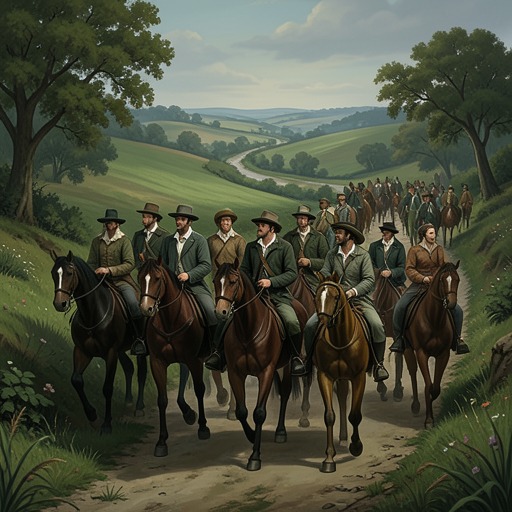
The Canterbury TalesThe Company of Canterbury Pilgrims is the temporary fellowship of travelers gathered for a shared ride from Southwark to Canterbury. Its decisive importance is structural: the pilgrimage gives strangers a common destination, while their overnight meeting at the Tabard creates the social setting in which the storytelling contest is proposed, accepted, and administered. The company is therefore both a devotional traveling party and the organizing institution of the work’s many voices.
Formation and Purpose
The company comes into being during the season when people desire to begin a pilgrimage and long to travel across foreign regions to distant shrines. Their destination is Canterbury, where they seek the blissful martyr whose aid has helped them in illness. The journey thus begins with a religious purpose, but the travelers’ fellowship gives that purpose a distinctly social form: devotion is pursued in company rather than isolation.
The immediate meeting occurs at night in Southwark, at the Tabard, where the narrator is already prepared to depart for Canterbury with a devout heart. About twenty-nine people have arrived at the inn, brought together by chance from different walks of life. They are not presented as a pre-existing order or formal society. Their unity is created by circumstance, shared intention, and the practical need to travel onward together.
The Tabard Gathering
The Tabard serves as the company’s first common space. Its chambers and stables are sufficiently wide, and the travelers are well served with the best available food. Hospitality allows the group to pause before departure and turns an accidental convergence into a recognizable fellowship. The inn is not merely a lodging place; it is the threshold between separate social lives and the collective road that follows.
The narrator speaks with each member about the trip and becomes a member of the fellowship. This detail gives the company an inclusive, participatory character. The narrator is both an observer who introduces the travelers and a participant bound to the same route. The company is consequently seen from within as well as described from outside, and its collective identity depends on conversation as much as on movement.
Rules and Governance
Before leaving, the pilgrims agree to rise early and take the road together. Their agreement supplies the first rule of the fellowship: coordinated departure. At supper, the Host welcomes everyone and begins serving the meal, establishing himself as the practical center of the gathering before he becomes its formal governor.
The Host proposes that each traveler tell two tales on the way to Canterbury and two more on the return journey, so that the ride will be enlivened by narrative. The arrangement transforms travel time into a regulated contest. Storytelling is not an accidental diversion but a collective obligation accepted by the group. Each pilgrim gives the Host an oath, and the company asks him to serve as governor, hear the tales, judge their quality, and decide who will receive the promised reward.
The Host’s authority is therefore consensual and functional. The travelers grant him office because the company needs a leader able to maintain order, direct the contest, and convert a loose fellowship into a temporary community with rules. His governance joins the material management of the road to the imaginative management of the tales.
Departure and Narrative Function
After supper, the pilgrims drink and go to bed. At dawn the Host rises and rouses them like a cock, gathering them together in a flock. The image emphasizes coordinated motion: the company that had assembled in separate rooms now becomes a single traveling body. Their departure fulfills the agreement made the previous evening and begins the movement toward Canterbury that will carry the stories forward.
The company’s journey also creates a frame capable of containing radically different kinds of narrative. Within the same traveling fellowship, tales of chivalry, religious suffering, marriage, divine judgment, death, deception, and comic appetite can follow one another without requiring the whole work to adopt one uniform tone. The common road supplies continuity while the individual tellers supply contrast.
Collective Identity and Significance
The Company of Canterbury Pilgrims is united by pilgrimage but marked by diversity. Its members come together through chance, lodge under one roof, eat at the same supper, swear to a common arrangement, and submit themselves to a shared governor. These acts produce a temporary social order without erasing the differences among the travelers.
Its significance lies in the tension between movement and assembly. The pilgrims are always preparing to leave, yet the stories require them to pause, listen, judge, and respond. The company makes that tension productive: a journey toward a holy shrine becomes a public exchange in which experience is classified, challenged, entertained, and morally tested. The fellowship ends neither as a permanent institution nor as a private circle, but as a mobile community whose shared road makes the entire storytelling contest possible.