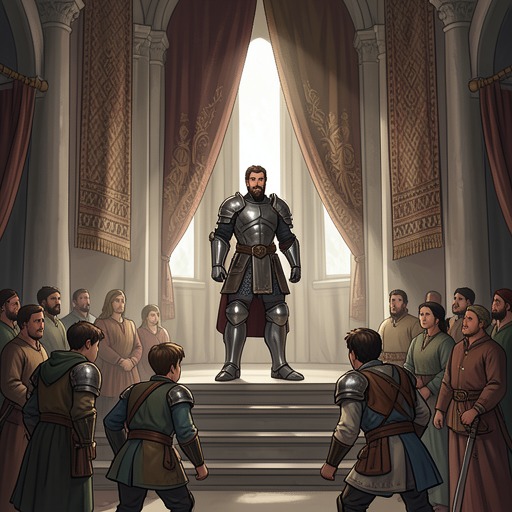
Creon
The Canterbury TalesCreon is the Theban king whose cruelty toward the dead gives the opening conflict its moral and political urgency. After Thebes has fallen under his rule, he refuses the defeated women the rites owed to their husbands, treats the corpses of slain lords with deliberate brutality, and thereby transforms grief into a claim for redress. His tyranny is answered by Theseus, who kills him in battle, defeats his forces, destroys the city, and returns the bones to the bereaved women for burial.
Identity and Rule
Creon is presented as the ruler of Thebes and as a figure defined less by personal complexity than by the abuse of sovereign power. He is described as “iniquitous and ireful, without pity,” a combination of injustice, anger, and emotional hardness that marks his government as tyrannical rather than merely militarily victorious. His authority over the city becomes an instrument for inflicting humiliation on those already made vulnerable by war.
The clearest expression of his rule is his treatment of the corpses of the women’s husbands. The bodies belong to defeated lords, but Creon’s hostility continues beyond their deaths: he has villainy inflicted upon them and denies the survivors the customary obsequies. The offense is therefore both physical and ritual. By preventing burial, Creon attacks the dead, the dignity of their families, and the social order that funeral rites are meant to preserve.
Conflict with Theseus
The women’s appeal places Creon at the center of a conflict that exceeds ordinary military rivalry. They have lost their husbands during the siege of Thebes, while Creon, now lord of the city, compounds that loss through despotic treatment of the bodies. Their suffering supplies Theseus with a cause: the campaign is not simply an attempt to seize territory but a response to tyranny and an effort to restore the dead to their kin.
Theseus confronts Creon in open battle. The account emphasizes that Theseus fights and kills the Theban king in a manner befitting a knight, presenting Creon’s defeat as the consequence of a direct contest between oppressive rule and martial justice. Creon’s men are then put to flight, so the king’s death also produces the collapse of his immediate military power.
Fall of Thebes and Aftermath
Creon’s defeat is followed by the assault and destruction of Thebes. Theseus wins the city and tears down its walls and structures, making the conquest a total reversal of the authority Creon had exercised from within them. The dismantling of the city gives material form to the end of his regime: the ruler who used the city’s power to dishonor the dead loses both his life and the urban stronghold that sustained him.
The most important consequence is restorative rather than destructive. Theseus gives the women back the bones of their slain kinsmen so that they can receive the funeral rites customary for the time. This act answers the specific wrong associated with Creon’s rule. The dead are not brought back, and the widows’ losses are not erased, but the violated boundary between death and dishonor is repaired through burial.
Narrative Function and Significance
Creon functions as the initiating antagonist of the Theban episode. His tyranny creates the chain of cause and consequence that leads from the women’s mourning to Theseus’s expedition, from the expedition to the battle, and from the battle to the fall of Thebes. Because the narrative gives him only a concentrated appearance, his significance lies in the structure of his actions and their consequences rather than in an extended interior portrait.
His treatment of the corpses also establishes a sharp contrast between power used as possession and power used as obligation. Creon possesses the city but fails in the duties expected of a ruler; Theseus conquers the city but is remembered in this episode for returning the dead to their families. The reversal suggests that legitimate authority is measured not only by victory or command, but by the protection of customary human and funerary obligations. Creon’s death thus closes the immediate tyranny while enabling the restoration that his rule had denied.