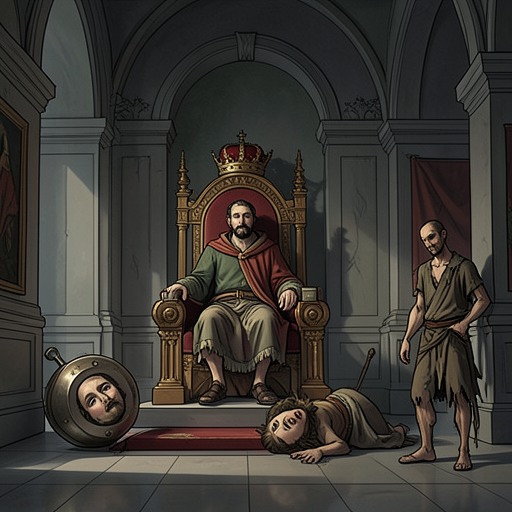
Daniel
The Canterbury TalesDaniel is presented in the poem as a figure of exceptional wisdom whose interpretive gift becomes evidence of divine power. Although he appears only through brief recollections and examples, those references place him within a chain of sacred deliverance: he is both the child who serves a king as an interpreter of dreams and the servant of God rescued from a cave of lions.
Identity and Sacred Reputation
Daniel is identified as one of the Israelites whom a conqueror had taken into slavery. Among them, he is distinguished as the wisest child, a description that joins youth to intellectual authority rather than treating wisdom as the privilege of age. His intelligence is immediately given a practical function: he begins serving as the king’s dream interpreter, occupying a position in which hidden meanings must be extracted from visions and translated into counsel.
The poem therefore makes Daniel’s wisdom more than a personal accomplishment. His ability to interpret dreams places him between the visible world of royal power and an unseen order that the king cannot master unaided. Daniel can read what others cannot, but the surrounding examples present this ability as inseparable from divine favor. His authority depends not simply on cleverness but on access to a truth beyond the court’s ordinary expertise.
Interpreter of Signs
Daniel’s interpretive role is reinforced through the episode of the mysterious writing that terrifies Belshazzar. The poem states that no magician in the land could interpret what the hand had written, yet Daniel explained it immediately. The contrast is decisive: the professional specialists of the kingdom possess status and technical reputation, but they fail before a sign whose meaning matters most, while Daniel succeeds.
This scene establishes a recurring opposition between a sign and the institutions that claim to control signs. The writing is physically present but intellectually unreadable; the magicians see it without understanding it. Daniel supplies the missing interpretation and thereby converts an alarming inscription into intelligible judgment. His gift exposes the limits of secular or courtly knowledge and confirms that genuine understanding arrives through a servant whose wisdom is aligned with God.
Deliverance from the Lions
Another allusion recalls Daniel as the young man saved from a dreadful cave in which everyone except the master was about to be eaten by the lion. The reference is used as a rhetorical example of miraculous rescue: the danger is extreme, the victim appears powerless, and survival cannot be explained by ordinary strength. Daniel’s name thus becomes shorthand for preservation when death seems inevitable.
The cave episode connects his physical deliverance with his larger identity as a witness to providence. The lion represents violent appetite and the apparent finality of death, while Daniel’s survival reverses the expected outcome. In the poem’s religious imagination, the rescue does not erase the threat; it demonstrates that divine power can operate within the threat and carry the faithful through it.
Narrative and Thematic Role
Daniel is not developed through a continuous personal plot in the supplied narrative. Instead, he functions as a compact exemplum invoked at moments when the story needs a precedent for divine knowledge or protection. His rescue from the lions supplies a model of deliverance, while his interpretation of royal dreams and Belshazzar’s writing supplies a model of truthful reading.
Together, these memories give Daniel a twofold symbolic role. He interprets what powerful people cannot understand, and he survives what ordinary human resources cannot overcome. The poem’s use of him binds interpretation and salvation together: hidden meaning and threatened life are both placed under divine governance, and Daniel’s remembered career makes that governance legible to the audience.