Death
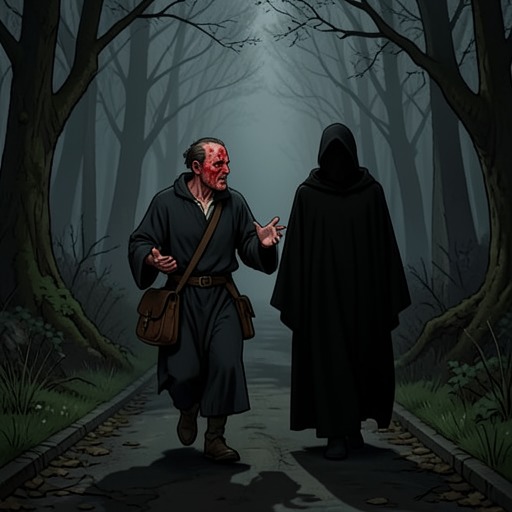
The Canterbury TalesDeath is both a physical ending and the governing truth of the world depicted in the tales. It closes Arcite’s life at the instant when love remains most vividly before him, removes King Alla from Constance after only about a year of happiness, and becomes the principle by which the narrator interprets worldly joy, suffering, and the instability of Fortune. Individual deaths produce sharply different griefs, but together they reveal a common condition: every person who has drawn breath must eventually die.
Death as Universal Condition
The narrator states the principle with deliberately plain logic: no person has ever lived on earth without some degree of life, and no person who has drawn breath can escape the time appointed for death. The world is described as a thoroughfare of woe through which human beings pass as pilgrims, so mortality is not an isolated interruption but part of the route itself. Death ends worldly care, yet the road toward it is marked by changing fortunes, with joy followed by woe and woe followed by renewed joy.
This general claim resists the illusion that rank, prosperity, or human power can provide security. In the narrator’s tragic examples, people who stand high may still fall and possess no remedy capable of bringing them out of adversity. Fortune may choose to flee, and no person can hold back her course. Death therefore belongs to the same moral pattern as the reversal of prosperity: both expose the weakness of trusting in conditions that appear stable because they are temporarily favorable.
Arcite’s Final Moment
Arcite’s death gives the abstract doctrine a concentrated human scene. His body visibly fails: his heart feels death, his eyes become glazed, and his breath falters. The narrative does not treat the end as a distant theological proposition; it watches the signs of life disappear in sequence, turning physical decline into a measured passage from presence to absence.
Even as his body gives way, Emily remains the last thing Arcite can see. His final words are addressed to her—“Mercy, Emily!”—so the end of his life is joined to the love and rivalry that have shaped the struggle over her. The plea compresses longing, vulnerability, and dependence into a final utterance. Arcite’s spirit then leaves its bodily dwelling, while the narrator refuses to claim knowledge of where it goes, admitting that such a destination lies beyond personal experience and abandoning divination rather than inventing certainty.
The scene thus combines emotional immediacy with epistemic restraint. The reader is allowed to witness the failing heart, glazed eyes, and failing breath, but not to receive a confident map of the spirit’s destination. Death marks the boundary not only of bodily life but also of what the narrator can responsibly say.
King Alla’s Death and Constance’s Grief
King Alla’s death unfolds differently. His marriage with Constance has brought joy and bliss, but that happiness lasts only a little while. After approximately a year, death takes Alla from the world. The brevity of the interval is decisive: even an apparently secure marital joy is shown to be temporary, and the household’s happiness is measured against the sudden power of mortality.
Constance responds with profound grief and heaviness. Her sorrow demonstrates that death does not merely remove the dead; it reorganizes the lives of those who remain. The narrative closes this episode with a prayer that God bless Alla’s soul, placing personal mourning within a Christian framework of intercession and hope. The prayer does not cancel Constance’s loss, but it gives the death a ritual and spiritual response rather than leaving grief without form.
Constance’s later posture intensifies this pattern of devotion. She falls to her knees and praises the Lord a hundred thousand times, while she and those bound to her in virtue and holy Christian conduct continue together without parting. The contrast is important: death creates separation in Alla’s case, but religious practice seeks continuity through praise, faithful conduct, and prayer. Mortality remains irrevocable, while devotion becomes a way of enduring its consequences.
Narrative Function and Moral Meaning
The narrator’s treatment of death moves between scene and exemplum. In Arcite’s case, the reader encounters a dying man at close range, with the beloved figure before his eyes and uncertainty at the threshold of the spirit’s departure. In the reflections on mortality, the individual scene broadens into a proposition about all human beings. In King Alla’s case, the proposition returns to a particular marriage, where the loss of one person transforms the emotional world of another.
The repeated movement from prosperity to sorrow gives death a structural role in the tales. Happiness is never allowed to become self-sufficient; it is exposed as vulnerable to a force that neither social position nor personal desire can restrain. The narrator therefore warns against blind trust in prosperity and directs attention to examples of people who rose, fell, and found no earthly remedy. Death is the most final form of that reversal, but it also clarifies the meaning of the journey: human beings are pilgrims moving through a world where every joy is provisional and every life has an appointed end.
At the same time, the narration avoids reducing death to a simple punishment. Arcite’s death follows an intensely personal history of love and conflict, while Alla’s death arrives after marital happiness and produces grief rather than a clearly stated moral fault. What unites these cases is not identical guilt but shared mortality. The narrative’s ethical force lies in that universality: the powerful and the vulnerable, the joyful and the sorrowing, all belong to the same human passage from life toward death.