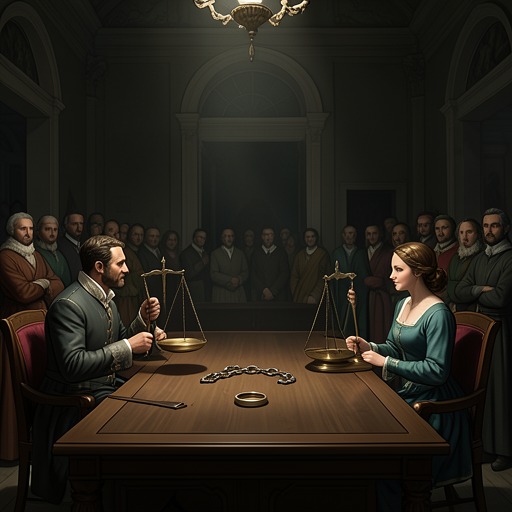
Griselda
The Canterbury TalesGriselda is the daughter of Janicula, a man regarded as the poorest inhabitant of his community, yet she becomes the wife of Walter and is publicly presented as his marchioness. Her decisive significance lies in the contrast between her lowly material origin and the moral stature attributed to her: she is formed by labor, chastity, sobriety, and obedience, then placed inside a marriage in which her husband repeatedly tests the limits of her submission. Her story turns patience in adversity into both an apparent ideal and an unsettling measure of how completely a woman may be required to surrender her will.
Identity and Background
Griselda grows up in poverty beside her father Janicula. The narrative does not treat her poverty as a sign of moral deficiency; instead, the labor demanded by her circumstances becomes part of her formation. Although she is young and unmarried, she is accustomed to hard work rather than idle leisure, and her inward character is described as sober and mature. Her virtue is presented as a settled habit, not as a decorative reputation acquired after she enters noble society.
This background gives Griselda a sharply defined social identity before her marriage. She is a peasant’s daughter whose worth is measured first through conduct, while the surrounding world measures status through rank, wealth, and public display. Her later elevation therefore does not erase Janicula or the conditions from which she comes. It makes the marriage a social transformation as well as a domestic one: a woman shaped by manual labor is transferred into the household of a ruler and expected to adapt without losing the obedience that first made her desirable.
Marriage and Public Recognition
Walter chooses Griselda and takes her from the village into his household. The marriage gives her a new public position, but that position is defined through Walter’s authority. When he brings her before the assembled people, he identifies her as his wife and asks those who love him to honor and love her. The declaration makes her status visible and instructs the community to treat her according to the rank Walter has granted her.
The scene also reveals the structure of her new power. Griselda is not shown claiming the title independently; Walter announces it, and the community receives it through him. Her advancement is therefore real but conditional, secured by the same marital sovereignty that can later threaten to withdraw it. The public recognition offers dignity while quietly establishing the terms of dependence under which that dignity exists.
Patience Under Trial
Griselda’s defining response to Walter’s conduct is composure. When she hears the words that recall the vows made on the day of her wedding in the village where she was born, neither her speech nor her expression changes. She appears not to be distressed. This outward stillness is the clearest sign of the discipline that governs her character: suffering does not produce an observable revolt, and humiliation does not interrupt her obedience.
Her silence is more than a momentary reaction. It becomes the practical principle by which she endures the marriage’s demands. The narrative makes her patience legible through what she does not do: she does not answer with anger, alter her countenance, or publicly challenge Walter’s authority. Such restraint can be read as extraordinary constancy, but it also exposes the severe gendered imbalance of the household. Walter’s will creates the crisis, while Griselda’s virtue is judged by the degree to which she can absorb its consequences without resistance.
The story thus makes marriage a test of sovereignty and service. Griselda’s value is praised as though obedience were evidence of inner strength, yet the circumstances of that obedience show how little formal power she possesses. Her patience gives her moral presence, but it does not give her control over the decisions that determine her status, family, or future.
Repudiation and Restoration
Walter’s treatment of Griselda eventually reaches the point of apparent repudiation. The marriage that raised her from poverty is presented as if it could be undone by the husband who created her public position. Her social identity becomes precarious because it depends upon his recognition, and the apparent rejection reverses the earlier scene in which he commanded the community to honor her.
The reversal is ultimately revealed as part of Walter’s testing rather than a final dissolution of the marriage. He restores Griselda and reunites the family, confirming that her place as wife has not truly been destroyed. The restoration resolves the outward crisis, but it does not cancel the violence of the test. Instead, it clarifies the story’s central paradox: Griselda’s constancy is rewarded, yet the authority that subjected her to suffering remains substantially intact.
Her return is therefore both a happy reintegration and an exposure of the marriage’s underlying terms. The woman who began as Janicula’s daughter and became a marchioness is restored to the noble household, but the narrative’s emphasis falls less on a change in Walter than on the endurance that allowed Griselda to survive his will. Her identity remains continuous across poverty, elevation, humiliation, and restoration.
Narrative Role and Significance
Griselda functions as the exemplary figure through whom the tale examines patience in adversity. Her movement through the plot is not a quest for independent power but a sequence of imposed changes: poverty gives way to rank, rank is threatened by repudiation, and the threatened family is finally restored. The causality of the story lies in Walter’s tests, while the moral drama lies in Griselda’s response to them.
She is also a figure of unsettling complexity. The narrative presents her as youthful and pure, yet inwardly mature; socially powerless, yet morally commanding; publicly elevated, yet dependent on a husband’s declaration. Her apparent simplicity conceals a difficult contradiction. If virtue is defined by the ability to endure every demand, then Griselda is exemplary. If marriage is also a relation between persons whose dignity should matter equally, her perfection becomes an indictment of the conditions imposed upon her.
The final restoration preserves both readings. Griselda is honored as a model of steadfastness, but the extremity of what she must endure prevents that honor from being uncomplicated. Her story asks whether patience is freely chosen virtue or a quality demanded from those denied the power to refuse. That unresolved tension gives Griselda her lasting force: she is not merely a passive sufferer, but the moral center of a plot that turns her silence, endurance, and restored position into a sustained examination of authority, class, gender, and the price of obedience.