Griselda–Janicula relationship
The Canterbury TalesThe Griselda–Janicula relationship presents filial duty as the moral ground beneath Griselda’s extraordinary rise from poverty to marquis’s wife. Janicula is not merely a background relative: his age, poverty, and dependence give concrete form to the household responsibilities that define Griselda before Walter enters her life, while Griselda’s care for him reveals the obedience and charity that later govern her conduct as a wife.
Poverty and Household Life
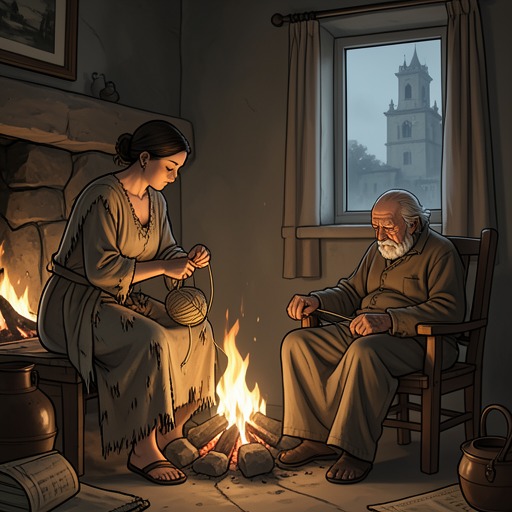
Janicula belongs to the poorest stratum of the community. The narrative describes him as a man who lived among poor people and was regarded as poorer than all the rest. His circumstances make the household economically fragile, so Griselda’s virtues are expressed through necessary work rather than through courtly display. She spins and watches their few sheep in the field, combining domestic labor with the care of the household’s scanty resources.
Griselda’s relationship with her father is therefore practical as well as affectionate. She cares for her poor, aged father with respect and charity, and her work sustains both of them. Her filial devotion is shown through repeated acts of attention: she works while maintaining the sheep, and she gives Janicula the diligent obedience expected from a reverent child. The relationship joins emotional loyalty to material responsibility, making poverty a condition in which love must take the form of labor.
Griselda’s Character Before Marriage
The narrator uses Janicula’s dependence to establish Griselda’s character before she is noticed by Walter. She possesses a sober and mature heart despite her youth, and her conduct toward her father provides the clearest evidence of that maturity. Her obedience is not presented as a single dramatic gesture but as a habitual way of life, formed through service to an elderly parent and through the management of a poor rural household.
This background gives special force to Walter’s attention. As he rides out hunting, he repeatedly casts his eye upon Griselda, whose visible poverty contrasts with the inward qualities that the narrative values. Her connection with Janicula allows the story to measure virtue independently from status: the daughter who cares for an aged father among the poor is later placed in a marquis’s household, but the moral discipline learned in the first household remains the basis of her conduct in the second.
Walter’s Approach to Janicula
Walter’s marriage decision brings the father-daughter relationship into direct contact with aristocratic power. Having observed Griselda, Walter asks her where her father is. Griselda answers reverently that Janicula is there, then immediately goes into the house and brings him to the marquis. Her response is marked by promptness and humility; she neither abandons her father in the moment of social opportunity nor treats him as an embarrassment to be concealed.
Walter then takes the aged man by the hand and draws him aside before speaking with him. This gesture places Janicula at the center of the marriage negotiation. Griselda’s future is not approached as an isolated romantic choice detached from her family circumstances; Walter must address the father whose household has formed her and whose poverty makes the proposed change in her life so momentous. Janicula’s presence also preserves the contrast between the girl’s humble origin and the authority of the man who seeks to raise her into a higher social station.
Social Ascent and Continuing Significance
The relationship marks the threshold between Griselda’s two worlds. Before Walter’s intervention, she is Janicula’s dutiful daughter, spinning, tending sheep, and caring for an aged father in extreme poverty. After Walter notices her and seeks her out, that same daughter is drawn toward a marriage that will transform her public position. The narrative does not make her new status erase her former identity; instead, the virtues displayed in service to Janicula explain why Walter finds her worthy of notice and why her later conduct is intelligible.
Janicula consequently functions as the human measure of Griselda’s origins. His poverty makes the social distance between father and marquis visible, while his age makes Griselda’s care a sustained obligation rather than a momentary act of kindness. Their relationship contributes to the story’s larger interest in whether true worth belongs to rank or to conduct. Griselda’s authority in the later household begins paradoxically in dependence: by faithfully serving Janicula, she demonstrates the patience, obedience, and charity that become central to her identity.
The bond also gives the marriage plot an ethical and familial dimension. Walter’s approach to Griselda necessarily passes through Janicula, and Griselda’s movement into aristocratic life is framed by her continued recognition of the father who shared her poverty. The relationship thus stands for the continuity of personal duty beneath radical changes in fortune: social elevation may alter Griselda’s place, but it does not cancel the household and filial obligations that first reveal her character.