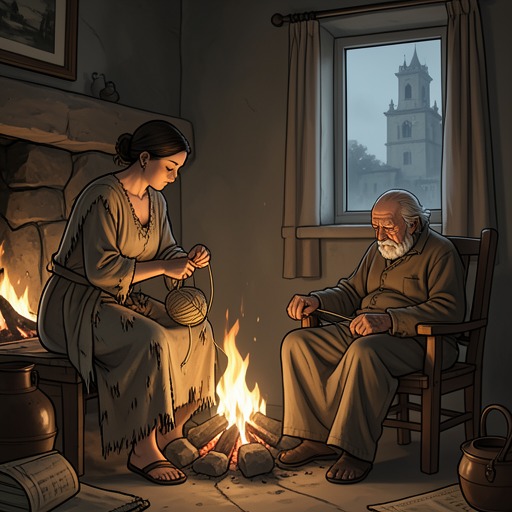
Griselda's restoration and family reunion
The Canterbury TalesGriselda's restoration and family reunion brings Walter's prolonged test of his wife's obedience to its decisive reversal. The woman he has repeatedly subjected to suffering is not discarded after all: her patience, cheerfulness, and absence of malice lead him to end the deception, restore her marital status, and return the children she believed lost. The episode turns apparent repudiation into recognition, converting private endurance into a public revelation of family identity.
The Final Test and Its Public Setting
The restoration follows the arrival of the Earl of Panik from Bologna, news of which spreads rapidly among the people. Walter uses the occasion to stage what appears to be a new marriage. Griselda comes at his command and kneels before him, greeting him with reverence and politeness. His declaration that the maiden is to marry him and must be received the next day with great ceremony makes the scene appear to confirm Griselda's complete displacement: she is treated not as the wife of the marquis but as a subordinate witness to the replacement of her own marriage.
This public setting matters because the humiliation is not confined to Walter and Griselda. The news has reached the people, and the planned ceremony gives Walter's apparent decision the force of a social fact. Griselda must face the spectacle while maintaining the same conduct that has marked her earlier trials. The event therefore tests not only whether she will remain obedient in private but whether her dignity can survive public repudiation.
Griselda's Endurance and Walter's Pity
Griselda cannot endure adversity merely because she is naturally hardened to it. The narrator contrasts her with a creature raised in poverty, suggesting that deprivation in childhood does not by itself explain the extraordinary composure she displays as a marquis's wife. Walter observes that she remains patient and cheerful, showing no malice despite the wrongs he has repeatedly inflicted upon her. Her behavior becomes the immediate cause of the reversal: what Walter sees is not rebellion, accusation, or revenge, but steadfastness sustained under the most degrading circumstances.
Walter's response is a movement from deliberate cruelty to pity. He feels distress at Griselda's wifely steadfastness and recognizes the moral weight of what he has done. The episode thus gives the test a limit. Walter's authority has allowed him to impose each ordeal, but Griselda's continued patience finally exposes the emotional cost of that authority to the man exercising it. The value at stake shifts from apparent marital loss to restored compassion, although the restoration does not erase the suffering that made it necessary.
Recognition and Restoration
Walter ends the deception with a direct announcement that Griselda should no longer be displeased or afraid. He tells her that she is and will remain his only wife, replacing the apparent divorce and impending remarriage with an explicit reaffirmation of their marriage. His speech is performative: the words do not merely describe a change but enact the public restoration of her position. The woman who had been summoned to witness another bride's triumph is named again as the legitimate wife.
He then reveals the identity of the supposed bride. The maiden whom Griselda had believed was destined to marry Walter is actually her daughter. Walter explains that the daughter is to be his wife only in appearance, while the other child, as he had always planned, is to be his heir. The revelation therefore restores two concealed relationships at once. The maiden is returned to Griselda as her child rather than taken from her as a rival, and the son is identified as the future inheritor of Walter's position.
The children had been preserved secretly while Walter waited to learn Griselda's purpose and will. This explanation clarifies the concealed design behind the earlier separations, but it also underscores the severity of the method: Walter's concern with testing her character required him to hide both children and their survival. Recognition consequently brings joy and injury together. The family has not been destroyed, yet its reunion is made possible only after Griselda has lived through the belief that her children were gone and that her husband would replace her.
The Family Reunion and Narrative Significance
When Griselda hears the truth, she faints from overwhelming joy. On rising, she calls her son and daughter to her side and takes them in her arms. The bodily gesture completes what Walter's declaration begins. Her identity as wife is restored by speech, but her identity as mother is restored through physical reunion. The fainting marks the force of the reversal: the accumulated grief of the tests gives way so suddenly to joy that she cannot remain standing, and the embrace makes the hidden family visible again.
The episode functions as the anagnorisis of Griselda's story, the recognition scene in which concealed identities and the true outcome of the supposed repudiation are disclosed. It also supplies the plot's strongest peripeteia. What seemed to be a final marriage arranged for Walter becomes the instrument of Griselda's restoration; what appeared to be the loss of her children becomes their return; and what looked like the end of her status as wife becomes a declaration that she is Walter's only wife. The family reunion provides emotional closure, but its moral tension remains. Griselda's patience is vindicated within the story, while Walter's tests are exposed as acts that required extraordinary suffering before pity and recognition could prevail.