Janicula
The Canterbury TalesJanicula is Griselda’s father and one of the poorest inhabitants of the rural community from which her story begins. His significance lies in the sharp contrast between his material condition and the worth later revealed in his daughter: the narrative places extreme poverty beside grace, labor beside aristocratic power, and a humble household beside the court that will eventually absorb it.
Identity and Background
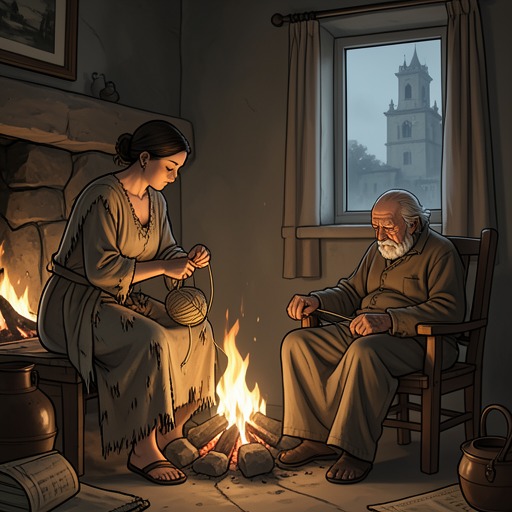
Janicula lives among poor people who sustain themselves through their own labor upon the land. The earth repays that work generously, yet he is described as the poorest of them all, marking him as a figure of genuine deprivation rather than merely modest circumstances. His name is supplied plainly, without a title or inherited distinction, and his social position is defined by poverty and agricultural labor.
The account nevertheless refuses to equate poverty with spiritual worthlessness. In the same movement that emphasizes Janicula’s desperate material condition, it presents divine grace as capable of entering even an ox’s small stall. That image places sacred value in the lowliest setting and prepares the moral reversal through which Janicula’s daughter, Griselda, will be recognized for qualities unavailable through birth or wealth.
Relation to Griselda
Griselda is introduced as Janicula’s fair young daughter. Their relationship establishes the domestic and social foundation of the tale: before she is connected with a marquis, she belongs to a poor household and to a father whose position stands at the very bottom of the local community. Her later transformation in status therefore cannot be separated from the memory of Janicula and the laboring world from which she comes.
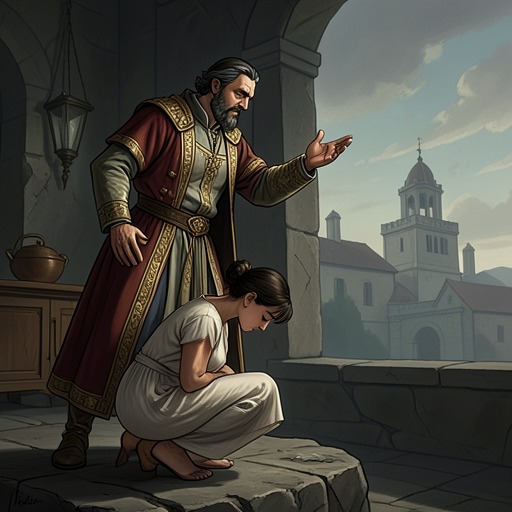
When Griselda is summoned into the marquis’s presence, she goes inside the house and seeks her father, then brings him to the marquis. This action keeps Janicula from remaining an abstract genealogical detail. He is physically drawn into the decisive encounter through which his daughter’s life changes, and the movement from the house to the marquis’s presence dramatizes the passage from rural poverty into aristocratic authority.
Entry into the Marquis’s Household
The marquis takes Janicula by the hand and draws him aside before addressing him. Even in this brief scene, the gesture gives the aged man a visible place within the proceedings surrounding Griselda’s marriage. The marquis does not simply marry Griselda while leaving her father outside the frame; Janicula is acknowledged and incorporated into the arrangement.
After the marriage, the marquis has his daughter married regally to a fine lord, described as one of the worthiest in Italy. Janicula’s own fate is equally important: his wife’s old father is kept at the marquis’s court in peace and rest. The movement is therefore not only Griselda’s elevation. Her father is removed from the hardship of his former poverty and granted security within the household of power.
Change and Ending
Janicula’s social trajectory runs from extreme poverty to protected residence at court. The narrative does not give him an independent quest, speech, or series of trials; his change occurs through his daughter’s marriage and through the marquis’s decision to preserve him within the new household. His fortune is consequently relational rather than self-generated, but the account treats his inclusion as part of the marriage’s proper completion.
He remains at court until his soul leaves his body. This quiet ending contrasts with the severe tests later imposed upon Griselda and with the emotional violence surrounding her marriage. Janicula’s old age concludes in peace and rest rather than renewed displacement, making his final condition a muted but significant counterpoint to the instability that marks his daughter’s life.
Narrative Significance
Janicula functions as the human measure of Griselda’s rise. By identifying him as the poorest of the poor and then placing him within an Italian marquis’s court, the narrative makes social rank appear radically unstable: birth and wealth determine position, but they do not exhaust the meaning of a person. His presence also gives concrete form to the tale’s insistence that grace may appear in the humblest dwelling.
At the same time, Janicula’s limited characterization is purposeful. He is not developed as a competing agent within the plot; instead, his labor, poverty, age, and eventual protection frame Griselda’s movement between worlds. His final preservation at court confirms that her elevation does not require the complete erasure of her origins. The poor father remains part of the aristocratic household, carrying the memory of the land and the ox’s stall into the marquis’s court.