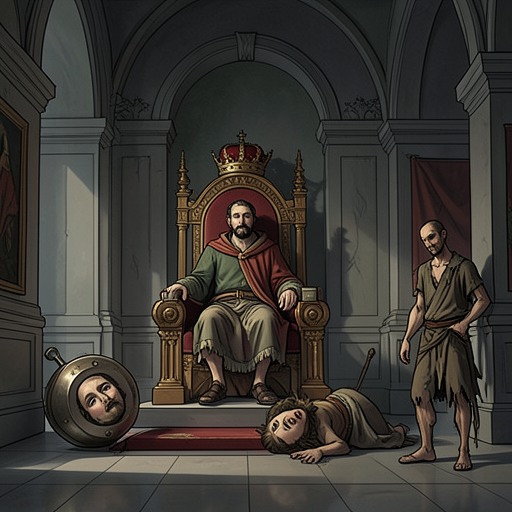
Julius Caesar
The Canterbury TalesJulius Caesar appears in the tale’s catalogue of exemplary historical figures as a conqueror whose rise from humble origins to imperial majesty is matched by the scale of his fall. His story gives concrete shape to the poem’s meditation on Fortune: wisdom, courage, labor, conquest, diplomacy, and public honor can carry a man to the summit, yet none can guarantee that he will remain there.
Identity and Ascent
Julius Caesar is presented as a man who rose “From humble bed to royal majesty.” His advancement is attributed not to inherited ease but to a combination of wisdom, manhood, and strenuous labor. The formulation makes his life an emblem of ascent through ability and effort, while also preparing the contrast between his earned eminence and the instability that later destroys it.
His power expands across both land and sea. He wins the whole West through force of arms and diplomacy, and he converts each conquered realm into a tributary of Rome. Conquest therefore operates in two forms: military strength subdues territories, while political skill incorporates them into an imperial system. The culmination of this process is his elevation as emperor of Rome, a change in status that makes his later reversal proportionately more severe.
Triumph and Fortune’s Reversal
After Pompey the Great has been defeated, Julius Caesar returns to Rome crowned with laurel in celebration of victory. The laurel marks the public and ceremonial confirmation of his success: his campaigns have produced not merely private fame but a spectacle of civic triumph. Yet the narrative places this return immediately beside the warning that Fortune will become his adversary. The crown thus becomes an image of unstable prosperity, suspended at the very moment it appears most secure.
The account treats Fortune as the force that turns achievement toward disaster rather than as a simple measure of Caesar’s worth. His wisdom, courage, labor, territories, and imperial office remain real, but they cannot prevent the change in circumstance. Caesar’s trajectory consequently belongs to the poem’s recurring pattern of prosperity followed by sudden descent: the higher the public position, the more devastating the reversal when Fortune withdraws her favor.
Assassination at the Capitol
Brutus and Cassius plan Julius Caesar’s death and choose daggers as the means. The conspiracy converts political opposition into intimate physical violence, and the Capitol becomes the decisive setting for the attack. Caesar goes there one day, as he often does, and the conspirators fall upon him without delay. The ordinary familiarity of his visit sharpens the shock: a customary movement through a public center becomes the threshold of murder.
The narrative emphasizes the number of blows while preserving uncertainty about the exact count, stating that he groaned after one stroke, or perhaps two if the full account is trustworthy. This detail does not lessen the violence; it compresses it. A life of vast campaigns and imperial labor ends in a few dagger wounds, and the uncertainty surrounding the count adds to the traditional, almost legendary quality of the recollection.
Courage, Probity, and Moral Memory
Julius Caesar is remembered as “so manly hearted” and as possessing deep love for stately probity. His final characterization is therefore ethical as well as political. The narrative does not present him only as a conqueror or emperor; it preserves an image of courage and principled public conduct that remains meaningful even when Fortune has stripped away his power.
That moral emphasis changes the meaning of his death. Caesar’s assassination is not merely the termination of an ambitious career but the violent overthrow of a figure associated with dignity and probity. The contrast between his public virtue and the daggers of Brutus and Cassius intensifies the injustice of the reversal, while his composure under mortal injury allows his character to survive the collapse of his political position.
Narrative and Thematic Significance
Julius Caesar’s episode functions as a compact moral exemplum within the tale’s larger meditation on the instability of worldly greatness. His life follows a severe arc: humble beginnings, labor and wisdom, conquest by land and sea, diplomatic consolidation, imperial elevation, laurel-crowned return, conspiracy, and death at the Capitol. Each stage enlarges the next, so that the final fall measures the full height of the earlier ascent.
The character also extends the poem’s historical range beyond the pilgrims and their immediate social world. Around him, the narrative surveys figures drawn from political and military history, including Pompey the Great, to show that no rank or achievement places a person outside the reach of Fortune. Julius Caesar’s lasting role is therefore double. He embodies the grandeur of human action—courage, labor, strategy, and the making of an empire—while his death exposes the fragility of every worldly order built upon those achievements.