Marriage as sovereignty and service
The Canterbury TalesMarriage as sovereignty and service is a model of intimate government built on a deliberate paradox: the husband may preserve the title and appearance of mastery, yet the marriage can endure only when he refuses to exercise mastery against his wife’s will. The concept joins hierarchy to reciprocity, making service in love compatible with lordship in marriage and treating mutual obedience—not coercion—as the condition of lasting affection.
Definition and Central Paradox
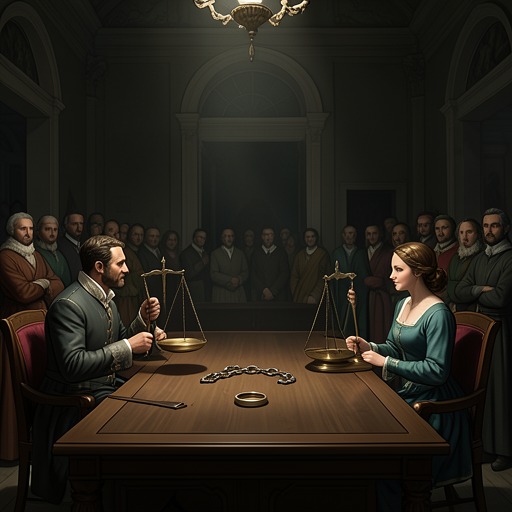
The idea begins from the medieval expectation that husbands possess lordship over wives. Yet the marriage described here qualifies that expectation through a knightly promise. The husband freely pledges that neither by day nor by night will he impose mastery against his wife’s will or display jealousy. He will be obedient to whatever she wishes, as a lover should be obedient to his lady. His only reservation is that he will retain sovereignty in name, because surrendering even that public designation might bring shame upon his rank.
This distinction separates authority as a social sign from authority as coercive practice. Sovereignty remains visible as a matter of status, but the daily conduct of the marriage is governed by restraint. The husband’s title protects the conventions of degree; his obedience protects the relationship itself. The arrangement therefore does not erase hierarchy so much as empty its power to command when command would violate the wife’s will.
Mutual Obedience and the Freedom of Love
The narrator broadens the private agreement into a general principle of friendship and marriage: friends must obey one another if they wish their friendship to last. The claim shifts obedience from a one-sided duty into a reciprocal discipline. A relation survives not because one party permanently rules, but because each recognizes the other’s claims and limits the use of power.
Love is presented as intrinsically free and therefore incompatible with mastery imposed upon it. When mastery enters, the God of Love immediately departs; love is compared to a spirit that cannot be held by force. Women, in particular, are said to desire liberty rather than the condition of a thrall. The passage thus makes freedom not an ornament of marriage but its operating necessity: affection cannot be secured through surveillance, jealousy, or constraint, because the very attempt to control it destroys the consent that gives it life.
Service in Love, Lordship in Marriage
The fullest formulation appears in the description of a humble and wise accord. The wife takes the husband as both her servant and her lord—servant in love, lord in marriage. The paired terms are not treated as mutually exclusive. He serves her through devotion and obedience, while she acknowledges his formal position within the institution of marriage. His lordship is therefore matched by servitude, and servitude becomes a chosen expression of love rather than a sign of degradation.
The model depends on keeping the two spheres distinct without allowing either to cancel the other. Publicly, the husband remains a lord; emotionally and practically, he submits himself to the beloved. The marriage becomes a reciprocal exchange of roles: she can accept his authority because it is not used to crush her liberty, and he can serve her without believing that service destroys his dignity. The language of sovereignty is retained, but its moral content is transformed by voluntary restraint.
Arveragus and Dorigen as the Exemplary Case
The concept is embodied in the marriage compact of Arveragus and Dorigen. Their arrangement is not merely a romantic sentiment but a formal pledge about how power will be exercised. Arveragus promises not to subject Dorigen to unwanted mastery, while preserving sovereignty in name; Dorigen responds with humility and assures him that he will find no fault in her. Their relief after making the agreement suggests that the marriage becomes secure when each understands the limits and obligations accepted by the other.
The relationship is later tested by Dorigen’s vow and the demands placed upon it. When Arveragus learns of the danger that his wife may become false to her promise, the narrative presents his response as a consequence of nobility: he would rather endure sorrow and distress than have his wife break her vow. This reaction confirms the earlier compact. He does not use marital authority to compel her, even when her fidelity to another promise threatens his own happiness. His conduct makes the principle concrete: the husband’s sovereignty is ethically legitimate only when it protects, rather than overrides, the wife’s pledged word.
Ethical and Narrative Significance
Marriage as sovereignty and service turns a potentially oppressive hierarchy into a test of character. Arveragus is judged not by how effectively he commands but by whether he can bear the pain of refusing to command. Dorigen’s freedom is likewise tied to responsibility, since liberty does not mean that promises have no force. The marriage joins two demands that can conflict—personal sovereignty and fidelity to one’s word—and asks whether love can preserve both without resorting to domination.
The concept also supplies a premise for the surrounding marital narrative: coercive mastery leads to the loss of love, while reciprocal obedience makes intimacy possible. Its language remains shaped by social hierarchy, but its moral emphasis falls on consent, courtesy, and self-restraint. The result is neither a simple rejection of sovereignty nor an uncomplicated defense of it. Instead, marriage is imagined as a negotiated structure in which the husband keeps lordship as a name, practices service as a lover, and proves his nobility by allowing the woman’s will and promises to remain genuinely her own.