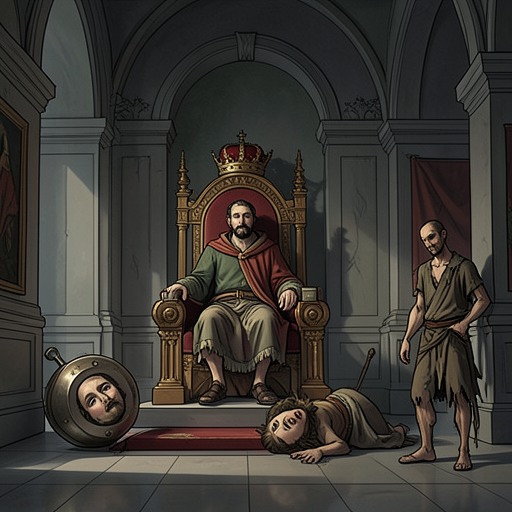
Nebuchadnezzar
The Canterbury TalesNebuchadnezzar embodies the danger of worldly sovereignty when royal power mistakes itself for permanence. Introduced through images of the throne, treasure, scepter, and majesty, he rises as a figure of concentrated authority, only to be brought low by the divine power he had assumed could never dispossess him. His story turns political grandeur into a moral demonstration: dominion may appear absolute, but it remains subject to judgment.
Identity and Royal Grandeur
Nebuchadnezzar is described as a great and mighty ruler whose authority is expressed through the visible emblems of kingship. The catalogue of his throne, precious treasure, glorious scepter, and royal majesty gives his power a ceremonial and almost material weight. He is not merely powerful in private; his identity is built around the public display of sovereignty and the splendor attached to it.
His pride is intensified by the scale of his ambition. He has a golden statue made measuring sixty by seven cubits and decrees that the image must be honored by both young and old. The statue externalizes his conception of power: authority is turned into a colossal object, and obedience is demanded from an entire population. The command reveals a ruler who seeks not only political submission but also symbolic confirmation of his greatness.
Pride and Defiance
Nebuchadnezzar is characterized as arrogant and vain. He believes that God, who sits in majesty, will never take his domain from him, so his confidence is not simply self-admiration but a challenge to divine sovereignty. The king treats the possession of territory as proof that it cannot be revoked, confusing present prosperity with permanent entitlement.
This defiance is set against the resistance of Daniel and Daniel's two young comrades, who will not assent to the king's demand concerning the golden image. Their refusal establishes the moral boundary that Nebuchadnezzar attempts to erase. His command represents the coercive force of royal power, while their dissent shows that obedience to a human ruler has limits when it conflicts with religious fidelity.
The Fall into Bestial Existence
Nebuchadnezzar's punishment reverses the signs of his kingship. The ruler associated with a throne, a scepter, treasure, and human ceremony is reduced to a grotesque bodily condition: his hair grows like eagle feathers, and his nails lengthen until they resemble bird claws. The transformation strips away the ordered, cultivated appearance of royal humanity and replaces it with an exaggerated, animal-like body.
The physical change makes his loss of authority visible. His former majesty had depended on a controlled public image, but the punishment gives him a body that crosses the boundary between human and beast. In this reversal, the king's own inflated conception of greatness is answered by an existence in which ordinary human status and royal distinction have collapsed. The narrative therefore makes humiliation not abstract but bodily, presenting the fall from sovereignty as a change in appearance, condition, and perceived identity.
Restoration and Recognition
The punishment does not last forever. After a period of degradation, God relieves Nebuchadnezzar and restores his sense. The recovery is marked not by renewed boasting but by tears, thanks, and lasting fear of God. His restored reason becomes a form of moral knowledge: he now understands that the power he treated as secure can be withdrawn and returned by a higher authority.
The ending thus reverses the beginning without simply repeating it. Nebuchadnezzar regains his senses, but the experience has altered the meaning of kingship. The throne and royal symbols no longer stand as evidence of autonomous power; they are measured against divine judgment. His tears and gratitude provide the final contrast with his earlier vanity, turning a proud monarch into a chastened witness to the limits of earthly dominion.
Narrative and Moral Significance
Nebuchadnezzar's episode functions as a compact moral exemplum organized around descent and restoration. It follows a clear pattern of excessive elevation, divine reversal, bodily abasement, and recognition. The golden statue represents the outward expansion of pride, while the feathered hair and claw-like nails represent its inward collapse. The story's force comes from the distance between these images and the speed with which one condition replaces the other.
His arc also gives the surrounding narrative a language for judging rank. The book repeatedly observes pilgrims according to occupation, clothing, manners, and social presentation, but Nebuchadnezzar's story supplies the largest possible version of that concern: even a king's public magnificence can be dismantled. The account does not deny the reality of royal power; it insists that power is contingent, and that humility begins when a ruler recognizes the authority beyond his own.