Palamon
The Canterbury TalesPalamon is a Theban knight whose story binds together war, imprisonment, rivalry, love, and eventual marriage. Found grievously wounded among the dead after Theseus’s victory, he lies beside Arcite, and the two are recognized as young knights who had fought together under identical, richly worked arms. Their survival does not bring release. Instead, they are carried into a tower and held there in anguish, where Palamon’s life becomes the first stage of a long conflict between loyalty to his companion and devotion to Emily.
Identity and Captivity
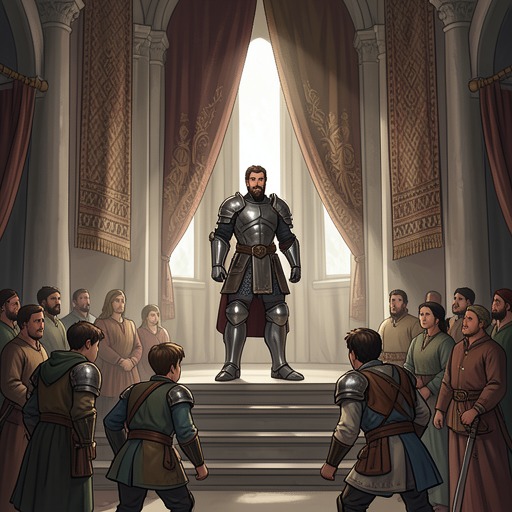
Palamon enters the narrative as a defeated enemy rather than as an independently described courtly hero. The pillagers discover him and Arcite in the battlefield heap, neither clearly alive nor dead, their wounds making the uncertainty of their fate literal. Their matching arms establish shared origin and military fellowship, while their capture places that fellowship under the authority of Theseus. The tower is therefore more than a prison: it is the enclosed space in which comradeship will be tested, desire will arise, and the conditions of their future rivalry will be created.
The imprisonment is presented as enduring and apparently hopeless. Palamon and Arcite remain confined in the tower, and no amount of gold can purchase an end to their plight. The image sharply contrasts the value of wealth with the power of political captivity: even noble warriors cannot convert their social standing into freedom. Palamon’s later claim that he has just escaped from prison confirms that his confinement is not a brief interruption but the defining pressure from which his next choices emerge.
Love, Recognition, and Rivalry
The central turn in Palamon’s plot comes when he sees Emily and falls in love with her. The imprisonment that had kept him and Arcite together becomes the setting for their division, because both men desire the same woman. Palamon’s attachment is not treated as a private feeling that can remain separate from action. It immediately produces rivalry, reorganizing the meaning of his friendship with Arcite and converting shared military identity into direct opposition.
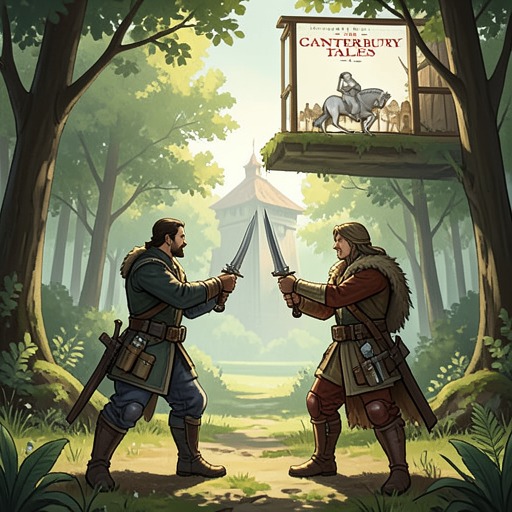
When Palamon confronts Arcite after his escape, he identifies himself plainly as Arcite’s mortal foe. He declares that Emily is his lady and insists that he alone shall love her. The declaration matters because Palamon is unarmed and has only just escaped confinement; he possesses neither the practical security nor the public authority needed to enforce his claim. His language therefore turns inward conviction into an outward challenge. Love supplies the objective, while the old bond between the two knights supplies the emotional force of the conflict.
Palamon’s conflict with Arcite is consequently double-edged. Arcite is at once the companion with whom he shared battle and imprisonment and the rival who prevents him from possessing Emily. Palamon does not simply abandon the earlier relationship; rather, the same closeness that makes Arcite an intimate equal also makes him the one opponent who can fully understand and threaten his desire. Their rivalry gives the love story its tragic structure, since Emily becomes the focus through which friendship is broken and martial honor is redirected.
From Escape to Marriage
Palamon’s escape marks a reversal in the value of freedom. Release from the tower should restore his ability to act, yet the moment of freedom exposes him to mortal conflict. His movement out of imprisonment does not end suffering; it transfers the struggle from a fixed architectural enclosure into the contested world of love, honor, and combat. The escape thus functions as a threshold: Palamon leaves one form of bondage while entering another created by his attachment to Emily.
The rivalry eventually reaches its formal resolution through the larger sequence of combat and judgment surrounding Emily. Palamon’s fate is not defined solely by private desire, because his claim must pass through the public structures of knightly competition and political authority. The story’s conclusion gives him what the tower denied him: a settled place in society. Palamon and Emily end together in marriage, and the narrative closes with the assertion that no word between husband and wife will ever be marked by jealousy or strife.
This ending transforms the earlier pattern of rivalry. Palamon’s love begins as a possessive declaration made against Arcite, but it concludes in a marriage represented as peaceful and enduring. The final emphasis on the absence of jealousy is especially important because jealousy had been one of the forces that turned companionship into hostility. The marriage therefore does not merely reward Palamon with Emily; it closes the emotional circuit opened by the two knights’ competing claims.
Narrative Role and Significance
Palamon is the principal bearer of the tale’s movement from captivity through desire toward social incorporation. His first appearance emphasizes bodily vulnerability and political defeat; his decisive speech emphasizes identity, choice, and antagonism; his ending restores him to honor through marriage. The sequence gives his character a distinctly tragic-romantic shape in which freedom, love, and conflict are never separate values. Each gain creates a new danger before the final settlement is reached.
His relationship with Arcite also makes Palamon a figure of divided allegiance. The two men begin as visibly matched warriors, are imprisoned together, and then become enemies because they love the same woman. Palamon’s insistence that he is Arcite’s mortal foe shows how completely the logic of courtly love can invade the code of chivalry: the knight who once shared a battlefield with his companion now treats that companion as the chief obstacle to his desired future.
At the close, however, Palamon is not left as a permanent figure of grievance or rivalry. His story ends with Emily and with the possibility of harmony after violence. The narrator’s blessing of the company gives the conclusion a communal and almost ceremonial tone, placing Palamon’s private conflict within the larger social world of the pilgrims and making his marriage the final confirmation that the tale’s cycle of imprisonment, competition, and loss has reached its intended resolution.