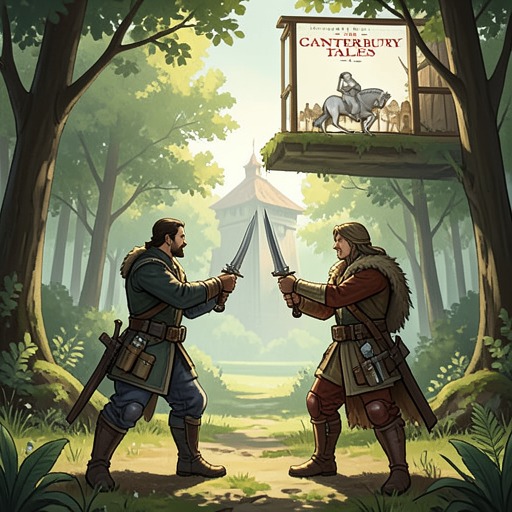
Palamon's escape from prison
The Canterbury TalesPalamon's escape from prison is the turning point that releases a captive knight back into the dangerous world of action. After years of confinement, he uses calculated deception rather than force: he drugs his jailer, slips out after midnight, and flees toward a temporary refuge. The escape does not resolve his difficulties. It gives him mobility, but also places him under immediate pressure to remain hidden while he plans a return to Thebes and a renewed challenge to Theseus.
Captivity and the Moment of Release
The escape occurs in the seventh year of Palamon's imprisonment. The narrator adds a more exact dating from the old books: it was the third night in May. That precision gives the episode the character of a recorded historical turn, while the narration also leaves room for the pressure of destiny, suggesting that chance and inevitability meet in the same event. Palamon has endured captivity long enough for release to become both an urgent practical necessity and a point of narrative reversal.
The decisive assistance comes from a friend. Soon after midnight, Palamon succeeds in leaving his prison cell and runs from the town as quickly as he can. His freedom is therefore neither a public pardon nor a lawful restoration of status. It is a covert escape dependent on secrecy, timing, and alliance. The night protects him, but only temporarily: dawn is approaching, and he knows that exposure would destroy the advantage he has gained.
Deception, Narcotics, and Flight
Palamon's method reveals a notably practical side of his character. He has given his jailer drink, carefully mixing honeyed wine with narcotics described as fine Theban opium. The jailer's helplessness is produced not by an open contest of strength but by a concealed alteration of the drink. Palamon thus converts the ordinary instrument of confinement—the jailer's vigilance—into the means of overcoming confinement.
The episode also reverses the moral and physical arrangement of the prison. The jailer, who should control the captive's movements, is rendered incapable of controlling anything, while Palamon, still officially a prisoner, becomes the agent who determines the course of the night. Yet the escape remains precarious. The sedated guard cannot protect him from discovery, and Palamon's flight must be followed by concealment rather than triumph. His success is real, but it is fragile and incomplete.
The Grove as Temporary Refuge
With the night already short and day coming quickly, Palamon approaches a grove standing apart from the town. He intends to hide there throughout the day and continue his journey when night falls. The grove is therefore more than a picturesque setting: it is a tactical interval between imprisonment and open action, an intermediate space in which the fugitive can survive the immediate danger of pursuit.
His movement from cell to town and from town to grove creates a sequence of narrowing possibilities. The prison has been escaped, but daylight threatens to expose him; the open road offers movement, but not safety; the grove supplies concealment, but only until night returns. Palamon's freedom is consequently measured by his ability to manage time and visibility. He has left one enclosed space only to depend upon another, less permanent form of shelter.
Intended Return and Renewed Conflict
Palamon's destination is Thebes. Once there, he plans to appeal to all his friends for help in marching against Theseus in war. The escape therefore has a clear strategic objective. Palamon is not merely running away from captivity; he is attempting to rebuild the political and military resources needed to confront the power that has kept him imprisoned and that stands behind the larger conflict.
This plan gives the episode its characteristic combination of escape and revenge. The immediate objective is survival through concealment, while the larger objective is return, alliance, and armed resistance. The movement is outward from the prison but backward toward Thebes, where Palamon expects friendship to become military support. His flight thus opens a new campaign rather than ending the old struggle.
Narrative Significance
As a plot action, Palamon's escape follows the logic of an escape narrative while bending it toward renewed rivalry and war. The captive crosses a threshold through ingenuity, but the reward is only provisional freedom. The sedated jailer, the honeyed wine, the Theban opium, the midnight departure, and the grove before dawn make the reversal concrete: captivity changes into concealment, and concealment prepares confrontation.
The event also establishes the rhythm that will govern Palamon's next phase. Night permits action; day demands hiding; the return of night promises further movement. Freedom is not represented as rest but as a dangerous interval requiring continual calculation. By placing Palamon between the prison he has left and the war he hopes to begin, the episode makes escape the hinge between enforced passivity and deliberate, if hazardous, agency.