Palamon–Arcite relationship
The Canterbury TalesThe Palamon–Arcite relationship is the central bond of kinship, fellowship, jealousy, and rivalry between two Theban knights. Found together among the dead and wounded after Theseus’s victory, they are initially presented as paired figures whose identical, richly worked arms make their solidarity visible. Their relationship is then transformed by their common love for Emily: what begins as mutual loyalty becomes a contest in which each treats the other as the chief obstacle to happiness. The resulting conflict gives the story its tragic structure, because the rivals are never simply strangers or enemies; they remain bound by the intimacy that their competition violates.
Identity and Foundation
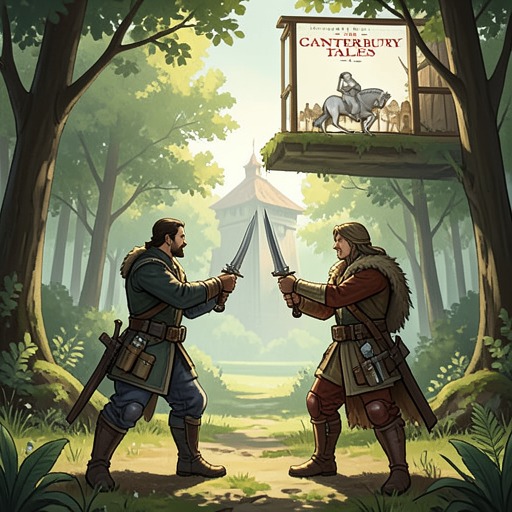
Palamon and Arcite enter the narrative together rather than separately. After the battle, pillagers search the heap of bodies and discover two youthful knights lying side by side, grievously wounded. Their arms are identical and richly wrought, a concrete sign of their shared status and likeness before either name is given. One is identified as Arcite and the other as Palamon; at first they appear neither fully alive nor definitively dead. The scene makes their relationship legible through physical pairing: they have fought on the same side, suffered the same defeat, and been found in the same precarious condition.
Their kinship is not incidental. Palamon later calls Arcite his cousin and his brother, language that places their quarrel inside a familial and quasi-fraternal bond. The terms matter because they establish what is at stake when affection becomes hostility. Arcite is not merely a competing knight whose ambition happens to cross Palamon’s path. He is the person from whom loyalty and truthfulness are expected most strongly, so any deception or betrayal wounds both personal trust and family obligation.
From Fellowship to Rivalry
The decisive change in the relationship comes when both knights’ attachment to Emily turns shared identity into mutual exclusion. Their conflict is not presented as a casual disagreement. Palamon accuses Arcite of being a traitor and of having lied to him, explicitly grounding the charge in their relationship as cousins and brothers. The accusation shows that Palamon understands the rivalry as a breach of an older compact: Arcite has not only sought the same beloved but has violated the loyalty that should govern their bond.
Arcite’s response reveals the opposite pressure within the relationship. When he hears and recognizes Palamon, spite courses through his heart, and he draws himself fiercely like a lion. The recognition does not restore fellowship; it intensifies the threat. Palamon’s identity makes the emotional danger immediate, because the rival is also the intimate companion whose claim cannot be dismissed as an outsider’s intrusion. The scene therefore turns recognition into a reversal: knowing exactly who stands before him produces anger rather than reconciliation.
Their rivalry has the shape of a tragic double pursuit. Each knight’s desire for Emily is strengthened by the other’s presence, while the other’s claim appears to cancel his own. The relationship becomes a conflict between two incompatible definitions of loyalty: loyalty to a cousin and brother requires restraint, but loyalty to personal love demands that neither yield. The narrative does not present the competition as a simple movement from friendship to hatred. Instead, the intensity of the hatred is generated by the depth of the prior attachment.
Conflict, Jealousy, and Recognition
The language surrounding the quarrel repeatedly preserves the relationship even as it describes its damage. Palamon says that he and his cousin have endured strife and rancor for many days because of love and jealousy. The duration of the conflict shows that the antagonism is sustained rather than momentary, while the reference to jealousy identifies the emotional mechanism that keeps it alive. Neither knight can regard Emily’s love as independent of the other’s claim; the beloved becomes the point at which family intimacy is measured against competitive honor.
Palamon’s charge that Arcite has lied gives the rivalry a moral dimension. The issue is not only who will possess Emily or prevail in combat, but whether Arcite has used their closeness against him. Because the accusation comes from a recognized relative, it carries the force of disappointed trust. Arcite’s fierce reaction, meanwhile, suggests that the relationship has become psychologically split between brotherly attachment and adversarial self-assertion. Each knight treats the other as both a loved relation and an enemy who must be overcome.
This doubleness makes their conflict more severe than an ordinary contest between suitors. Their matching arms at their first appearance anticipate a pair whose identities are structurally linked, while their later confrontation dramatizes the destructive consequences of that likeness. They are rivals precisely because they are so closely matched: neither can easily accept the other’s superiority, and neither can escape the other’s claim to shared history.
Tragic Course and Emotional Residue
The relationship’s trajectory follows a movement from bodily and martial companionship to emotional estrangement and open hostility. At the beginning, Palamon and Arcite lie together after battle, their wounds and weapons making them almost interchangeable. Later, the sight of one by the other provokes spite, and their kinship becomes part of the language of accusation. The same bond that once joined them now supplies the standard by which each judges the other’s conduct.
Yet the relationship is not emptied of affection by the rivalry. The very need to name Arcite as cousin and brother indicates that Palamon continues to experience him through the old bond, even while condemning him. Arcite’s violent reaction likewise has the force of a personal wound rather than an impersonal military calculation. Their antagonism retains the emotional intensity of intimacy: betrayal matters because trust once mattered, and jealousy burns because the rival remains deeply significant.
The tragedy therefore lies not simply in competition for Emily but in the failure to reconcile love, kinship, and honor. Palamon and Arcite cannot preserve their brotherhood while accepting the other’s claim, and the story drives them toward a contest in which victory over the rival becomes inseparable from the hope of possessing Emily. Their relationship embodies a tragic reversal: the qualities that make them admirable companions—courage, loyalty, passion, and commitment—also make compromise increasingly difficult.
Narrative Significance
Palamon and Arcite function as paired protagonists whose relationship organizes the story’s emotional and dramatic architecture. Their first appearance as two wounded knights found side by side establishes symmetry; their later quarrel breaks that symmetry into opposition. The recurrence of paired images and fraternal language keeps the earlier fellowship present within the later rivalry, preventing the reader from treating the conflict as a clean division between hero and villain.
The relationship also gives personal form to the story’s larger concerns with chivalry and courtly love. Both knights are committed to the code of the warrior and to the claims of love, but their commitments collide when the beloved becomes the object of a contest between equals. Their behavior asks whether honor can survive when a knight’s strongest obligation to a fellow warrior is challenged by desire. The answer suggested by their conflict is tragic rather than doctrinal: ideals that appear compatible in abstraction become mutually destructive when embodied by two men who are both relatives and competitors.
Most importantly, the Palamon–Arcite relationship makes the plot’s violence intelligible as a crisis of attachment. Their rivalry is not the disappearance of kinship but its deformation. They fight because they remain bound to one another through family, memory, likeness, and shared love; the enemy is therefore also the brother whose recognition carries the greatest emotional charge. Their story endures as a study of how affection can become the ground of jealousy, and how a bond may persist even when the people within it turn against each other.