Russell
The Canterbury TalesRussell is the black-marked fox whose predatory intelligence drives the central crisis of the animal tale. He has lived for three years in the grove near the widow’s cottage, and the narrator presents that long residence as part of a design extending from the beginning. Russell is therefore not a random animal crossing the story’s path: he is an established danger concealed within a familiar landscape, an iniquitous and sly presence waiting for the right lapse in vigilance.
Identity and Setting
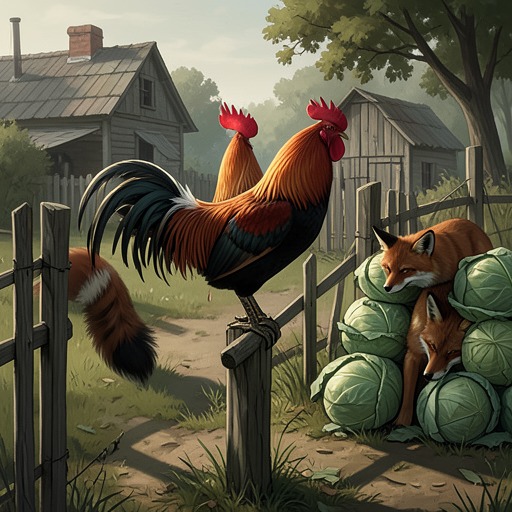
Russell’s identity is defined by contrast. He is a fox, an animal conventionally associated with stealth and cunning, but the narrative gives him a personal name, Sir Russell, that lends his pursuit a mock-chivalric polish. The title sounds courteous while his conduct is openly predatory. His black markings make him visually distinctive, and his three years in the nearby grove establish patience as one of his practical advantages. He knows the ground, remains close to the widow’s cottage, and waits until his intended victim is exposed.
The grove functions as both refuge and trap. It is near enough to the cottage for Russell to observe the domestic world of Chanticleer and Pertelote, yet secluded enough to conceal an ambush. His continued habitation there turns the setting into a latent threat: the danger is present before the attack begins, though the rooster does not respond to it in time.
Capture of Chanticleer
Russell acts at the precise moment when Chanticleer abandons caution. Chanticleer rises high upon his toes, stretches his neck, closes both eyes, and begins to crow loudly. The gesture displays confidence, but it also makes him physically and mentally vulnerable. With his eyes shut and his attention given to his own crowing, he cannot see the fox approach.
Russell springs from concealment without delay. He grabs Chanticleer by the throat and carries him on his back toward the woodland. No one pursues him at first, so the attack appears successful: the fox has converted concealment into movement, and the rooster’s public display into an opportunity for abduction. The violence is sudden, but it depends on a carefully prepared condition. Russell does not overpower Chanticleer through a prolonged contest; he waits until the rooster’s self-assurance has removed the need for a fair contest at all.
Speech, Deception, and Reversal
Russell’s strength is not limited to physical surprise. After capturing Chanticleer, he becomes involved in a verbal exchange in which the fox declares that he will eat the cock in front of those who challenge him. His reply presents the threatened killing as deliberate and immediate, reinforcing his apparent control over the captive. The words are an extension of the capture: Russell uses language to make the danger seem settled.
Yet the speech produces the opposite result. As Russell speaks, Chanticleer breaks nimbly from the fox’s jaws and flies immediately into a tree. The reversal exposes a weakness beneath Russell’s confidence. His grip is secure only while his attention remains fixed on physical domination; once he speaks, the captive finds the opening required for escape. The episode makes eloquence double-edged. Russell’s words help sustain the illusion of mastery, but they also interrupt the action that mastery requires.
When Russell sees his captive flee, he laments and addresses Chanticleer with an admission that he has wronged him and caused him to fear. The belated regret cannot restore the lost opportunity. The fox’s acknowledgment comes after the decisive consequence: Chanticleer is already beyond his reach, safe in a tree. Russell can recognize the failure, but recognition arrives only after cunning has been defeated by a moment of distraction.
Conflict with Chanticleer
Russell and Chanticleer form a sharply organized predator-and-prey opposition. Russell possesses concealment, patience, and the ability to seize an unsuspecting victim. Chanticleer initially possesses neither adequate vigilance nor physical security; his closed eyes and loud crowing make him easy to locate and capture. The balance changes only when the fox’s confidence becomes excessive.
The conflict is consequently a contest of attention as much as of strength. Russell watches Chanticleer before the attack, while Chanticleer fails to watch Russell. After the capture, however, the fox’s own speech divides his attention, and Chanticleer takes advantage of that division. The story’s pursuit structure thus reverses itself: the fox begins as the observer and pursuer, but ends as the animal watching his prey escape.
Narrative Role and Significance
Russell is a compact, largely single-purpose character, but that flatness suits the moral architecture of the tale. He embodies sly predation, the danger hidden near ordinary life, and the instability of apparent victory. His black markings, his long residence in the grove, his sudden leap, and his grasp at Chanticleer’s throat all make the threat concrete rather than abstract.
The fox also makes the tale’s warning about speech visible. Chanticleer’s crowing helps bring about his capture, while Russell’s speaking helps bring about his release. In both cases, voice becomes action with consequences: sound draws danger, and words create the opening through which danger is escaped. Russell’s defeat does not erase his cunning; it shows that cunning can be undone when it becomes self-satisfied. His pursuit gives the story its sharpest reversal, turning a seemingly completed capture into an escape and leaving Russell as the memorable figure of predatory intelligence frustrated by its own display.