Saluzzo
The Canterbury TalesSaluzzo is presented as a noble and fertile region in northern Italy and serves as the geographical frame for the tale of Walter and Griselda. More than a place-name, it is the territorial foundation of Walter’s marquisate and the social space in which his choice of an obscure bride, his severe tests of her obedience, and the eventual restoration of his household acquire their full political and moral force.
Setting and Description
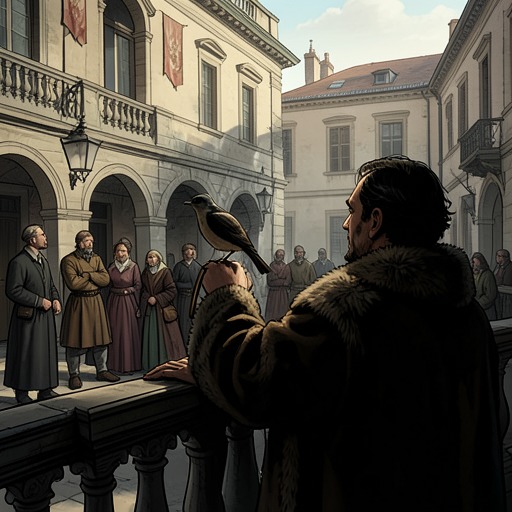
Saluzzo lies along the western side of Italy, below Mount Viso, whose summit is described as cold and elevated. The surrounding plain is pleasant and exceptionally fertile, while the region is said to contain many other sights worthy of admiration. This combination of productive lowland and imposing mountain backdrop gives Saluzzo both material richness and visual grandeur: it is a land capable of sustaining prosperity, yet marked by a natural elevation that suits the dignity of its ruling house.
The tale introduces Saluzzo through a formal geographical preface associated with Petrarch. That introduction speaks of Piedmont, Saluzzo, and the Apennines before the narrative itself begins. The effect is to establish the story within a recognizable Italian landscape rather than in an abstract moral nowhere. Geography supplies the tale with a concrete political setting, while the elevated description lends the marquis’s actions the scale and solemnity of a courtly example.
Political Territory and Social Order
Saluzzo is governed by a marquis whose forebears had ruled the land from ancient days. His command is obeyed, and his authority appears inseparable from the region’s inherited order. The landscape therefore functions as a territorial expression of aristocratic continuity: the fertility of the plain, the grandeur of the mountains, and the obedience of the inhabitants all reinforce the sense of a stable principality organized around hereditary power.
That stability also sharpens the social contrast at the center of the tale. Walter is the lord of a noble region, whereas Griselda comes from a poor household. When he decides that he will marry only the woman who has impressed him through her virtue, he selects her despite her lack of rank and wealth. Saluzzo makes this decision politically consequential. Walter does not merely marry within a private village; he brings a woman from the margins of his territory into the ruling household of a prosperous land.
The Setting of Walter and Griselda’s Marriage
The marriage of Walter and Griselda unfolds against Saluzzo’s prosperity and ceremonial hierarchy. Her elevation from poverty to the marquis’s wife reverses the social expectations attached to the region, but it does not erase those expectations. Her new position remains defined by Walter’s sovereignty, and the contrast between her former condition and her public role makes every later test more severe.
For many years, Walter and Griselda live in high prosperity, peacefully and happily. Saluzzo thus becomes the setting not only of ordeal but also of apparent domestic success. Its resources and political order support a flourishing household, and Griselda’s conduct allows that household to appear harmonious. Yet the same prosperity exposes the imbalance within the marriage: the marquis possesses the power to determine the family’s fate, while Griselda’s security depends on continued submission to his will.
Narrative Significance
Saluzzo gives the tale a structure in which public authority and private obedience cannot be separated. Walter’s conduct as husband is shaped by the same command that governs his land, and the marquisate’s orderly prosperity provides the backdrop against which his exercises of power become visible. The region’s fertility suggests abundance, but the marriage plot repeatedly tests whether abundance can coexist with domination without producing suffering.
As the named homeland of Walter’s rule, Saluzzo also magnifies the tale’s reversals. Griselda’s movement from poverty into the marquis’s household is a social ascent within the region; Walter’s later treatment of her threatens to cast her back outside that order; and the eventual restoration of the family confirms the household’s public continuity. Saluzzo therefore remains constant as territory while identities within it change. Its enduring landscape frames a story in which rank, marriage, and obedience are repeatedly rearranged, making the region an essential spatial counterpart to the tale’s inquiry into sovereignty and patience.