Southwark
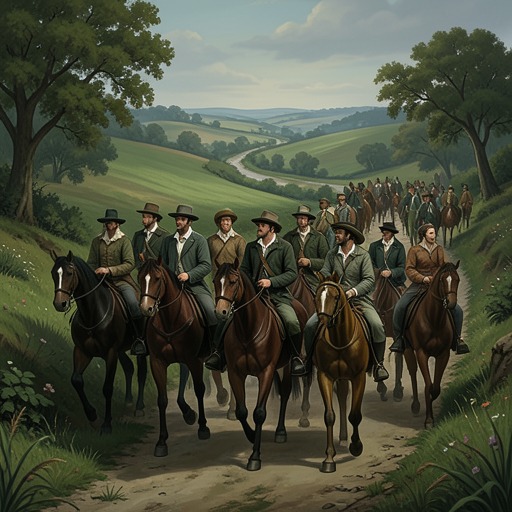
The Canterbury TalesSouthwark is the point of departure for The Canterbury Pilgrimage and the first social space in which the pilgrims become a company. At the Tabard, the journey is still anticipated rather than completed: people driven by the desire to travel to distant shrines assemble before setting out for Canterbury, and the narrator uses their meeting to introduce the social variety, occupations, clothing, and moral reputations that will shape the work.
Setting and Departure
Southwark appears at the opening as the place where the narrator is staying when the impulse toward pilgrimage becomes action. One day, while prepared to leave with a devout heart, he is at the Tabard and joins the movement toward Canterbury. The location therefore links private religious intention with public travel: the pilgrims do not begin as an abstract list of characters, but as travelers gathered at a real hostelry before a shared road.
The Tabard is identified as a pleasant inn near the Bell, and the assembled group is explicitly described as a company of pilgrims. Their destination is the shrine of the blissful martyr in Canterbury, whose help is associated with healing illness. Southwark consequently marks the threshold between ordinary life and sacred travel, the moment when separate intentions become a collective undertaking.
The Pilgrims Gathered There
The narrator pauses in Southwark to explain the pilgrims’ circumstances as they seemed to him, making the inn a site of observation as well as departure. The company includes figures whose identities are signaled through rank, profession, appearance, and conduct. The Knight is presented in a plain, rusty fustian tunic despite possessing good horses; Madam Eglantine, a Prioress, is distinguished by her coy smile and the oath “By Saint Loy!”; and the Sergeant of the Law is described as a wise and prudent man often seen at Saint Paul’s porch.
Other members make the social range of the gathering still more visible. A Haberdasher, Dyer, Carpenter, Tapestry Maker, and Weaver appear together in the livery of their guild. The Wife of Bath comes from near Bath and is identified as an excellent clothier, though she is a little deaf. The Miller and The Reeve are present alongside The Summoner, The Pardoner, The Manciple, and the narrator himself. Southwark thus functions as a compressed social map: occupational groups, religious personnel, legal authority, rural officeholders, and travelers meet in one enclosed setting before the road disperses them into stories.
The Inn as Narrative Threshold
The gathering at Southwark establishes the work’s narrative mechanism. Once the company is assembled at the Tabard, the journey can become a storytelling contest rather than merely a sequence of religious movements. The proposed entertainment is to tell tales on the way to Canterbury, with the pilgrims’ speech providing the means by which their identities will continue to unfold after their physical departure.
This arrangement gives Southwark a double role. It is a geographic starting point, but it is also the first stage of the discourse that organizes the whole pilgrimage. The narrator first presents the travelers from the outside—by degree, array, profession, and number—and then allows the company to generate its own succession of voices. The inn is therefore both a waiting place and a narrative engine: its temporary community produces the stories that will carry the travelers toward their shrine.
Social and Religious Significance
The religious purpose of the journey remains central. The pilgrims desire to travel abroad to renowned shrines, and their particular destination is Canterbury, where they seek the blissful martyr who helped people when they were ill. At the same time, the Southwark gathering places devotion beside social display. Clothing, office, professional affiliation, and reputation are already visible before any tale is told, so the pilgrimage begins with an examination of how people occupy and perform their social identities.
The location also carries a broader institutional resonance. The company includes a legal officer associated with Saint Paul’s and a priest whose conduct is measured against the duty of providing an example to his “sheep,” while later discussion invokes the mediation of the Pope in matters involving the church and chivalry. Within that larger religious and political world, Southwark is the practical urban threshold through which travelers pass before entering the sacred itinerary. Its importance lies less in a detailed physical description than in the convergence it enables: commerce, law, religious office, craft, rank, and popular sociability meet there before becoming literature.
Lasting Narrative Role
Although the company soon moves onward, Southwark remains foundational because every later tale is structurally rooted in this departure. The narrator’s account of the pilgrims begins there, the storytelling proposal is made there, and the group’s identities are first arranged there for the reader’s attention. The place converts a collection of individuals into a temporary fellowship with a common destination and a shared rule of entertainment.
Southwark is consequently more than a backdrop. It is the threshold at which pilgrimage becomes narrative, observation becomes characterization, and social difference becomes the material of an extended literary exchange. The road to Canterbury begins at the Tabard, but the imaginative journey of the work begins with the company assembled in Southwark.