The Canon's alchemical fraud
The Canterbury TalesThe Canon's alchemical fraud is an embedded tale of manufactured wonder and calculated exploitation. A deceitful Canon visits a priest, arranges a demonstration that appears to turn base material into silver, and then converts the priest's astonishment into a sale. The fraud succeeds not because the process is genuine, but because the Canon controls the materials, the timing, and the priest's access to knowledge; once the payment is made, the supposed miracle vanishes with its maker.
The Canon and the Opportunity for Deception
The episode begins when the deceitful Canon comes to visit a priest who is lying in his room and asks him for a loan. The request establishes the Canon's immediate need for money, but it also places him before a man whose curiosity can be turned into profit. Rather than presenting himself simply as a beggar or debtor, the Canon offers access to an extraordinary craft. His financial urgency therefore becomes inseparable from a performance of expertise.
The priest is not merely shown a finished object. He is drawn into a process and encouraged to observe each stage as though he were being admitted to a secret discipline. That arrangement gives the fraud its persuasive force. The Canon makes the priest feel that friendship and trust have opened a door normally closed to outsiders, while the priest's position as witness allows him to mistake proximity for proof.
The Counterfeit Demonstration
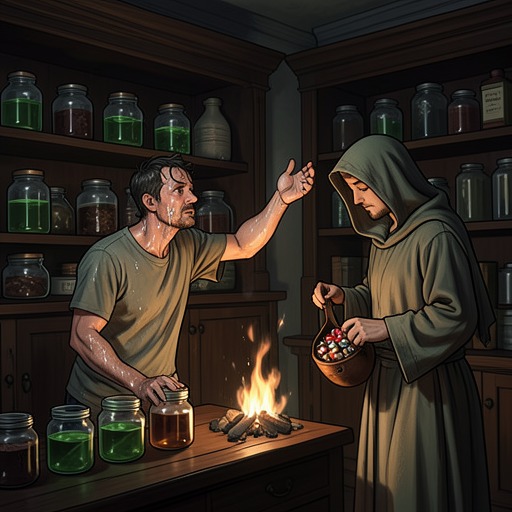
The Canon orders the priest's servant to fetch quicksilver, asking for two or three ounces. The instruction sounds precise and technical, and that precision helps disguise the absence of genuine knowledge. In the course of the operation, the Canon uses an imitation coal taken from his coat. The object is crucial to the trick because it introduces a prepared material into what the priest believes is an open experiment.
The imitation coal is placed over the work, and the Canon lets the priest watch while it burns. When it has done so, the filings hidden within it fall into the crucible below. The apparent transformation is thus produced by concealment rather than by any power to alter metals. The material object that seemed to be an ordinary piece of fuel suddenly becomes the mechanism of deception: its hidden contents emerge at exactly the moment when the priest expects the process to yield a result.
The Canon then returns to the operation without delay. He takes chalkstone and shapes it like a mold, continuing to give the appearance of a repeatable method rather than a single lucky marvel. The movement from the burning coal to the shaped chalkstone makes the performance look systematic. Each manipulated object reassures the priest that there is a formula behind what he has seen, even though the objects have been selected and prepared to create that impression.
Silver, Proof, and the Price of Knowledge
The priest brings up a silver bar from the crucible and asks that the bars be taken to a goldsmith for examination. His suggestion shows that the result has crossed from spectacle into practical value. The metal is no longer merely evidence within the room; it is treated as something that can enter the marketplace and be publicly tested. The priest's confidence has therefore become commercial expectation.
The priest then asks the Canon what price he would charge to teach him the method. He appeals to the love of God and presents his request as a claim upon the Canon's goodwill, but the Canon answers in strictly commercial terms. The formula, he says, costs forty pounds, though it would surely be worth more were it not for the friendship previously shown to him. The language of friendship functions as a sales device: it makes the high price appear to be a special favor rather than the extraction of money from a credulous buyer.
The priest immediately finds the sum in nobles and pays the Canon every pound. The payment completes the fraud's central reversal. What began as a loan requested by the visitor ends with the priest financing the visitor's disappearance and purchasing a recipe whose apparent proof was already contained in the Canon's prepared materials. The priest believes he has acquired a means of producing wealth, but he has instead paid for access to a staged illusion.
Disappearance and Aftermath
The Canon leaves with the money, offering thanks and wishing the priest good luck. Afterward, the priest never sees him again. The disappearance is not an incidental ending but the final step in the method: the Canon must be absent before the priest can test the formula independently and discover that the demonstration cannot be reproduced.
The priest does eventually have an opportunity to try the formula, but the result is disastrous for his hopes. The narrative does not describe a successful continuation of the process; instead, the Canon's departure leaves the priest with a purchased promise and no teacher to answer questions or correct the deception. The fraud is complete because the proof was temporary, the formula was worthless, and the seller had already converted appearance into payment.
Narrative and Thematic Significance
The episode makes Alchemy inseparable from avarice, misplaced trust, and the desire to possess secret power. The Canon's trick depends on the priest wanting more than silver: he wants the means to reproduce silver, to move from spectator to master. That ambition makes him vulnerable to a performance in which technical language, hidden materials, and apparent repetition substitute for truth.
The story also makes fraud visible through things. Quicksilver, imitation coal, filings, chalkstone, the crucible, and the silver bar are not neutral props. Each object governs what the priest can see and what he cannot see. The coal appears to be fuel but conceals the source of the supposed miracle; the crucible appears to reveal the truth but merely receives what has been planted; the silver bar appears to authenticate the process but proves only that the Canon prepared a convincing result. The material world becomes persuasive precisely because its evidence has been manipulated.
Finally, the episode's direct, self-conscious storytelling reinforces its moral design. The narrator announces that the tale will proceed to its conclusion about how a Canon brought the priest to confusion, then follows the fraud through its requests, staged operations, bargain, payment, and disappearance. The sequence leaves no redemptive transformation and no genuine discovery behind. It ends instead with the exposure of a counterfeit promise whose glitter lies in the demonstration, while its real product is the priest's loss.