The Monk
The Canterbury TalesThe Monk is one of the pilgrims whose presence makes the pilgrimage a cross-section of medieval society. He combines the authority of a religious office with the habits of a wealthy horseman: instead of embodying withdrawal from the world, he rides out into it with the energy of an aristocratic sportsman. His characterization is therefore built on a sharp contradiction between institutional discipline and personal appetite, a contradiction that becomes central when he tells a succession of stories about fallen rulers and the instability of worldly fortune.
Identity and Introduction
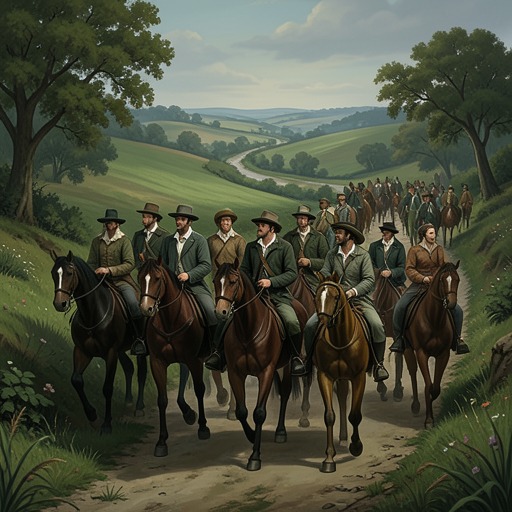
The narrator presents The Monk as a fine outrider associated with monastic lands and as a notably manly figure, someone who appears capable of becoming an abbot. That description grants him status, physical confidence, and administrative importance, but it does not make him seem spiritually self-denying. His identity is immediately legible through movement and equipment: he is a mounted churchman rather than a secluded figure confined to his cell.
His clothing and possessions reinforce this worldly image. He has good horses, yet he is not richly dressed; his fustian tunic is visibly rusty. The contrast suggests a man whose resources are invested less in polished ceremonial clothing than in the active life of riding and hunting. He is not introduced as a poor or powerless cleric, but as a substantial religious landholder whose chosen display is practical, mobile, and martial in tone.
Rejection of Monastic Discipline
The Monk’s defining principle is his refusal to treat older monastic rules as binding in every circumstance. Saint Maurus and Saint Benedict are said to have established regulations that he considers old and excessively strict. He dismisses the expectation that such rules should govern his own behavior, implying that the demands of the contemporary world, or his own preferred way of living, require another standard.
This rejection is not merely theoretical. The Monk’s activities make his distance from strict observance visible. He is described as a pricker and keeps greyhounds swift enough to pursue the hare. Hunting is presented as a serious pleasure, supported by animals, mobility, and the equipment of a practiced rider. His life thus turns monastic wealth outward: the resources connected with religious lands sustain sport and status rather than only prayer, study, or enclosure.
The Monk’s Tale and Its Interruption
Later in the pilgrimage narrative, The Monk is identified as the teller of The Monk’s Tale. Harry Bailly addresses him as “Sir Monk—or Sir Piers by your name” and asks him to expound something for the company. The form of address acknowledges both his clerical identity and his individual name, while the request places him within the social economy of the storytelling contest: every pilgrim is expected to contribute a narrative to the shared journey.
The tales he offers are not light adventures but grave accounts shaped by reversals, suffering, and the collapse of worldly prosperity. The surviving evidence identifies the sequence as a formal section of the work and shows that the Host eventually reacts against its tone. Harry Bailly objects that such talk is not worth a butterfly and finds no sport or game in it. He therefore asks The Monk to turn to something else, interrupting the performance before its solemnity can dominate the gathering.
The interruption reveals an important difference between The Monk’s narrative temperament and the company’s immediate social purpose. His stories direct attention toward disaster and moral reflection, whereas the pilgrims’ fellowship depends on movement, variety, and pleasure. The Monk can command the floor through his clerical dignity and his grave subject matter, but Harry Bailly retains the practical authority to regulate the contest’s mood.
Social and Narrative Significance
The Monk’s characterization belongs to the pilgrimage’s broader method of describing people through occupation, clothing, conduct, and social position. He stands beside a company that includes religious figures, artisans, officials, merchants, and other travelers, so his presence helps make visible the range of roles gathered together. His rusty fustian, good horses, hunting dogs, and monastic office form a compact social portrait: religious privilege and secular appetite coexist in one body.
The character is especially effective because the narrator does not need to accuse him through an explicit legal or theological argument. The details perform the criticism. A churchman who resists Saint Benedict’s rules, rides well, and hunts with greyhounds appears to have adapted religion to a gentleman’s life. At the same time, the text does not reduce him to simple hypocrisy: he remains a learned and authoritative teller, and his chosen tragedies show an interest in the moral consequences of power, fortune, and human failure.
The Monk consequently links two kinds of worldly display. His riding and hunting make him resemble a secular lord, while his tale claims the elevated seriousness of historical and moral instruction. Harry Bailly’s rebuke exposes the tension between those modes. The Monk may prefer solemn exempla, but the storytelling contest requires responsiveness to an audience, and the audience insists that moral gravity be balanced by entertainment. His narrative role therefore extends the same contradiction that defines his social identity: he is a religious man who lives as a worldly rider and a grave storyteller whose performance is judged by a company seeking pleasure.