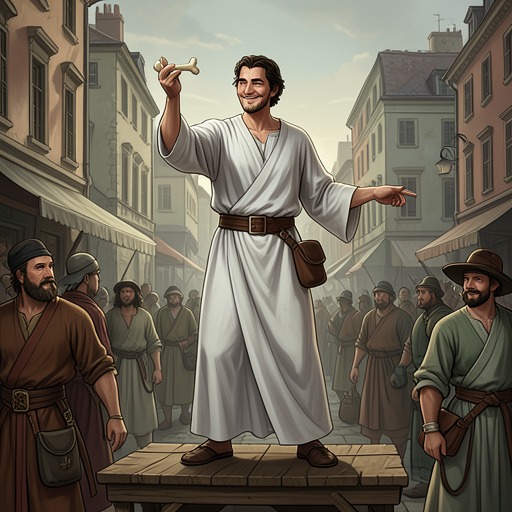
The Old Man
The Canterbury TalesThe Old Man is the aged wanderer whom the Three Rioters meet beside a stile, and whose strange account of endless life directs them to the oak where they discover the means of their own destruction. He embodies the paradox at the heart of the tale: the young men pursue Death as an object of revenge, while the old man longs for Death precisely because life has become an unending burden. His encounter with them turns their abstract vow into a fatal, concrete quest.
Identity and Appearance
The Old Man appears suddenly after the Three Rioters have gone not fully half a mile from the place where they set out. As they are about to cross a stile, they meet a poor old man who greets them meekly and calls them “My lords,” adding a prayer that God watch over them. His poverty, humility, and age place him at a sharp social and moral contrast with the revelers, whose drunken fellowship has already hardened into an oath to find and kill Death.
The narrative emphasizes that he is wrapped so that only his face is visible. When questioned about this covering and about the reason he has lived to such an extreme age, he does not answer with ordinary biography. Instead, his appearance becomes part of an enigma: he is recognizable as a human being, yet his condition seems to place him outside the normal limits of human time. The Three Rioters treat him with suspicion and hostility, but his meek greeting and patient replies make their violence appear still more reckless.
The Burden of Endless Life
The Old Man explains that he could walk as far as Hindustan and still fail to find a person willing to exchange ages with him. The statement presents his longevity not as a blessing but as a condition from which no ordinary human companion can rescue him. He is condemned to remain an old man for as long as God wills, and the religious wording places his fate under divine duration rather than personal control.
His central complaint is that Death will not take his life. Because Death refuses him, he continues to wander as a restless wretch, going from place to place and knocking with his staff early and late. The staff gives his condition a repeated physical rhythm: each step and knock marks another continuation of the life he wishes to end. In contrast, the Three Rioters are young, impatient, and eager to turn Death into a victim. The Old Man has already reached the condition they imagine they can impose on someone else; he wants the encounter they seek, but cannot obtain it.
The Encounter with the Three Rioters
The meeting exposes two opposed attitudes toward mortality. The Three Rioters speak to the old man as though age makes him contemptible and perhaps complicit with Death. Their accusation joins the old man and Death together as having one intent, namely to kill the young. The charge is unjust on its face, since the old man has presented himself as a sufferer rather than an agent, but it reveals the revelers’ need to make death an enemy that can be confronted and blamed.
The Old Man does not answer their aggression by defending himself at length. Instead, he accepts the terms of their desire and gives them a direction. If they truly wish to find Death, he tells them to turn up a crooked way. He says that he left Death in a grove and identifies a nearby oak as the place where they will find him. The reply is both practical and ominous. It converts an impossible search into a destination and makes the old man an unwitting-seeming guide—or, at the level of the tale’s moral design, an instrument through which their oath is fulfilled.
The Oak and the Fatal Quest
The Old Man’s final gesture points toward the oak. He tells the revelers to look at it, assures them that Death is there, and closes with the blessing, “God save you, as he ransomed all mankind, And mend you!” The blessing invokes Christian redemption at the exact moment when the young men are being sent toward violence, greed, and mutual betrayal. It gives his direction a religious resonance without explaining whether he possesses supernatural knowledge or merely speaks in the form of a traditional moral tale.
Each of the Three Rioters then runs until he reaches the tree. The old man therefore stands at the threshold between talk and action. Before the meeting, the quest for Death is a boast made in fellowship; after his directions, it becomes a race toward the oak. The value of life shifts accordingly: the old man’s life is presented as unwanted prolongation, while the young men’s lives—until then treated by themselves as instruments of revenge—are placed in immediate danger by the very search they have demanded.
Narrative and Thematic Significance
The Old Man’s role is brief but structurally decisive. He supplies the encounter that links the Three Rioters’ drunken oath to the gold beneath the oak and to the deaths that follow. His words also complicate the tale’s title idea, “Death”: the men believe Death is a person they can kill, whereas the old man experiences Death as the absent release that would end his misery. The same figure is thus feared by the young and desired by the old.
His poverty and wandering further sharpen the tale’s contrast between age and revelry, endurance and appetite, patience and reckless action. He does not share the revelers’ drinking, swearing, or violent excitement; he greets them meekly, bears the burden of time, and sends them onward with a blessing. Whether read as a literal wanderer or as a symbolic threshold figure, The Old Man makes mortality visible before the revelers reach the oak. He has already learned that Death cannot be summoned by human command, while the Three Rioters are about to learn that their attempt to master death will instead expose their greed and destroy them.