The Pardoner
The Canterbury TalesThe Pardoner is both a member of the Canterbury pilgrimage company and its most conspicuous religious self-marketer. He arrives from the court of Rome carrying pardons and relics, presents himself with theatrical authority, and turns penitence into a source of income. His decisive significance lies in the gap between what he teaches and what he practices: his preaching can condemn avarice with force, yet his own conduct makes avarice its governing principle. Through him, religious language becomes at once a vehicle of moral instruction, a performance of credibility, and a commercial instrument.
Identity and Introduction
The Pardoner travels among the pilgrims alongside the Summoner, the Manciple, and the other members of the company. His association with the Summoner places him within the tale-telling group’s cluster of questionable official and quasi-official religious figures, while his direct arrival from the court of Rome gives his wares an appearance of institutional legitimacy. He is not introduced as a contemplative churchman but as a public operator whose authority depends on what he carries, displays, and claims to represent.
His appearance is designed for immediate recognition. A veronica is sewn onto his cap, and his long, loose hair is left uncovered beneath it. His eyes are described as glaring, like those of a hare, an image that makes his face seem both startling and faintly ridiculous. The visual details do not merely individualize him; they establish him as a performer whose body and costume advertise sanctity while also inviting suspicion.
Relics, Pardons, and Performance
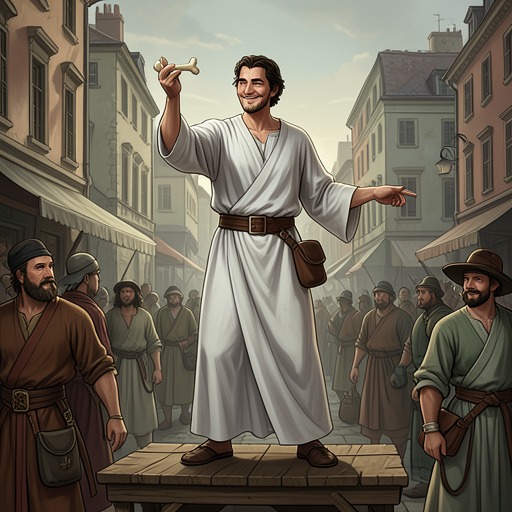
The Pardoner keeps a bag in his lap, brimming with pardons from Rome. The bag makes his office visibly portable: absolution is presented as something that can be carried from place to place and offered to an audience ready to pay. He also possesses a cross of latten set with stones and a glass containing old pig’s bones, which he treats as relics. These objects combine cheap or doubtful material substance with the impressive signs of sacred value, allowing him to convert appearance into profit.
His method is especially effective against a simple parish priest from the countryside. When he encounters such a priest, he uses the cross and the supposed relics to make more money in a single day than the priest might earn in a month. The scene presents religious commerce as an unequal exchange: the Pardoner’s confidence, props, and knowledge of popular credulity overpower the honest but less sophisticated cleric. His success depends not on the spiritual truth of the objects but on the audience’s willingness to believe that visible tokens can purchase invisible benefit.
The performance is therefore rhetorical as well as material. The Pardoner’s authority rests on institutional association, dramatic display, and the management of emotion. He knows how to make religious claims seem immediate and profitable, and he understands that a frightened or inexperienced listener may respond more quickly to a relic and a pardon than to patient moral instruction. His ministry is a form of persuasion in which sacred symbols function as commercial evidence.
Preaching and Self-Contradiction
At the end of the tale told by the Canon’s Yeoman, the Pardoner announces his own tale. He begins by explaining that, when he preaches in churches, he takes great pains to adopt a haughty speech. This admission reveals that his public voice is constructed deliberately. The elevated manner is not presented as the spontaneous expression of devotion; it is a professional technique, a posture chosen because it works upon listeners.
The contradiction becomes the center of his character. The Pardoner can denounce vice while being governed by the same vice he condemns. His moral instruction may still reach an audience, but his personal motive remains corrupt: he uses the sermon as a means of earning money. The resulting irony is more severe than a simple contrast between a good message and a bad messenger. His very skill at preaching proves that effective moral language does not guarantee moral character, and his success suggests that spiritual commerce can thrive even when its agent understands its falseness.
This makes him a particularly complex example of the moral exemplum. The sermon’s lesson may possess practical force, yet the preacher’s confession prevents the audience from accepting his authority without qualification. The Pardoner exposes the danger of separating words from conduct, but he also demonstrates that words can retain persuasive power after the speaker’s motives have been discredited.
Relationships and Social Exchange
The Pardoner’s closest recorded association on the road is with the Summoner, who rides with him as a comrade and friend. Their partnership links two figures who profit from religious or quasi-legal authority and who move through society by exploiting the obligations, fears, and hopes of others. The pairing is not simply companionship; it creates a social image of institutional power detached from pastoral responsibility.
His dealings with the parish priest reveal another important relationship: the Pardoner treats a fellow religious official not as a colleague in spiritual care but as a market opportunity. The priest becomes a target whose limited sophistication can be converted into the Pardoner’s gain. This commercial logic echoes other exchanges in the wider narrative, but here it is especially disturbing because the commodity is forgiveness itself.
The Pardoner also positions himself against the ordinary listener. His power depends on an asymmetry of knowledge and confidence. He knows how the signs of Rome, relics, pardons, and preaching style can be made to appear authoritative, while the people he approaches are expected to supply money in return for spiritual security. The transaction presents piety as debt and absolution as a purchasable service, revealing how easily religious need can be transformed into economic dependence.
Narrative Role and Evaluation
As a pilgrim, the Pardoner is a participant in the storytelling contest; as a storyteller, he becomes an exhibit in the very moral problem his tale addresses. His presence allows the work to place a sermon inside the mouth of a man who openly exploits sermons. That structure creates deliberate distance between the ethical content of his teaching and the credibility of his character, forcing listeners and readers to judge both separately.
His costumes and objects make hypocrisy visible, but his confession makes it articulate. He does not merely behave like a fraudulent preacher; he understands the mechanism of his fraud and explains how he prepares his church speeches. The result is a character who is at once flat in his governing appetite for profit and unusually powerful in narrative function, because the single idea attached to him generates a broad inquiry into rhetoric, commerce, authority, and moral knowledge.
The Pardoner’s ending in the supplied material is not a conversion or punishment but the continuation of his performance. He finishes the preceding narrative and immediately presents his own tale, preserving the unresolved tension between useful doctrine and corrupt intention. His lasting significance comes from that refusal of easy resolution: the audience may learn from his sermon, but it cannot forget that the sermon is also a sales instrument. In him, religious speech becomes both warning and merchandise, and the exposure of that contradiction becomes the character’s deepest moral achievement.