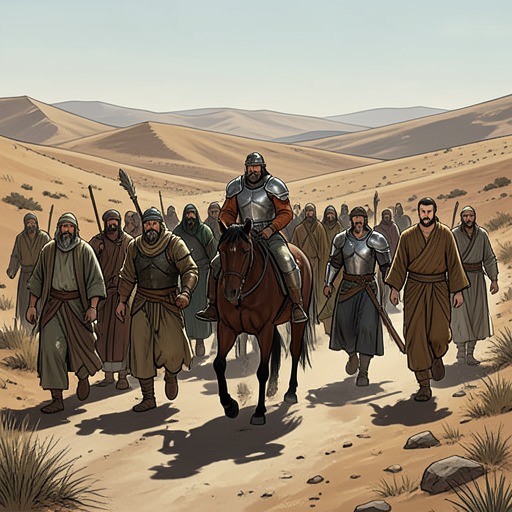
The Plowman
The Canterbury TalesThe Plowman represents the ideal of ordinary Christian virtue in the pilgrimage company. Though introduced only briefly, he is defined by the harmony between belief and conduct: he loves God wholeheartedly, serves people in material need, and fulfills his religious obligations without seeking worldly advantage. His importance lies in this contrast between sincere labor and the self-interest associated with other social and clerical figures.
Identity and Background
The Plowman travels with his brother, the Parson, and belongs to the world of physical labor rather than learning, commerce, or aristocratic display. He is described as a true and well-intentioned laborer who has carried many loads of dung. The detail places him unmistakably in the agricultural economy and gives his goodness a practical, bodily foundation: his virtue is not abstract speculation but work performed in fields and communities.
His clothing and transportation reinforce his modest status. He wears a tunic and rides a mare, details that present him as a plain rural worker rather than a prosperous gentleman. The portrait does not romanticize him through luxury or social rank; instead, it makes humble occupation compatible with moral dignity.
Faith Expressed Through Labor
The Plowman loves God with his whole heart in both prosperity and distress. His devotion therefore does not depend on favorable circumstances. The narrative joins religious constancy to endurance, presenting him as one whose faith remains stable when times are good and when they are difficult.
His love of neighbor takes the form of useful, unpaid work. For the love of Christ, he is willing to thresh or dig a ditch in order to help poor people in trouble, and he does so without wages whenever he has the ability. These are not ceremonial gestures but strenuous services that answer immediate communal needs. The Plowman turns Christian teaching into acts of maintenance: he handles the labor that keeps land productive and helps vulnerable neighbors survive.
Duties, Reciprocity, and Contrast
Although he gives labor freely to the poor, the Plowman does not treat religious obligation as optional. He pays his proper tithes faithfully, contributing both from his labor and from his property. His charity is therefore accompanied by disciplined participation in the church’s material order. He gives without demanding payment from those he helps, yet he does not evade the dues expected of him.
This balance distinguishes him from figures whose religious activity is entangled with fees, privilege, or acquisition. The Friar is praised for hearing confession and granting absolution pleasantly, but he has paid for an exclusive right to beg in a particular area, while the Clerk spends what he can obtain from friends on books and learning. Against such specialized or self-directed economies, the Plowman’s ethic is transparent: he works, shares his capacity with the poor, and pays what he owes.
Relationship with the Parson
The Plowman’s closest stated relationship is with his brother, the Parson. Their companionship links two forms of Christian service. The Parson teaches what Christ and the apostles have taught and follows that teaching himself; the Plowman embodies the same principle through agricultural labor, charity, and tithing.
The brothers consequently form a deliberate ethical pair. The Parson’s vocation is pastoral and instructional, whereas the Plowman’s is manual and communal, but neither is presented as superior because of status. Their shared presence suggests that genuine Christianity can be practiced through preaching and through work, provided that conduct accords with doctrine.
Narrative Role and Significance
The Plowman is a compact moral exemplum rather than a character driven by a separate plot. His portrait supplies a standard against which the pilgrimage company’s more compromised forms of service can be measured. In a collection attentive to the gap between public religious language and private motives, he offers a rare case in which profession, action, and obligation coincide.
His significance also rests on the dignity assigned to necessary work. Carrying dung, threshing, digging, and paying tithes are presented not as signs of inferiority but as the material practices through which charity becomes real. The Plowman’s humility is thus active rather than passive: he has little social ornament, but he possesses the dependable virtues of labor, generosity, fidelity, and love of neighbor.