The Tabard
The Canterbury TalesThe Tabard is the Southwark hostelry that serves as the threshold of the Canterbury pilgrimage. It is there that the narrator, prepared to travel to Canterbury with a devout heart, encounters a company of twenty-nine travelers brought together by chance. The inn transforms a collection of strangers into an organized fellowship: Harry Bailly welcomes them, supper brings them into shared space, wine seals their agreement, and the road ahead becomes the setting for the Canterbury Tales storytelling contest.
Setting and Threshold
The Tabard stands in Southwark, near the Bell, and is described as a pleasant hostelry. Its importance is less architectural than transitional. Pilgrims arrive there before the journey has properly begun, occupying an intermediate condition between ordinary life and the foreign roads and distant shrines they desire to visit. The narrator presents the inn as the place where it is reasonable to pause and describe the travelers—their circumstances, appearance, degree, and conduct—before proceeding with the larger narrative.
The setting therefore acts as a narrative threshold. The impulse toward pilgrimage draws people away from familiar surroundings, while The Tabard gathers them before separation into the road. Within this temporary enclosure, social identities can be observed closely: clothing, occupation, manners, and reputation become visible before the company disperses across the route.
The Company Assembled
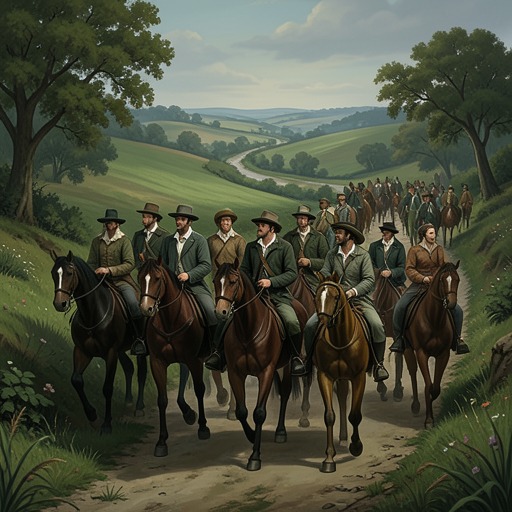
The company at The Tabard is defined by variety. The Knight arrives with good horses but without rich clothing, wearing a fustian tunic marked by use. A Nun, Prioress, is also present, characterized by a coy and simple smile and by the oath “By Saint Loy!” A Haberdasher, Dyer, Carpenter, Tapestry Maker, and Weaver appear together in livery, their coordinated clothing making professional identity visible as a collective display.
The gathering also includes the Wife of Bath, a clothier from near Bath who is somewhat deaf, together with the Miller, the Reeve, the Summoner, the Pardoner, the Manciple, and the narrator. These details make The Tabard a concentrated social cross-section rather than a gathering of pilgrims who resemble one another. The inn gives the narrative a fixed vantage point from which distinctions of rank, trade, dress, bodily condition, and personal reputation can be placed side by side.
Hospitality and Common Fellowship
Harry Bailly’s welcome gives the gathering its first social form. He receives every traveler, and supper begins immediately. The host serves the company the finest food, turning the inn from a place of lodging into a site of fellowship. Eating together temporarily softens the distance between people who otherwise occupy different positions in society, though it does not erase the distinctions that the narrator carefully records.
After supper, more wine is brought for every guest. The company drinks, agrees that Harry Bailly’s judgment will be heeded, and goes to bed without delay. The sequence is practical but also ceremonial: welcome, shared food, wine, agreement, and rest prepare the travelers for departure. The inn’s hospitality supplies the material conditions under which a public community can form, while the host’s accepted authority gives that community an organizing principle.
Narrative Function and Significance
The Tabard is the point at which pilgrimage becomes storytelling. The travelers’ original desire is religious: pilgrims long to journey to foreign lands and renowned shrines, and the company is preparing for Canterbury. Yet the inn introduces another form of movement, from seeing to speaking. Before the road begins, the narrator inventories the people who will inhabit the journey, and the host’s welcome creates the circumstances in which their voices can later be heard.
Its enclosed space also frames the contrast between unity and difference. The guests can share a meal, drink the same wine, and accept one host’s judgment, but they remain marked by distinct professions, degrees, garments, and habits. The Tabard thus contains both fellowship and social tension. It is a temporary common world in which medieval hierarchy is not abolished but made legible through proximity.
The inn’s position near the beginning of the work gives it structural importance beyond its brief appearance. The travelers leave it for Canterbury, but the narrative energy generated there continues along the pilgrimage road. The Tabard is the launch point for a collective adventure and the first stage in the transformation of a group of chance companions into the Company of Canterbury Pilgrims.