The Three Rioters
The Canterbury TalesThe Three Rioters are three young revelers whose story exposes how quickly proclaimed brotherhood can be corrupted by greed. They begin together in a tavern, united by drink and bravado, and set out to kill Death; after discovering gold beneath a tree, they abandon their shared pledge and plot against one another. Their deaths complete the tale’s grim reversal: the men who hunt a personified enemy create the conditions of their own homicide.
Identity and Introduction
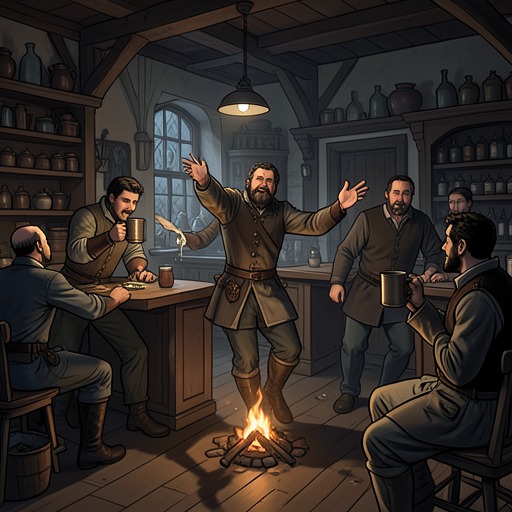
The Three Rioters are introduced collectively rather than as individually developed personalities. They are young men sitting in a tavern and drinking well before nine o’clock, a setting that establishes drunkenness, idleness, and impulsive fellowship as the conditions of their conduct. Their defining identity is therefore social and moral: they are revelers bound together by appetite, boasting, and the unstable solidarity of a drinking company.
The group’s opening posture is aggressively theatrical. They speak as men ready to turn revelry into violent action, declaring their intention to find and slay the killer responsible for so many deaths. The narrative presents this purpose as an oath made in the heat of drink rather than as a considered duty, so their apparent courage already contains recklessness and moral confusion.
The Oath Against Death
The three make a pledge to live and die for one another as though they had been naturally born brothers. The language of kinship gives their alliance a solemn shape, but the later action reveals the gap between a spoken bond and a practiced virtue. Their promise is not tested by loyalty to a friend in danger; it is tested by the prospect of wealth, and it fails as soon as gold offers a more immediate object of desire.
Their declared target is Death, imagined as the slayer of many people and treated as an enemy who can be pursued and killed. This quest gives the tale the structure of a hunt, but its moral direction is unstable. The men leave the tavern seeking an external cause of mortality, while the narrative gradually shows that the more immediate danger lies within their own appetites. The search for Death becomes a revelation of avarice and violence among the living.
The Gold Beneath the Tree
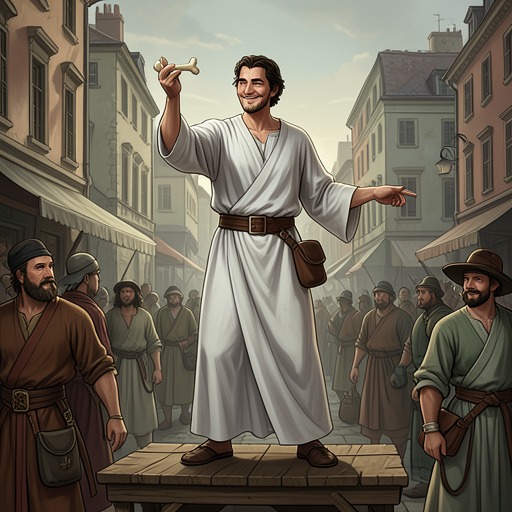
The three eventually reach a tree and find florins beneath it, coined of gold and fine and round. The specific form of the treasure matters: the gold is tangible, portable, and immediately convertible into pleasure. It transforms the men’s imagined brotherhood into a contest over possession. What had been shared purpose becomes private calculation.
The discovery produces a division of plans. Two of the rioters agree to betray and slay the third so that they can divide the treasure between themselves, satisfy their lusts, and play at dice as often as they wish. Their scheme exposes the practical meaning of their earlier oath: once wealth appears, the supposed brothers treat one another not as companions but as obstacles. Their desire is not merely to possess money but to convert it into repeated indulgence, making the gold a material emblem of appetite without limit.
The youngest is sent to town while the other two remain with the treasure. His absence creates the opportunity for the first conspiracy, but it also gives him time to form a separate one. He returns as the intended victim of his companions’ plot while carrying the means of their destruction. The structure is sharply symmetrical: each side believes it is deceiving the others, and each act of deception tightens the trap around all three.
Betrayal and Mutual Homicide
The two conspirators attack the third with the intention of taking his share. Their violence is the direct collapse of the pledge to live and die together. The third, meanwhile, has obtained poison and uses it against them, intending to remove his rivals before claiming the entire fortune. The treasure thus passes through a chain of plans in which every participant treats murder as an instrument of ownership.
The result is not a victory for any one plotter. The two killers meet with homicide, while the false poisoner also dies from the poisoned drink or provisions prepared for the others. The wording makes the outcome morally circular: those who kill are themselves killed, and the man who poisons becomes another casualty of the same avarice that motivated the conspiracy. No Rioter reaches the imagined future of pleasure, dice, or unrestricted possession.
Narrative Role and Moral Significance
The Three Rioters function as a collective moral exemplum rather than as psychologically rounded individuals. Their sameness is important because the story distributes the same vice across the group: drink loosens judgment, the oath disguises self-interest as fraternity, and gold reveals the underlying priority of personal gratification. Their individuality matters less than the repeated pattern by which each man converts companionship into calculation.
Their story also turns a quest into an ironic descent. They set out to destroy Death, but their search leads them to a tree where greed organizes a sequence of betrayals and poisonings. The men are therefore both hunters and hunted: they pursue an enemy imagined outside themselves, while their own choices produce the deaths they hoped to escape. The tale’s final emphasis falls on the wretchedness of sin, presenting mutual murder not as an accidental misfortune but as the consequence of appetites first displayed in the tavern.
In this compact chain of oath, discovery, conspiracy, poison, and death, the Three Rioters illustrate the proverb-like moral that sworn fellowship cannot survive unrestrained avarice. Their brotherhood is loudly announced, materially tested, and finally disproved. Death is never successfully confronted as an adversary; instead, the rioters become the agents of one another’s destruction, and the gold beneath the tree remains the silent center of the catastrophe.