The death of Arcite
The Canterbury TalesThe death of Arcite is the catastrophic reversal at the heart of the tournament for Emily. Arcite has apparently achieved the victory for which he and Palamon have contended, but a supernatural intervention turns triumph into ruin: a Fury sent from Pluto, acting at Saturn’s request, terrifies his horse and causes the victorious knight to fall. The injury worsens despite medical attention, and Arcite dies after recognizing that Palamon is the man most worthy of Emily’s love. His death releases the conflict from the logic of martial victory and redirects it toward mourning, recognition, and the eventual marriage of Palamon and Emily.
Causes and Background
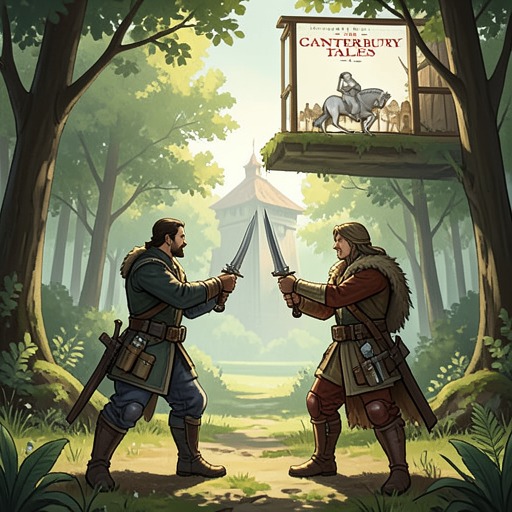
The event follows the long rivalry between Arcite and Palamon over Emily, a rivalry intensified by their shared imprisonment, their love for the same woman, and their agreement to settle their claim through formal combat. The tournament gives Arcite the immediate advantage. The spectators are joyful for him, and he has reason to believe that Fortune will continue to favor him. His victory therefore carries more than the ordinary meaning of success in battle: it seems to promise possession of the beloved and the completion of the knightly quest.
That apparent fulfillment is precisely what the narrative overturns. Arcite removes his helmet so that his joyful face can be seen, a gesture of exposure at the moment when victory seems secure. The supernatural force that follows is not presented as the consequence of an ordinary tactical mistake alone. A Fury rises from the ground from Pluto and Saturn’s intervention, and the episode places human competition within a larger order governed by powers beyond the contestants’ control. Arcite’s fall thus becomes a tragic peripeteia: the same instant that displays his success prepares his destruction.
The Fatal Fall
The Fury frightens Arcite’s horse so violently that the animal turns, rears, and founders before Arcite can react. He is thrown and lands on his head, apparently dead. The fall also shatters his breast against the saddlebow, converting the public spectacle of victory into a scene of bodily devastation. The speed of the reversal is central to the event. No gradual defeat explains Arcite’s condition; the winner is removed from the contest almost at the instant of winning it.
Arcite does not die immediately. His breast swells, and the pain around his heart grows steadily worse. Clotted blood resists the physicians’ art, and the narration eventually states that he will die if Nature does not intervene. The medical failure gives the supernatural catastrophe a prolonged human aftermath: the fall is sudden, but death unfolds through increasing pain, physical decline, and the recognition that no remedy can restore him.
Recognition and Final Words
Knowing that death is approaching, Arcite sends for Emily and Palamon, his cousin and former companion. The summons changes the scene from a private medical crisis into a final meeting among the three people bound together by the tournament. Arcite’s last actions are not attempts to reclaim his victory or revive the quarrel. Instead, he speaks of the affection and loyalty that remain between the cousins and acknowledges Palamon’s worth.
Arcite declares that he knows no one in the world more worthy of love than Palamon, who serves Emily and will continue to do so throughout his life. This recognition resolves the central rivalry at the level of moral judgment even though it cannot preserve Arcite’s life. The man who has won the tournament accepts that Palamon is the proper object of Emily’s future love. Arcite’s final sight is Emily, and his last words are, “Mercy, Emily!” His spirit then leaves his body, making the tournament’s apparent reward inseparable from death.
Consequences and Funeral Order
Arcite’s death removes the obstacle that neither imprisonment nor combat could settle. His victory cannot produce the marriage he sought, while Palamon’s survival allows the love triangle to be reorganized without further combat between the cousins. The event therefore changes the value of the tournament from public honor to private loss: the crowd’s joy for Arcite gives way to grief, and the defeated rival becomes the eventual beneficiary of the dead victor’s recognition.
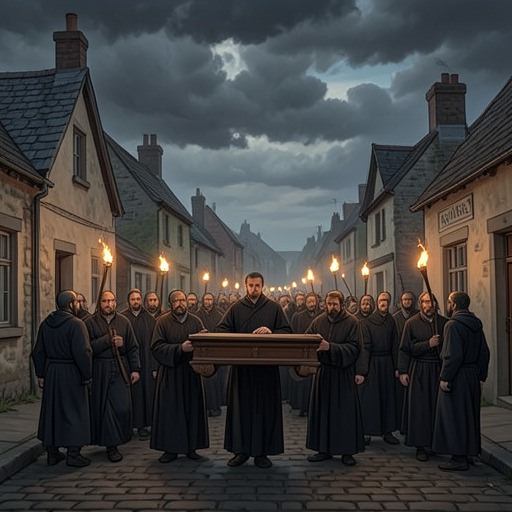
Theseus responds by taking the greatest care to find a proper setting for Arcite’s sepulchre. The funeral is not treated as a minor epilogue but as a necessary public act through which the violence of the tournament is given ceremonial form. A tomb and memorial setting preserve Arcite’s status while acknowledging the limits of earthly achievement. The knight’s end consequently passes through a ritual transition from champion to mourned dead, allowing the surviving community to absorb a reversal that ordinary ideas of justice and victory cannot explain.
Narrative Significance
The death of Arcite is a concentrated tragedy of Fortune’s instability. Arcite appears to move from rivalry to victory, yet the narrative makes that ascent the threshold of his fall. His destruction is caused by an external supernatural force rather than by a clearly stated moral fault, which gives the episode the harsh arbitrariness associated with Fortune’s wheel. The tournament’s rules can regulate human combat, but they cannot govern the powers that decide who may live to enjoy its result.
At the same time, the event does not leave only disorder behind. Arcite’s dying recognition supplies an ethical resolution that combat could not provide. He accepts Palamon’s service to Emily, and that acceptance transforms the cousins’ opposition into a final act of generosity. The death is therefore both a reversal and a transfer: Arcite loses life and marriage, while Palamon inherits the possibility of union with Emily; the public winner becomes the source of the private settlement. Through the funeral arranged by Theseus and the grief surrounding Arcite’s last moments, the narrative turns a broken victory into the condition for reconciliation and the marriage that follows.