The deaths of the three rioters
The Canterbury TalesThe deaths of the three rioters are the decisive reversal in their pursuit of the gold. What begins as an apparent fellowship among men bound by an oath becomes a chain of betrayals in which each rioter tries to convert the common treasure into private advantage. Their end is therefore not an accidental interruption of the quest but its moral completion: the gold they seek becomes the occasion and instrument of their destruction.
Brotherhood and Betrayal
The first turn comes immediately after one rioter has departed for town. One of those who remain tells the other that they are sworn brothers and presents the information as something profitable to know. The language of brotherhood gives the ensuing plot a false surface of loyalty. Their relationship is framed by an oath, yet the oath does not protect the absent companion; instead, it creates the confidence through which the two can speak privately and coordinate his murder.
The second rioter accepts the proposal and gives his own assurance that he will not be false to his companion. This promise is dramatically double-edged. It sounds like a reaffirmation of fellowship, but it functions as the verbal seal of treachery against the third man. The scene thus makes speech part of the crime: the oath does not express a stable moral bond, but exposes how easily the rioters use the forms of loyalty to authorize disloyal action.
The Two Murder Plots
The two conspirators agree to betray and slay the rioter who has gone to town. Their plan depends on numerical advantage: two men will overpower one, and the absent companion, returning to the group, will be treated as a victim rather than a brother. The shared hoard has already altered the meaning of their companionship. Possession is no longer collective; each man measures the others as obstacles between himself and the gold.
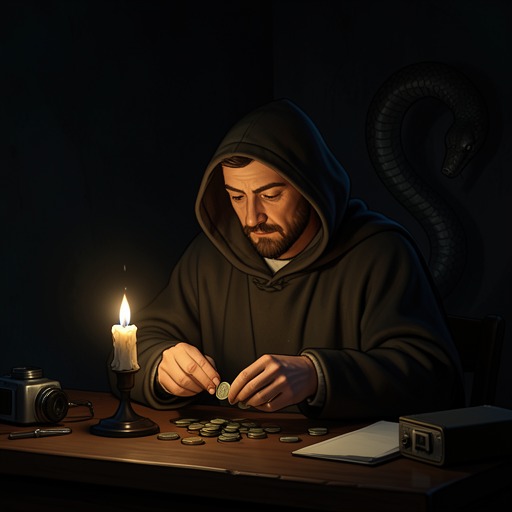
The absent rioter, meanwhile, is not innocent of the same corruption. As he travels to town, he imagines the beauty of the newly minted florins and pictures the happiness that possession will bring him. His thoughts isolate him from the others even before he returns. The treasure appears bright and desirable, but the brightness conceals the violence it has stimulated. He does not merely return with provisions; he returns with a private scheme aimed at the same companions who have independently decided to kill him.
The fiend then puts into his mind the idea of buying poison and giving it to both of his mates so that they will die. The device makes his intention precise: he will not share the treasure with the other two, but remove them and take the whole hoard for himself. The first conspiracy and the second therefore mirror one another. The two men plan to kill one; the returning man plans to kill two. Each version of the plan treats fellowship as a temporary disguise for avarice.
The Poisoned Return
In town, the youngest rioter fills three bottles to the brim with wine before going back to the others who are waiting for him. The wine carries the lethal design back into the fellowship’s ordinary ritual. A drink that might have represented celebration and shared pleasure has become a concealed weapon, and the completeness of the preparation—three bottles for three men—shows that his plan encompasses the entire remaining group.
The returning rioter’s preparation does not save him from the plot already formed against him. Just as the two had planned his death, they slay him on the spot. The narrative gives the murder a blunt symmetry: his companions enact the crime they had agreed upon, while he arrives carrying the means of their destruction. Their separate schemes meet at the same place, and the first death appears to make the surviving pair masters of the treasure.
The Final Reversal
After killing their companion, the two surviving rioters propose to sit, drink, and make merry before burying his body. Their proposed merriment reveals the depth of their moral inversion. Murder is placed beside drinking as though it were merely another step in the evening’s entertainment, while burial is postponed until after pleasure. The language of companionship survives, but only as a shell around violence.
The final reversal occurs through the bottle prepared by the dead man. By chance, one of the survivors takes the poisoned bottle and drinks from it, then gives some of the poison to his mate. The plan intended for both men is thereby fulfilled by the very act through which they imagine themselves celebrating their victory. The surviving pair are not spared because their own conspiracy succeeded; their success delivers them into the second conspiracy. The gold-hoard murders close in a compact cycle: the two kill one, and the poison carried by that one kills the two.
Moral and Narrative Significance
The event converts greed into a self-executing punishment. The rioters’ desire is directed toward a visible object, the newly bright florins, but their fatal actions are directed toward one another. The treasure does not need to move, speak, or defend itself. It remains the fixed center around which loyalty disintegrates, and the men destroy the very fellowship that might have allowed them to possess it together.
The deaths also give the episode the structure of a warning tale. A sworn promise leads to betrayal; private calculation leads to murder; murder leads to poisoned celebration; and the attempt to enjoy the reward ends in universal death. The event’s irony lies in the fact that every rioter believes he is escaping dependence on the others, yet each becomes dependent on the others’ treachery for his own destruction. Their deaths complete the lesson that the pursuit of wealth governed by avarice turns both alliance and possession into forms of ruin.