The fox's capture of Chanticleer
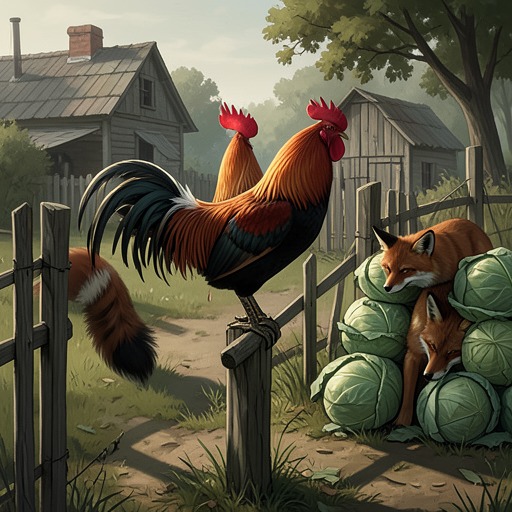
The Canterbury TalesThe fox's capture of Chanticleer is the decisive ambush in which Russell converts speech into physical action. A black-marked fox that has lived for three years in the nearby grove finds Chanticleer exposed in the cabbage bed, wins his confidence by pretending friendship, and flatters him into singing. When Chanticleer closes his eyes and crows, Russell springs forward, grips him by the throat, and carries him toward the woodland. The episode makes predation depend not on strength alone but on the victim's willingness to believe praise.
Setting and Predatory Design
The encounter begins in the enclosed yard where Chanticleer, the unrivaled crowing cock, lives. He has been presented as a conspicuous and valued animal, celebrated for a voice more cheerful than a play, while the fox has remained hidden nearby for three years. The contrast establishes two different kinds of power: Chanticleer's public voice makes him admired, but Russell's patience and concealment make him dangerous. The cabbage bed becomes the point where these powers meet, as the fox lies low and waits for the cock to notice him.
The fox's appearance is not accidental or neutral. He is described as black-marked, iniquitous, and sly, and his long residence in the grove gives the attack the character of a prepared design rather than a spontaneous chase. When Chanticleer casts his eye across the cabbage bed and sees the fox lying there, the first danger is visual recognition: the cock has detected the hunter before the hunter has acted. Russell therefore abandons concealment only when he has a verbal means of controlling what Chanticleer will perceive.
Flattery as a Weapon
Russell begins by denying the threat that his presence should signify. He addresses Chanticleer as a gentleman, asks what is wrong, and claims friendship, even suggesting that he would be worse than a fiend if he intended harm. The speech is a calculated appeal to the cock's self-image. Chanticleer is not merely asked to remain still; he is invited to understand his own superiority as evidence that danger is impossible. Russell's words turn suspicion into vanity.
The fox then offers a more specific inducement. He asks Chanticleer to sing and to show how well he can reproduce his father's voice. This request gives the trap an apparently honorable purpose: the cock is encouraged to display inherited excellence rather than to satisfy a predator's appetite. The language also shifts attention from the fox's position to Chanticleer's performance. Instead of watching the animal lying low in the cabbage bed, Chanticleer is led to imagine an audience waiting for his song.
The Capture
Chanticleer responds physically to the flattery before he fully recognizes its danger. He begins beating his wings like one betrayed but unable to see the betrayal, so completely is he ravished by the fox's praise. The passage makes credulity visible as bodily excitement: the cock's wings answer the words, and admiration becomes a movement that Russell can exploit.
At the crucial instant, Chanticleer stands high on his toes, stretches out his neck, and closes both eyes. His posture is the opposite of watchfulness. The action Russell requested has produced precisely the vulnerability he needed, and the song completes the sequence. Chanticleer loudly begins to crow; Russell immediately springs from his hiding place and grabs him by the throat. The sudden transition from musical display to bodily seizure is the episode's central reversal. A voice that should announce authority instead marks the moment of capture.
Russell then bears Chanticleer on his back toward the woodland. The carrying action confirms that the fox's success is not merely an attempted attack or a momentary fright: the predator has secured his prey and is removing him from the yard. The scene ends while no one yet pursues the fox, leaving the capture suspended at its point of apparent triumph and emphasizing how completely the deception has worked.
Speech, Recognition, and Moral Pattern
The episode treats speech as an action with consequences. Russell's apparent reassurance does not simply describe friendship; it creates the conditions under which Chanticleer will behave as though friendship were real. His request to sing functions as an instruction disguised as admiration, while Chanticleer's crow becomes an involuntary signal that helps execute the ambush. The literal content of the exchange and its practical purpose diverge: words of fellowship produce an act of predation.
The scene also belongs to the pursuit and temptation patterns of animal fable, but it reverses the expected contest between hunter and hunted. Russell does not outrun Chanticleer or overpower him in an open struggle. He identifies the cock's susceptibility to praise and makes that susceptibility serve the hunt. The capture therefore resembles a moral exemplum as much as a natural encounter: the immediate cause of danger is the fox's deceit, but the mechanism of success is Chanticleer's surrender of judgment to flattery.
This dynamic gains force from the wider animal world associated with the tale. The cock and his household are treated as living social subjects with voices, desires, and relationships, while the fox occupies the position of a calculating political actor. Against that background, the attack dramatizes a recurring danger in human society as well: public reputation can become a weakness when an opponent learns how to praise it. The episode's memorable irony is that Chanticleer's most celebrated faculty, his crowing voice, becomes the instrument through which the fox confirms his own victory.