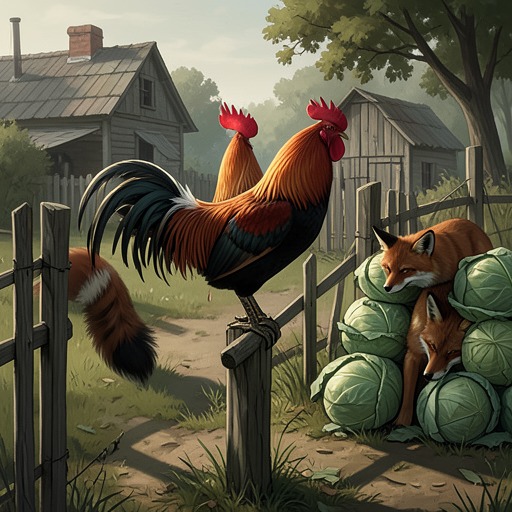
The grove near the widow’s cottage
The Canterbury TalesThe grove near the widow’s cottage is a small woodland beside the home of an elderly, impoverished widow, and it provides the decisive setting for the encounter between Chanticleer and the fox. What first appears as a modest rural backdrop becomes the space in which predation, captivity, pursuit, and escape are compressed into a single dramatic movement. The grove is therefore not merely scenery: it is the borderland that allows the fox to enter the domestic yard and later gives Chanticleer a route beyond immediate danger.
Setting and Association
The grove is located beside the widow’s cottage, which stands in a dale. The narrator introduces the widow as old and poor, dwelling in a small cottage, and places her home directly next to the woodland. This arrangement gives the grove a close relation to humble domestic life: it is not a remote wilderness, but a neighboring natural space touching the boundaries of the household. Its position beside the cottage makes the later intrusion of the fox feel like a breach of the yard’s ordinary security rather than an adventure detached from human habitation.
The grove is also identified through its relation to Chanticleer. The surrounding narrative presents it as the place where the fox has lived for three years, establishing the woodland as his familiar territory. In this sense, the grove belongs symbolically to the predator before the attack begins. The fox knows its approaches and margins, while the household and its animals encounter it from the more vulnerable side of the boundary.
The Fox’s Hunting Ground
A black-marked fox, described as wicked and sly, has made the grove his dwelling for three years. That duration matters: the fox is not a passing danger but a settled presence, rooted in the landscape and practiced in concealment. The grove consequently carries a history of lurking threat before the immediate action is narrated. Its apparent naturalness conceals an organized predatory space, one in which the fox can wait, approach, and exploit the weakness of the yard.
The narrative adds that the fox’s presence has been permitted by heaven’s high design from the beginning. This framing places the grove within a tension between local cunning and larger providence. The fox acts with apparent independence, yet the narrator presents his residence there as part of a divinely ordered pattern. The woodland thus becomes a setting where danger is real and immediate while still being absorbed into the poem’s broader concern with destiny, design, and the limits of human or animal control.
Boundary, Intrusion, and Escape
On the night of the attack, the fox bursts through the hedges into the yard where Chanticleer is present. The grove is the source of the threat, but the hedge is the physical threshold that converts hidden danger into open violence. Once the fox crosses it, the safe distinction between woodland and household collapses. Chanticleer is seized, and the action shifts from stealthy approach to visible capture.
The grove also marks the place toward which the fox attempts to retreat. When he reaches the woodland’s side, he declares that the cock will remain there despite the objections of those pursuing him and that he will eat his captive in front of them. His words reveal the grove as a zone in which he expects to possess unquestioned advantage. It is the territory to which he carries his prize and where he believes the surrounding voices can no longer affect the outcome.
That confidence is overturned almost immediately. As the fox speaks, Chanticleer breaks nimbly from his jaws and flies high into a tree. The grove therefore changes function within the same episode: it begins as the fox’s concealed base, becomes the destination of his attempted retreat, and ends as the setting of the cock’s release. The woodland does not guarantee the predator’s victory; instead, it supplies the final spatial opening through which the captive escapes.
Narrative Significance
The grove’s importance lies in its double character. It is near enough to the cottage to expose domestic life to external danger, yet wild enough to shelter a practiced predator. Its boundary structure creates the episode’s central rhythm: the fox comes out from concealment, carries Chanticleer toward familiar cover, and loses him at the edge of that cover. The same landscape that seems to belong to the fox becomes the stage for his defeat.
As a narrative space, the grove also concentrates the poem’s contrast between appearance and outcome. The fox’s long residence, sly reputation, and control of the woodland suggest mastery, while Chanticleer’s position in the fox’s jaws suggests that the struggle has already ended. Yet the grove’s edge produces a reversal. Predatory confidence becomes frustrated possession, and the apparent captive reaches the tree above the woodland. The grove near the widow’s cottage thus functions as a threshold space where danger is generated, authority is claimed, and that authority is abruptly undone.