The imprisonment of Palamon and Arcite
The Canterbury TalesThe imprisonment of Palamon and Arcite is the decisive consequence of Theseus’s victory over Thebes: two wounded enemy princes are rescued from the battlefield only to be confined permanently in Athens. Their survival preserves the possibility of future action, but their captivity converts the open violence of war into a sealed struggle over freedom, identity, and love. The prison becomes the pressure chamber in which the relationship between the two kinsmen changes from shared military loyalty to rivalry.
Causes and Discovery
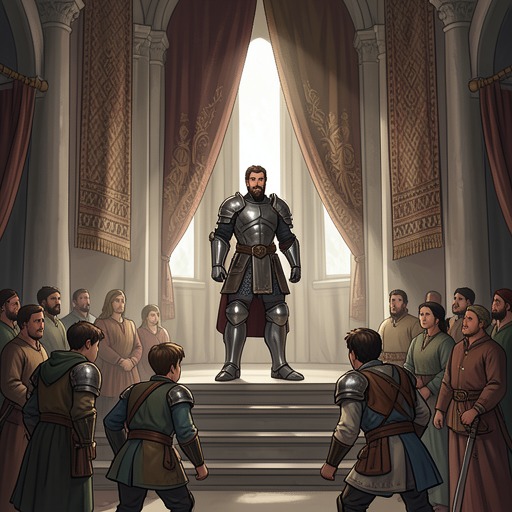
The event follows battle and victory, when pillagers carefully search the battlefield and the dead. Among the heap they find two young knights lying side by side, both suffering grievous wounds. Their armor is identical and richly wrought, marking them as closely associated fighters before their names or rank are fully established. They appear neither clearly alive nor clearly dead, so the discovery initially carries the uncertainty of a battlefield rescue: the men have escaped immediate death, but their condition remains precarious.
The heralds then identify the wounded knights as Arcite and Palamon. The discovery is politically important because they are not ordinary soldiers but members of the royal family of Thebes, described as the sons of two sisters. Their kinship and lineage make them valuable captives and give Theseus a reason to treat them differently from the nameless casualties around them. The same fact that protects them from being left among the dead also ensures that their imprisonment will be deliberate and lasting.
Removal to Athens
The finders remove Arcite and Palamon from the heap and carry them gently to Theseus’s tent. The gentleness of the transport contrasts with the violence that produced their wounds: the defeated are handled as persons of rank rather than discarded as enemies. Yet rescue does not lead to release. Theseus orders that they be sent to Athens, where they are to dwell perpetually in prison.
Theseus refuses to accept a ransom for either knight. That refusal closes the customary route by which a noble captive might recover freedom through wealth, family negotiation, or political exchange. The decision therefore has both personal and governmental force. Arcite and Palamon remain alive because Theseus does not execute them, but they are deprived of any recognized means of buying or bargaining their way out. Captivity becomes their fixed condition rather than a temporary aftermath of war.
The Prison as a Narrative Threshold
The journey from the battlefield to Athens marks a sharp change in the value at stake. On the field, life and death are uncertain; in Athens, life is preserved while liberty is taken away. The event thus replaces one danger with another. The princes no longer face the immediate sword, but they are removed from their homeland and held under the authority of the conqueror.
Their imprisonment also separates them from the ordinary movement of the world. The wider narrative is framed by pilgrimage, as people desire to travel toward foreign lands and distant shrines, but the two Theban knights are denied precisely this capacity for movement. While pilgrims set out toward renowned destinations, Arcite and Palamon are sent to Athens only to remain there. This contrast makes imprisonment more than a physical condition: it is a reversal of the journeying impulse that organizes the surrounding tale.
Consequences for Arcite and Palamon
The two men enter confinement together, still linked by blood, battlefield experience, and the identical arms in which they were found. Their shared imprisonment initially preserves the image of paired warriors rescued from the same ruin. At the same time, their royal identity ensures that their confinement carries the memory of Thebes into the Athenian court. The defeated city is not erased; it survives through its captive heirs.
The prison later becomes the setting from which their central conflict emerges. Their freedom is already denied by Theseus before any contest over Emily begins, so the subsequent rivalry develops inside a condition neither man has chosen. The enclosure concentrates their attention upon whatever can still be pursued: recognition, desire, honor, and escape. Their captivity therefore supplies the structural origin of the rivalry that will eventually draw them out of prison and back into open conflict.
Political and Thematic Significance
Theseus’s treatment of the princes combines mercy with domination. He allows wounded enemies to live and has them carried carefully from the battlefield, but he exercises absolute authority over their future. The episode exposes the unstable boundary between clemency and control: survival is granted, while autonomy is withheld. A conquered prince may be spared as a body and imprisoned as a political fact.
The event also establishes a pattern of reversal that governs the larger story. Arcite and Palamon pass from royal fighters to helpless captives, from the exposed field to the enclosed prison, and from possible death to a life whose value is defined by confinement. Their imprisonment is consequently not a pause between more important scenes. It is the foundational reversal that preserves them for later struggle while determining the terms under which every later choice will be made.